
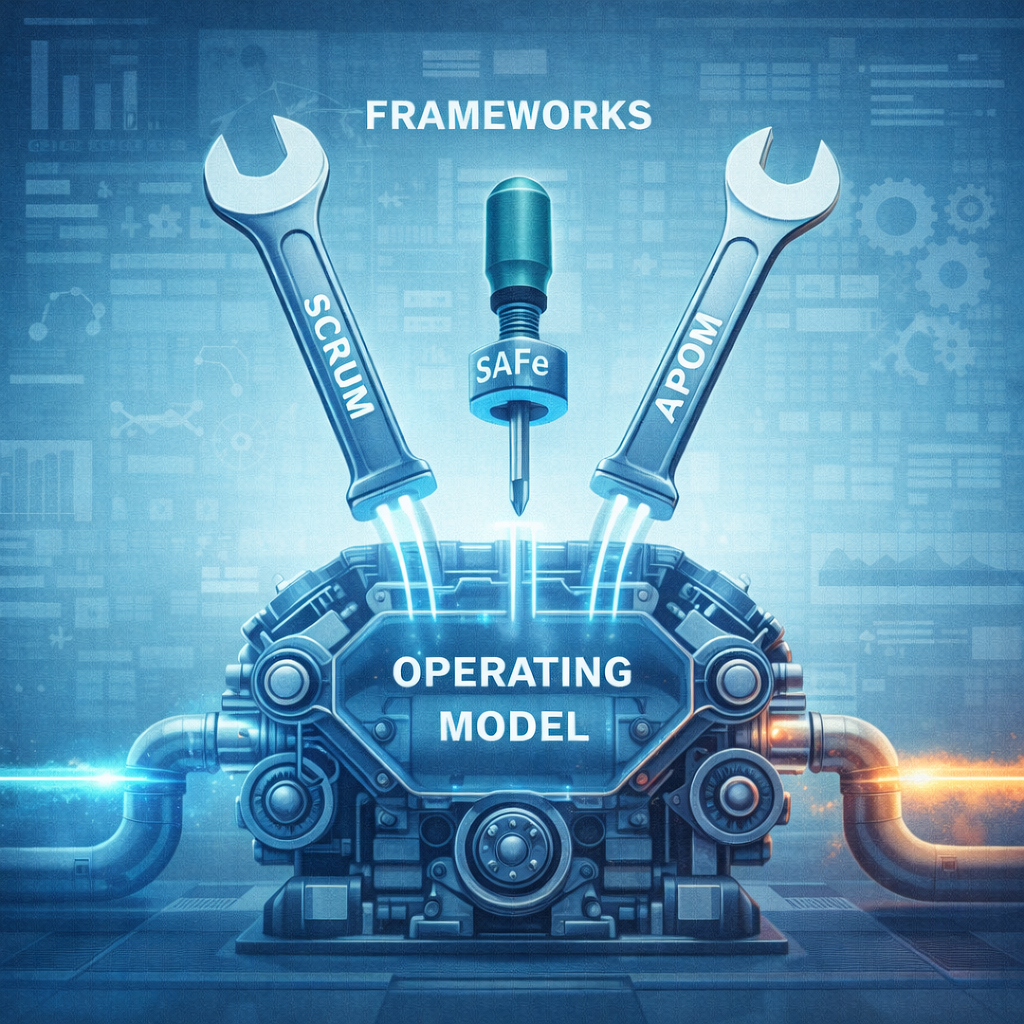
Organizations often begin their transformation journey with a framework.
They adopt Scrum. They scale using SAFe. They implement Product Operating Models. They explore emerging approaches such as the Agile Product Operating Model (APOM).
Each framework promises improved alignment, faster delivery, and better outcomes.
Some organizations achieve these results.
Many do not.
The difference is rarely the framework itself.
It is the operating model.
Frameworks influence how teams work.
Operating models determine how organizations behave.
This distinction defines the success or failure of transformation.
Frameworks Optimize Execution. Operating Models Define Outcomes.
Frameworks operate primarily at the execution layer.
Scrum improves team coordination. It introduces structured feedback loops. It creates transparency and accountability within delivery teams.
Scaling frameworks such as SAFe extend coordination across multiple teams. They provide planning synchronization, dependency management, and governance structures for large organizations.
Product Operating Models shift focus toward long-lived product ownership. They emphasize continuous value creation rather than project delivery.
APOM extends this thinking further. It integrates strategy, governance, portfolio management, leadership behavior, and value measurement into a coherent operating system.
Each of these frameworks can improve execution efficiency.
None of them can independently correct systemic misalignment.
Execution efficiency does not guarantee strategic effectiveness.
Organizations can execute perfectly against flawed priorities.
The Feature Factory Can Exist Inside Any Framework
Many organizations unknowingly operate as Feature Factories.
They measure success by output. They prioritize delivery volume. They allocate funding based on predefined scope. They reward predictability over adaptability.
This operating logic persists regardless of framework choice.
Scrum teams can operate as Feature Factories.
SAFe organizations can scale Feature Factories.
Product Operating Models can become structured Feature Factories.
Even APOM can fail if implemented superficially.
Framework adoption does not automatically transform incentives, governance, funding models, or leadership behavior.
The underlying system remains unchanged.
The framework becomes a delivery mechanism for the same industrial logic.
The Operating Model Determines Decision Flow
Operating models define how decisions are made.
They determine who allocates capital. They define how priorities are evaluated. They shape how performance is measured. They influence how risk is managed.
Frameworks operate within these constraints.
If funding is allocated annually to predefined scope, Agile teams cannot dynamically adapt. If performance evaluation rewards plan adherence, managers will enforce predictability. If governance emphasizes compliance, experimentation will remain constrained.
The operating model shapes behavior more powerfully than any framework guideline.
Frameworks provide structure.
Operating models provide direction.
Without operating model alignment, frameworks optimize the wrong system.
Comparing Framework Intent vs Operating Model Reality
Scrum was designed to enable empiricism. It assumes that teams can inspect and adapt based on evidence. But if portfolio decisions remain fixed, Scrum teams can only optimize locally.
SAFe attempts to introduce enterprise coordination. It provides portfolio constructs and alignment mechanisms. But if capital allocation remains static and value measurement remains weak, coordination does not guarantee value creation.
Product Operating Models emphasize continuous product ownership. They encourage long-term accountability for value. But without governance evolution, product teams remain constrained by legacy funding and evaluation systems.
APOM represents a more comprehensive attempt to address operating model alignment. It integrates strategic intent, portfolio governance, leadership behavior, and evidence-based management.
Yet even APOM cannot succeed if treated as a procedural implementation rather than a structural redesign.
Frameworks enable possibility.
Operating models determine reality.
The Governance Layer Is the True Constraint
Governance defines strategic behavior.
It determines how investments are initiated, evaluated, and terminated. It shapes leadership incentives. It controls capital flow.
If governance remains optimized for predictability and compliance, agility cannot fully emerge.
Teams may iterate faster. Coordination may improve. Transparency may increase.
But strategic adaptability remains constrained.
Governance determines whether organizations prioritize learning or delivery.
Frameworks cannot override governance.
They operate within its boundaries.
Transformation Requires Operating Model Redesign
True transformation requires redesigning the operating model itself.
Capital allocation must become dynamic. Portfolio management must evaluate ongoing value rather than upfront projections. Leadership incentives must reward value creation rather than delivery predictability.
Performance evaluation must focus on outcomes, not activity.
Decision authority must move closer to validated learning.
This redesign aligns the system with the realities of complex environments.
Frameworks become effective when operating models support their intent.
Without this alignment, frameworks become ceremonial.
They create activity without transformation.
Why This Is a C-Level Responsibility
Operating model design is not a team-level concern.
It is an executive responsibility.
Only executive leadership can redesign governance structures. Only executives can redefine capital allocation mechanisms. Only executives can realign incentives and performance systems.
Transformation fails when delegated exclusively to delivery organizations.
It succeeds when owned by executive leadership.
Framework selection is a tactical decision.
Operating model design is a strategic decision.
Strategic decisions define competitive advantage.
From Framework Adoption to System Evolution
Organizations often focus on adopting frameworks because frameworks are visible and actionable.
Operating model redesign is less visible. It requires confronting legacy assumptions. It requires challenging established governance structures. It requires redefining leadership roles.
But this evolution determines long-term effectiveness.
Framework adoption improves execution.
Operating model evolution improves outcomes.
The distinction defines transformation maturity.
Final Reflection
Frameworks matter.
They improve coordination. They enhance transparency. They enable more effective execution.
But frameworks do not define strategic effectiveness.
Operating models do.
Organizations do not transform by adopting Scrum, SAFe, Product Operating Models, or APOM.
They transform by redesigning how decisions are made, how capital flows, and how value is measured.
Frameworks support transformation.
Operating models enable it.
The operating model is the system.
Frameworks are only tools within it.
Reach a global audience of portfolio, program, and project managers, product leaders, and certification professionals. Explore advertising opportunities .
Sponsored