
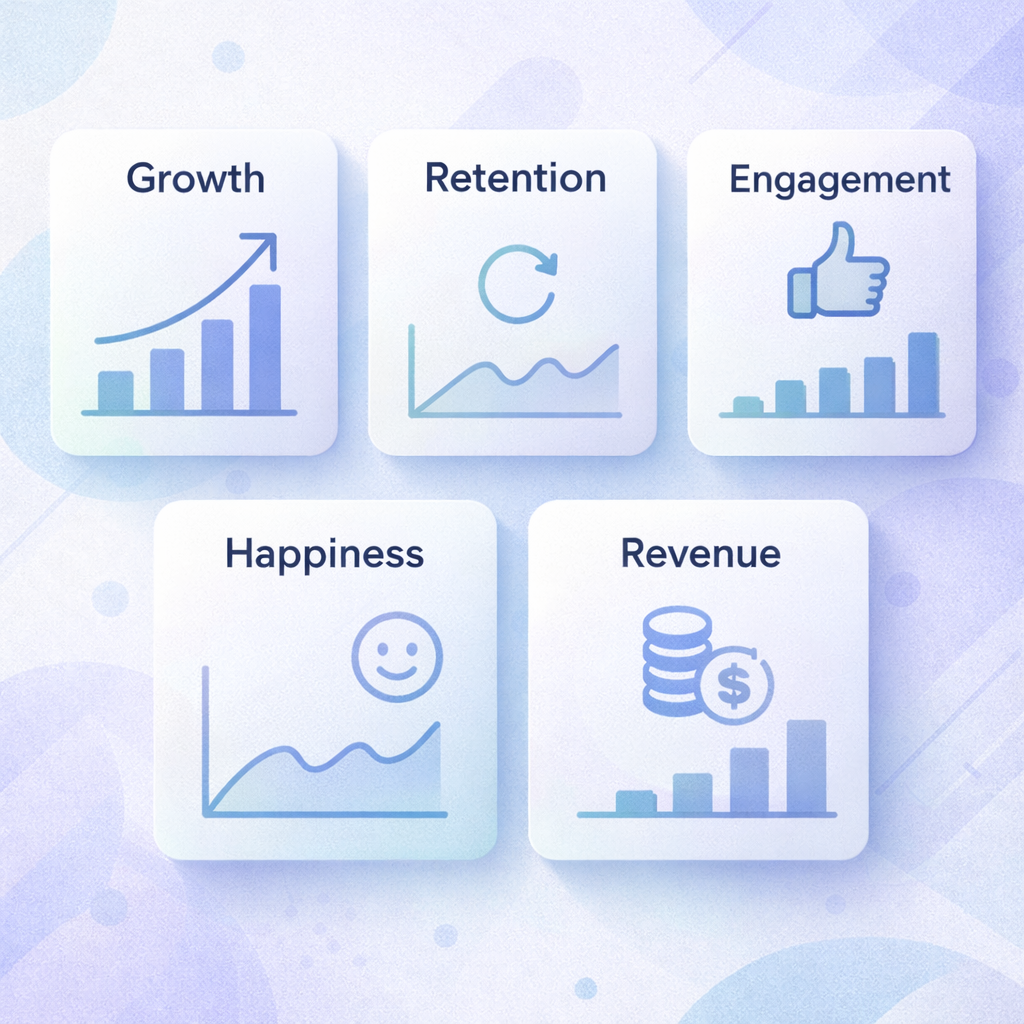
Metrics are one of the most powerful tools in a product manager’s toolbox. They translate user behavior, product performance, and business health into clear signals that support better decision-making. But not all metrics serve the same purpose. Metrics fall into categories, each helping you understand a different dimension of your product’s reality: how fast it’s growing, how often users come back, how they interact, how happy they are, and how much revenue it generates.
Understanding the five fundamental types of metrics—Growth, Retention, Engagement, Happiness, and Revenue—is essential for any product manager who wants to build a healthy, scalable, data-driven product. These categories form the foundation of measurement frameworks across the tech industry.
In this article, we will dive deeply into these five types, illustrate their strategic importance, and show how PMs can use them to build better products.
1. Why Understanding Metric Types Matters
Before we dive into each category, it’s important to understand why the classification itself matters.
a) They give you a complete view of the product
Focusing only on new users gives you a distorted picture. You may have a large inflow of new users, but if none stick around, your product is not sustainable.
Similarly, improving engagement without revenue metrics leaves you guessing about business viability.
Metrics categories ensure a holistic understanding.
b) They help you see relationships between metrics
Metrics rarely move independently:
- Growth can increase activation.
- Better engagement can improve retention.
- Higher user happiness can increase revenue.
- More revenue can fund changes that boost growth.
Seeing categories helps PMs understand cause-effect dynamics.
c) They guide where to focus next
A product with weak retention should not invest heavily in marketing. A product with strong engagement but poor revenue must look at monetization.
Categories help you identify:
- where you are strong
- where you are weak
- what deserves immediate attention
d) They help stakeholders understand progress
Executives think in categories.
Stakeholders care about succinct summaries, such as:
- “Growth is stable, engagement is improving, but retention is weak.”
- “Revenue is strong, but user happiness is declining.”
Clear categories make communication easier and more strategic.
Now that we established the importance of classification, let’s explore each of the five categories in depth.
2. Growth & Activation Metrics
Growth metrics tell you how your product is expanding over time. They measure how many new users you are attracting and how effectively you are converting them from visitors into active users.
Growth is not just about acquisition; it’s about ensuring new users take meaningful first steps.
Key Growth Metrics
1. Total New Users
A simple but important metric indicating how many new users arrive each week or month.
2. New Users by Source
Knowing where users come from helps PMs understand which channels are effective:
- paid advertising
- social media
- organic search
- referrals
- partnerships
Each channel has different costs and different quality of users.
3. Activated Users
Activation is one of the most important metrics in the early user journey.
An activated user is someone who not only installs or visits your product, but who completes the key action that delivers value.
Examples:
- Twitter → following accounts, tweeting
- YouTube → watching videos, subscribing
- SaaS → completing onboarding or setting up an integration
- Mobile apps → completing the first task or feature flow
Activation is often the clearest indicator of product-market fit in the early days.
Why Growth Metrics Matter
Growth metrics reveal:
- the effectiveness of your marketing
- whether users understand your value quickly
- if your onboarding flow is working
- how well your product attracts new user segments
A product cannot survive without growth, but growth without retention (our next category) is unstable and expensive.
3. Retention Metrics
Retention is the heartbeat of product success. It tells you how many users come back to use your product repeatedly.
If growth shows how many users arrive, retention shows how many stay.
Types of Retention
1. Retained Users
Users who consistently return within a defined period:
- daily for a social network
- weekly for a productivity app
- monthly for a subscription tool
Retention shows long-term value delivery.
2. Resurrected Users
These are users who previously stopped using your product but later returned, usually because:
- you released a new feature
- they received a notification
- they were reminded of the value
Resurrected users teach PMs about reactivation strategies and lifecycle marketing.
Why Retention is Critical
Retention is arguably the most important metric category in product management.
High retention means:
- your product delivers strong, consistent value
- users integrate the product into their lives or workflows
- growth becomes cheaper (word-of-mouth increases)
Low retention means:
- product-market fit is weak
- users don’t see sustained value
- acquisition costs will burn cash
- churn will erode any gains in growth
Retention drives sustainable growth.
4. Engagement Metrics
Engagement metrics measure how users interact with your product and how frequently they perform key actions. They reveal behavioral patterns that signal true involvement and value extraction.
Engagement is especially important for:
- social networks
- content platforms
- mobile apps
- marketplace apps
- gaming experiences
But every product—SaaS, B2B, mobile, enterprise—has engagement indicators.
Examples of Engagement Metrics
Engagement metrics are highly tailored to each product, but some common patterns include:
1. Frequency of Use
How often do users log in?
- multiple times per day?
- daily?
- weekly?
Frequency indicates how essential your product is.
2. Depth of Use
What actions do users perform?
Examples:
- number of tweets
- messages sent
- videos watched
- tasks completed
- documents created
Depth shows how meaningfully users interact with the product.
3. Feature Usage
Which features are used the most?
- Are users exploring?
- Are they ignoring features your team spent months building?
- Are there power-user behaviors emerging?
Feature usage helps PMs understand value concentration.
4. Time Spent
Time-based metrics show how engaging your content or experience is.
Examples:
- watch time (YouTube’s north-star metric)
- session duration
- time to complete key flows
Time spent can indicate addiction or boredom depending on the product, so interpretation should be contextual.
Why Engagement Matters
Engagement metrics reveal:
- what users actually do (not what they say they do)
- which features matter most
- what to prioritize in the roadmap
- which users are power users
- future retention patterns
Strong engagement often predicts strong retention.
5. User Happiness Metrics
User happiness is the most human and qualitative category of metrics. It measures satisfaction, sentiment, and emotional connection.
These metrics are sometimes harder to measure, but they provide direct insight into how users feel about your product.
Key Happiness Metrics
1. Net Promoter Score (NPS)
NPS asks users:
“How likely are you to recommend this product to a friend or colleague?”
Promoters, passives, and detractors create a standardized measurement of customer sentiment.
2. Number of Complaints
Complaints reveal friction points. A spike in complaints usually indicates:
- bugs
- performance issues
- bad releases
- confusing user flows
Complaints may not represent all users, but they highlight loud pain points.
3. App Store Rating
A highly visible indicator of user satisfaction.
Ratings also influence:
- install likelihood
- trust
- brand perception
Happiness is not always correlated with engagement—users can use a product a lot and still be unhappy—but it strongly influences retention and word-of-mouth.
Why Happiness Metrics Matter
Happy users:
- stay longer
- recommend your product
- pay more
- engage more
- resist switching to competitors
Unhappy users churn silently or loudly.
6. Revenue Metrics
Revenue metrics measure how effectively your product generates income and whether the business model is sustainable.
Every successful product eventually needs a clear path to monetization—even if it starts as free.
Key Revenue Metrics
1. Lifetime Value (LTV)
How much revenue the average customer generates over a defined period.
LTV depends on:
- pricing
- retention
- upsell/cross-sell rates
LTV is essential for financial planning.
2. Cost per Acquisition (CPA or CAC)
How much you spend to acquire a single paying customer.
CAC includes:
- ads
- marketing spend
- sales salaries
- content creation
- partnerships
If CAC > LTV, your business is losing money on every customer.
3. Monthly Recurring Revenue (MRR)
Standard for SaaS businesses.
MRR = predictable subscription revenue each month.
4. Annual Recurring Revenue (ARR)
Yearly version of MRR. Used widely in B2B SaaS.
ARR is critical for:
- forecasting
- valuation
- board reporting
Why Revenue Metrics Matter
Revenue proves product viability.
Revenue fuels growth.
Revenue stabilizes operations.
Without revenue metrics, a product cannot scale sustainably.
7. Bringing It All Together: The Five Categories in Harmony
Think of these five metric categories as parts of a story:
- Growth introduces new users into the story.
- Activation ensures they start reading the book.
- Engagement makes sure they keep turning pages.
- Retention shows whether they return for the next book.
- Happiness measures how much they enjoyed it.
- Revenue tells whether the business can publish more books.
Each category complements the others.
A PM who masters these categories can diagnose product health with precision.
8. Conclusion: Mastering Metric Types Is the Foundation of Product Success
Each metric type offers a unique lens:
- Growth shows reach
- Retention shows stickiness
- Engagement shows depth
- Happiness shows sentiment
- Revenue shows sustainability
A complete measurement system incorporates all five.
In the next article, we will explore how to pick good metrics, avoid vanity metrics, differentiate exploratory vs reporting metrics, and ensure metrics are understandable, actionable, and changeable.
You may also like: How to Pick Good Product Metrics: Understanding What Really Matters
Reach a global audience of portfolio, program, and project managers, product leaders, and certification professionals. Explore advertising opportunities .
Sponsored