
Abstract
This article presents a detailed analysis of the Time and Material (T&M) contract model, highlighting its structure, typical use cases, advantages, and potential drawbacks. It also reflects on the growing trend of using T&M contracts within Agile implementations, questioning whether this usage reflects a strategic alignment or a convenient justification for reduced scope commitment.
Introduction
Contractual structures play a critical role in defining the responsibilities, risk allocation, and financial parameters of a project. Among the most flexible models is the Time and Material (T&M) contract, which combines the characteristics of both cost-reimbursable and fixed-price agreements. In recent years, especially with the rise of Agile methodologies, T&M contracts have become increasingly popular. However, their use raises important questions about governance, control, and value delivery.
Description of the Time and Material (T&M) Contract
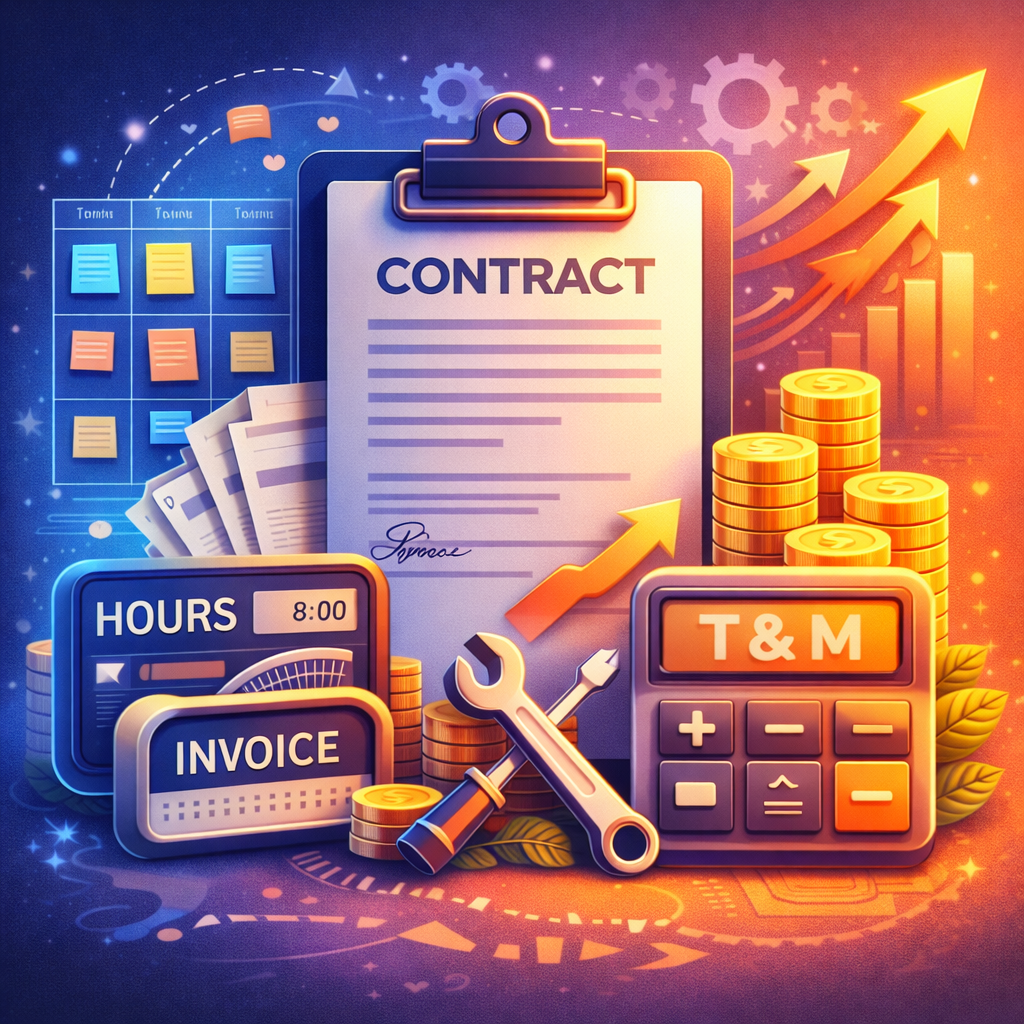
A T&M contract is a hybrid contractual model where the buyer agrees to pay the supplier based on the actual time spent and materials used in the execution of the work. The key components of a T&M contract typically include:
- Hourly or daily rates for labor categories
- Reimbursement for materials or expenses with or without markup
- No predefined total cost (though ceiling values may be added for budget control)
Unlike fixed-price models, T&M contracts do not transfer cost risks to the supplier. Conversely, unlike pure cost-reimbursable contracts, they often involve simpler tracking of predefined rates and units of time.
Companies That Use T&M Contracts
T&M contracts are commonly used by:
- Technology firms, especially in software development, system integration, and consulting services
- Construction and engineering companies for small-scale, exploratory, or repair work
- Startups and scale-ups engaging external professionals or freelancers
- Government agencies executing maintenance or emergency response projects
- Agile teams where scope is variable and delivery is iterative
Benefits of T&M Contracts
- Flexibility: Particularly suitable when scope, specifications, or duration cannot be fully determined at the outset.
- Speed of Engagement: Easier and faster to initiate than lengthy fixed-price negotiations.
- Resource Control: Clients can replace, reallocate, or scale teams quickly.
- Transparency: Clients pay only for work done and can monitor progress and resource use in real time.
Pitfalls and Risks of T&M Contracts
- Lack of Cost Predictability: Without a firm ceiling or milestone discipline, costs can spiral beyond budget.
- Lower Supplier Accountability: No direct financial incentive for the supplier to complete work efficiently.
- Micromanagement Risk: Clients may need to closely monitor hours and deliverables, increasing operational overhead.
- Potential for Abuse: If not monitored, the supplier may prolong tasks or allocate excessive time.
Use of T&M Contracts in Agile Implementations: Strategic or Excuse?
Agile methodologies emphasize iterative development, adaptive planning, and stakeholder collaboration. As such, many teams have shifted toward T&M contracts claiming better alignment with Agile principles. However, this practice is not without controversy:
- Strategic Alignment: In Agile, scope evolves based on feedback. T&M enables ongoing refinement and avoids early over-specification.
- Excuse for Lack of Commitment: Some buyers and vendors use Agile terminology to justify vague scoping and avoid commitments, leading to uncontrolled budget usage and diluted accountability.
- Governance Challenge: Without clear sprint goals, KPIs, or value metrics, Agile-T&M contracts risk becoming “open tabs” with low strategic value.
For T&M to succeed in Agile contexts, it must be paired with strong backlog management, velocity tracking, periodic review, and business outcome evaluation.
Conclusion
The Time and Material (T&M) contract remains a highly adaptable tool for project-based work. When properly structured and governed, it supports innovation, Agile development, and dynamic environments. However, it also carries risks of inefficiency and overspending, especially if used to bypass rigorous planning and accountability. Organizations must carefully assess when and how to use T&M contracts, particularly in Agile settings, to ensure alignment with value delivery goals.
You may also like: Firm Fixed Price (FFP) Contract: An Overview
Reach a global audience of portfolio, program, and project managers, product leaders, and certification professionals. Explore advertising opportunities .
Sponsored