
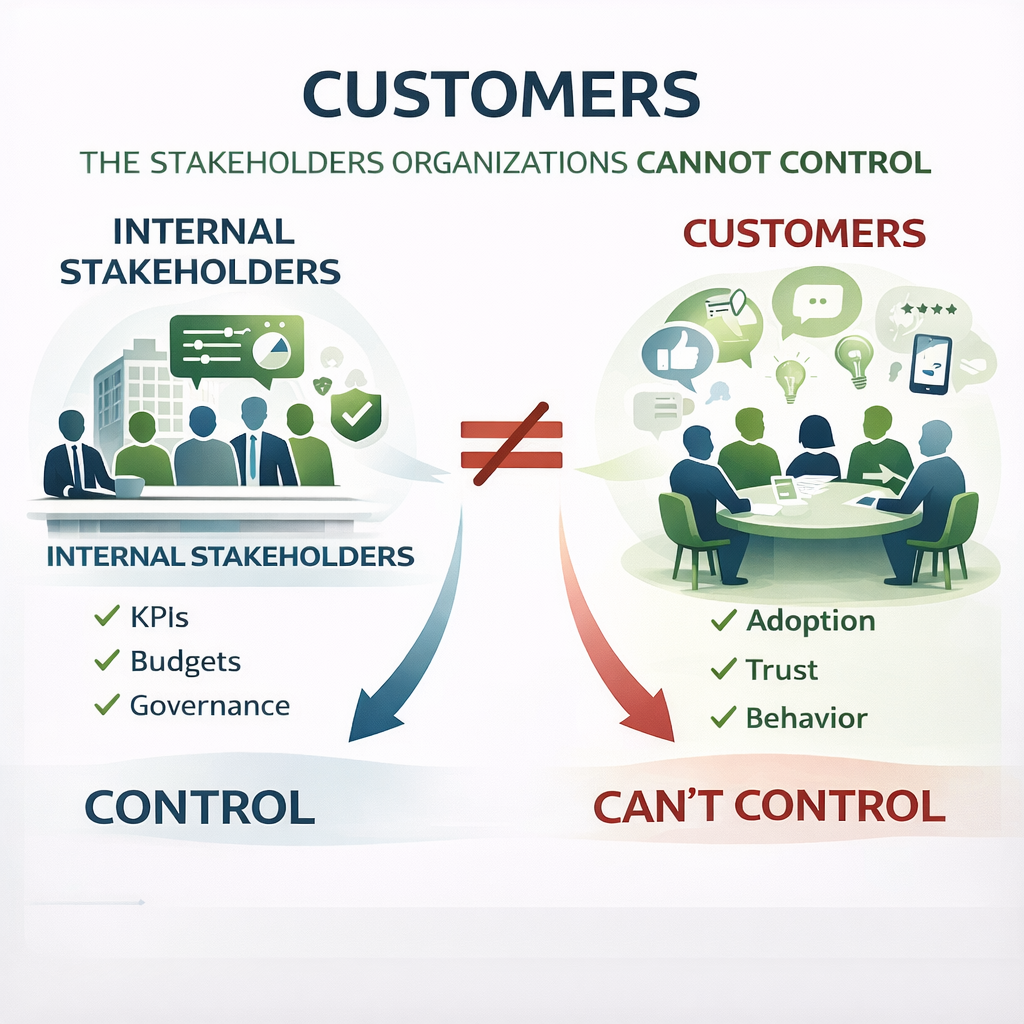
Organizations can control systems. They can control budgets. They can control internal processes, priorities, and timelines. But there is one stakeholder they can never control: the customer.
Customers ultimately decide whether value is realized. They decide whether to adopt a product, trust a service, or change their behavior. No amount of internal alignment, technical delivery, or executive sponsorship can force customers to perceive value. Value exists only when customers recognize it and act accordingly.
This reality makes customers fundamentally different from internal stakeholders. They are not obligated to support organizational initiatives. Their participation is voluntary. Their engagement must be earned.
Customers are the ultimate arbiters of value realization.
Capability Deployment Does Not Guarantee Customer Value
Many organizations mistakenly assume that delivering new capabilities automatically produces value. They invest heavily in digital transformation, product development, and operational modernization, believing that technical deployment is synonymous with success.
Yet customers evaluate outcomes, not effort. They assess whether a capability improves their experience, reduces friction, saves time, lowers cost, or creates new opportunity. If the change does not meaningfully improve their situation, adoption will remain limited.
This disconnect explains why many technically successful projects fail commercially. The system works as designed. The product functions correctly. But customers do not adopt it.
Value realization requires customer adoption, not technical completion.
Customers Operate Outside Organizational Authority
Internal stakeholders operate within organizational structures. Their roles, incentives, and responsibilities can be influenced through leadership, governance, and management processes. Customers operate outside these structures.
Organizations cannot mandate customer adoption. They cannot enforce behavioral change through authority. They must instead create compelling value propositions that align with customer priorities.
This requires understanding customer needs deeply. It requires empathy, observation, and engagement. Organizations must view initiatives not from an internal perspective, but from the customer’s perspective.
Customer behavior is influenced by perceived value, not organizational intent.
Customers Often Evaluate Change Differently Than Organizations Expect
Organizations frequently define value based on internal assumptions. They prioritize features, technical sophistication, or operational efficiency. Customers, however, often prioritize simplicity, reliability, and usability.
This mismatch creates adoption barriers. Features designed to increase capability may increase complexity. Enhancements intended to improve performance may disrupt familiar workflows. Improvements perceived as valuable internally may be irrelevant externally.
Organizations must validate value from the customer’s perspective. This requires direct engagement, observation, and feedback. Assumptions must be tested, not trusted.
Customer perception determines value.
Customers Are the Most Important Stakeholders in Product and Transformation Success
In product management, customer adoption determines commercial success. Features that customers do not use produce no return on investment. Customer engagement drives revenue, retention, and growth.
In digital transformation, customer behavior determines whether transformation produces strategic impact. Digital capabilities only produce value when customers incorporate them into their interactions with the organization.
In portfolio management, expected returns often depend on customer response. Investment justification assumes customer adoption, increased demand, or improved retention. Without customer engagement, financial projections remain theoretical.
Customers connect capability to economic value.
Customers Cannot Be Managed, Only Influenced
Internal stakeholders can be managed through formal structures. Customers cannot. Their engagement must be influenced through experience design, trust, and demonstrated value.
Organizations influence customers by reducing friction, improving usability, and delivering consistent value. They influence customers by communicating clearly, supporting adoption, and addressing concerns.
Trust plays a central role. Customers must believe that adopting new capabilities will improve their experience without introducing unacceptable risk or complexity.
Influence replaces authority in customer engagement.
Customer Engagement Must Begin Before Capability Deployment
Customer engagement is often treated as a post-delivery activity. Organizations build capabilities first and attempt to drive adoption afterward. This sequence increases adoption risk.
Engaging customers early improves solution quality and increases adoption probability. Customer input helps ensure that capabilities align with real needs rather than internal assumptions.
Early engagement also creates familiarity. Customers who understand the purpose and benefits of change are more likely to adopt new capabilities when they become available.
Engagement reduces uncertainty. Reduced uncertainty accelerates adoption.
Customers Shape Strategic Outcomes
Customer behavior determines whether strategic initiatives achieve their intended outcomes. Growth strategies depend on customer acquisition and retention. Efficiency strategies depend on customer adoption of digital channels. Innovation strategies depend on customer willingness to try new offerings.
Organizations may define strategy internally, but strategy success depends on external stakeholders.
Customers are not passive recipients of change. They are active participants in value creation.
Recognizing this reality shifts organizational focus. Instead of asking, “Have we delivered the capability?” leaders must ask, “Are customers adopting the capability?”
This shift transforms execution priorities.
Customer Resistance Is Often Rational
Customer resistance is frequently interpreted as irrational or conservative behavior. In reality, resistance is often a rational response to perceived risk or insufficient value.
Customers evaluate change based on their own incentives and constraints. If adopting a new capability introduces uncertainty, learning effort, or potential disruption without clear benefit, resistance is logical.
Organizations must address these concerns directly. They must reduce friction, clarify value, and support transition.
Resistance is feedback. It signals misalignment between capability and perceived value.
Understanding resistance improves adoption strategy.
Implications for Portfolio, Product, and Transformation Leaders
For portfolio leaders, customer adoption determines whether investments produce expected returns. Investment justification must consider customer behavior, not just internal readiness.
For product leaders, customer engagement is central to product success. Product development must be guided by customer insight rather than internal assumptions.
For transformation leaders, customer behavior determines whether transformation achieves strategic objectives. Transformation success requires customer participation.
Across domains, customers determine whether value is realized.
Customers Are the Ultimate Source of Value
Organizations create capabilities. Customers create value.
This distinction is fundamental. Technical excellence enables potential. Customer adoption converts potential into outcomes.
Benefit Realization Management recognizes this principle. Benefits emerge when stakeholders change behavior. Customers are among the most critical stakeholders in this process.
Organizations cannot control customers. But they can understand them, engage them, and design capabilities that align with their needs.
Value realization begins and ends with customers.
They are the stakeholders organizations cannot control—and the ones they must understand most deeply.
You may also like: Stakeholder Commitment Is the Primary Predictor of Transformation Success
Reach a global audience of portfolio, program, and project managers, product leaders, and certification professionals. Explore advertising opportunities .
Sponsored