
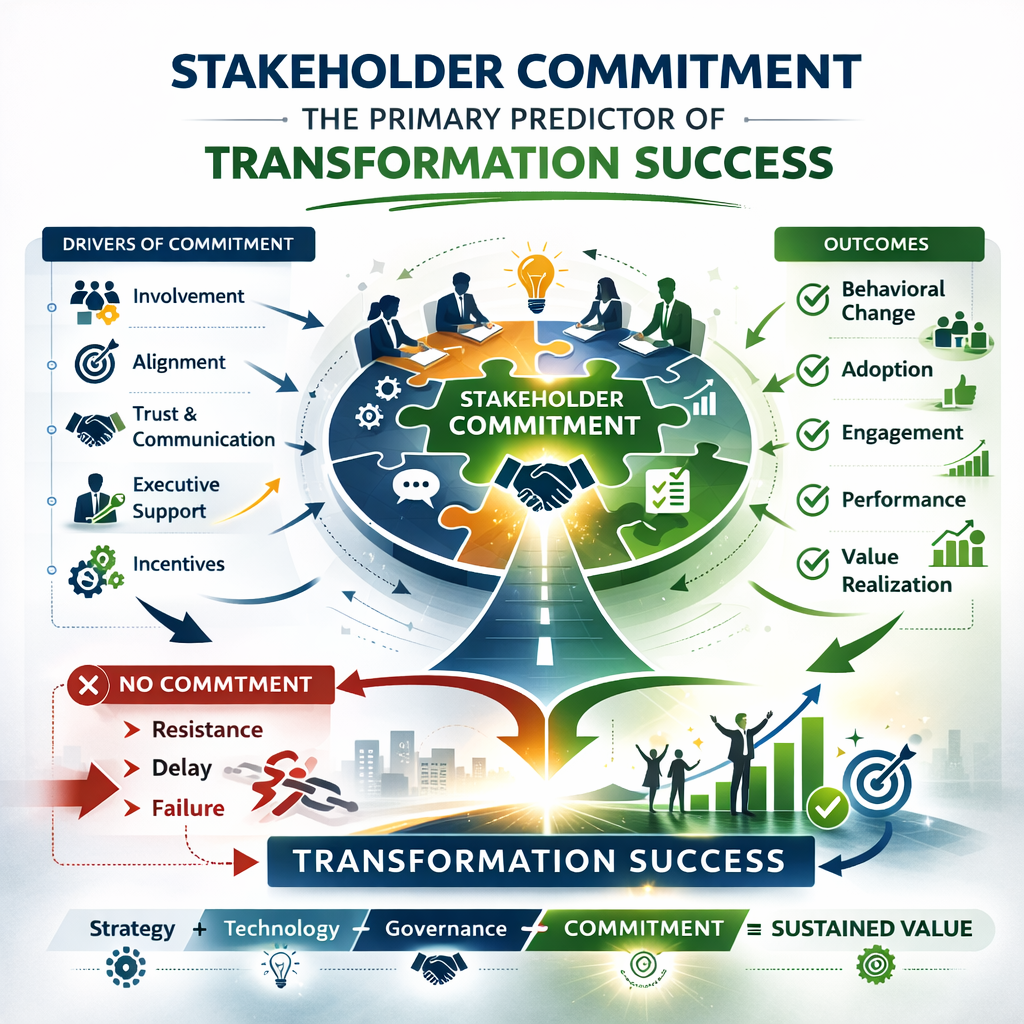
Organizations frequently analyze why transformations fail. They attribute failure to inadequate technology, insufficient funding, poor planning, or weak execution. While these factors matter, they rarely explain the full story. Many transformation initiatives that were well-funded, carefully planned, and technically sound still underperform or collapse entirely.
The missing variable is often stakeholder commitment.
Transformation success is not determined solely by strategy design or technical deployment. It is determined by whether stakeholders are committed to changing their behavior in alignment with the new direction. Without commitment, transformation remains superficial. With commitment, even imperfect strategies can succeed.
Stakeholder commitment is the most reliable predictor of transformation success.
Awareness Is Not Commitment
Organizations frequently equate awareness with engagement and engagement with commitment. They communicate vision statements, hold town halls, and publish transformation roadmaps. Stakeholders understand what is changing. Yet understanding alone does not drive sustained behavioral change.
Commitment requires more than clarity. It requires belief, alignment, and ownership. Stakeholders must believe that the transformation is necessary, that it is achievable, and that it will generate meaningful value. They must perceive alignment between organizational objectives and their own incentives.
When awareness exists without commitment, compliance may occur temporarily. But sustained transformation demands deeper alignment.
Commitment transforms passive acceptance into active support.
Commitment Drives Behavioral Change
Transformation initiatives ultimately aim to change behavior. Digital transformation seeks new ways of interacting with customers. Operational transformation seeks improved efficiency. Strategic transformation seeks repositioning in competitive markets.
Behavior does not change because of new systems alone. It changes because stakeholders choose to act differently. That choice is driven by commitment.
When stakeholders are committed, they invest effort in learning new tools. They overcome obstacles proactively. They advocate for change among peers. They tolerate short-term disruption in pursuit of long-term benefit.
When commitment is absent, stakeholders revert to legacy behaviors at the first sign of friction.
Behavioral persistence depends on commitment.
Commitment Is Built Through Involvement, Not Instruction
Instruction informs stakeholders about what to do. Involvement gives stakeholders a voice in shaping the change. Commitment emerges from involvement.
When stakeholders participate in defining objectives, identifying benefits, and mapping risks, they develop psychological ownership. They shift from being subjects of transformation to being co-authors of transformation.
This involvement improves solution quality by incorporating diverse expertise. More importantly, it increases resilience during implementation. Stakeholders who helped shape the change are more likely to defend and sustain it.
Transformation cannot be imposed sustainably. It must be co-created.
Executive Alignment Signals Organizational Commitment
Stakeholders closely observe executive behavior. Visible executive alignment signals seriousness and reduces ambiguity. When leadership demonstrates consistent support, resource allocation, and accountability, stakeholders interpret transformation as strategic rather than temporary.
Conversely, mixed signals undermine commitment. If transformation priorities conflict with performance metrics or incentive systems, stakeholders rationally prioritize what is measured and rewarded.
Governance must reinforce commitment. Performance management, incentives, and communication must align with transformation objectives.
Commitment at the top legitimizes commitment throughout the organization.
Commitment Is a Leading Indicator of Transformation Risk
Traditional transformation monitoring focuses on milestones, budgets, and timelines. While necessary, these metrics are lagging indicators. By the time delays or budget overruns occur, stakeholder disengagement may already be entrenched.
Stakeholder commitment provides an earlier signal. Declining enthusiasm, increasing skepticism, or passive resistance often precede performance deterioration.
Monitoring stakeholder sentiment, influence, and engagement enables proactive intervention. Leaders can address concerns, clarify value propositions, and adjust strategies before resistance solidifies.
Commitment is not only an outcome to be achieved. It is a risk metric to be monitored.
Commitment Requires Alignment of Incentives
Stakeholders evaluate transformation through the lens of personal and professional impact. If new behaviors are not aligned with incentive systems, commitment weakens.
For example, organizations may promote cross-functional collaboration while continuing to reward individual performance metrics exclusively. They may encourage innovation while penalizing short-term failure. These contradictions undermine transformation credibility.
Commitment strengthens when incentives support desired behaviors. Clear linkage between transformation objectives and performance evaluation reinforces alignment.
Behavior follows incentives. Commitment follows credible alignment.
Commitment Extends Beyond Internal Stakeholders
Transformation success also depends on external stakeholders. Customers must adopt new channels. Partners must integrate with new systems. Suppliers must adapt to revised processes.
External commitment cannot be mandated. It must be earned through trust, value demonstration, and transparent communication.
Organizations that treat external stakeholders as peripheral risk underestimating their influence on transformation outcomes. Customer disengagement, partner resistance, or supplier friction can derail strategic initiatives.
Commitment must extend across the ecosystem.
Portfolio and Product Implications
In portfolio management, commitment should influence prioritization. Initiatives facing strong stakeholder support may present lower execution risk than financially attractive initiatives facing resistance.
In product management, customer commitment determines adoption and revenue. Internal commitment determines enablement and support quality.
Transformation leaders must integrate commitment metrics into governance dashboards. Financial viability alone does not guarantee success. Stakeholder commitment determines execution resilience.
Commitment connects strategy to sustained value realization.
Commitment Is the Engine of Sustainable Change
Transformation is not a one-time event. It is an ongoing evolution of capabilities, culture, and behavior. Sustained change requires sustained commitment.
Stakeholders who are genuinely committed continue adapting even when initial enthusiasm fades. They internalize the transformation as part of organizational identity.
Without commitment, change erodes over time. Legacy behaviors re-emerge. Systems are underutilized. Investments underperform.
With commitment, transformation becomes embedded.
Stakeholder Commitment Is Strategic Capital
Organizations often measure financial capital, human capital, and technological capital. Stakeholder commitment should be viewed as strategic capital.
It represents the collective willingness of stakeholders to invest energy, attention, and effort in realizing strategic objectives. It amplifies the effectiveness of resources and mitigates execution risk.
Leaders who cultivate stakeholder commitment increase the probability that transformation produces durable value.
Technology enables transformation. Strategy directs transformation. Governance structures transformation.
But commitment powers transformation.
Stakeholder commitment is not a soft variable.
It is the primary predictor of transformation success.
You may also like: Stakeholders in Portfolio Management: The Missing Link in Strategic Execution
Reach a global audience of portfolio, program, and project managers, product leaders, and certification professionals. Explore advertising opportunities .
Sponsored