
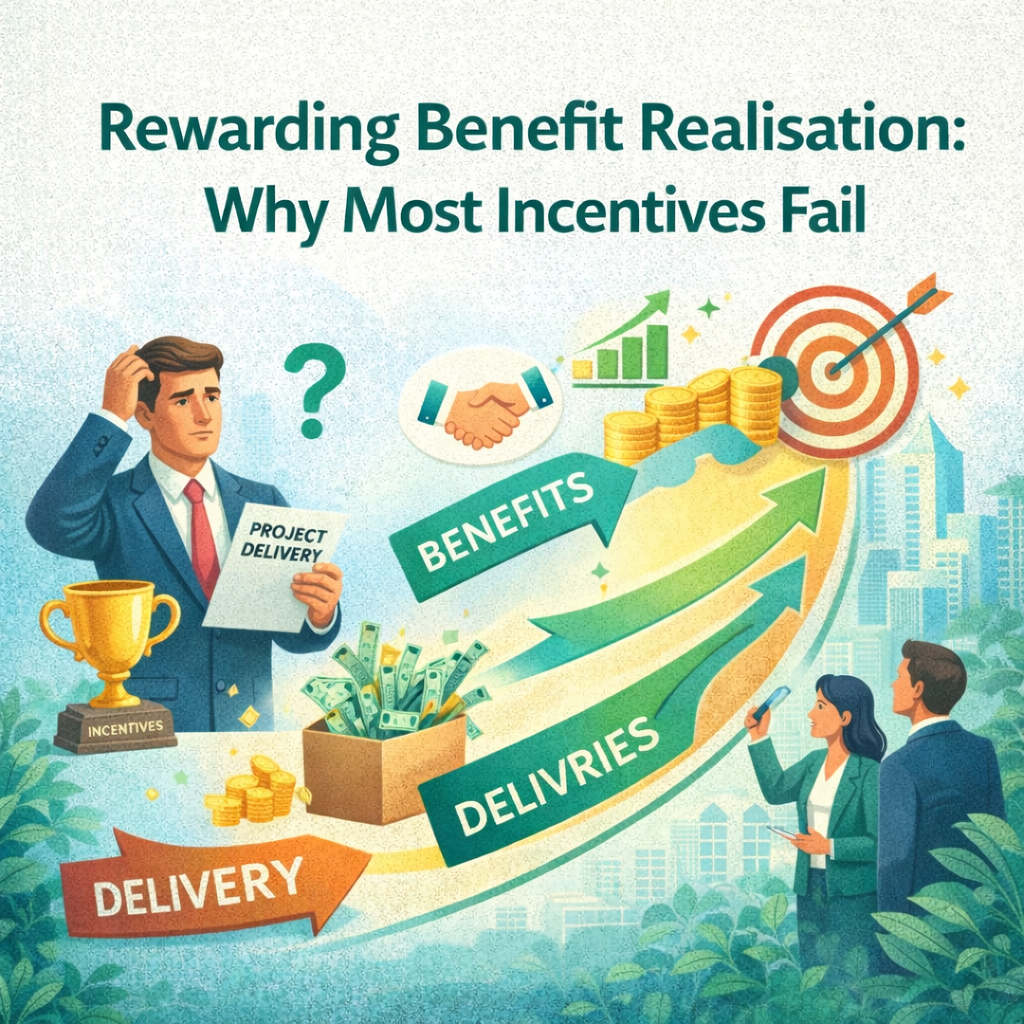
Organisations often declare that benefits are the ultimate justification for investments in projects and transformation programmes. Business cases promise measurable improvements, executives approve funding based on expected returns, and governance structures track the delivery of initiatives intended to produce those outcomes. Yet when the time comes to reward performance, the incentive structures inside many organisations remain disconnected from the actual realisation of benefits.
In theory, this should be straightforward. If transformation initiatives produce measurable value, organisations should reward the individuals responsible for achieving that value. In practice, however, incentive systems frequently fail to support benefit realisation. Instead of encouraging behaviours that lead to sustained improvements, they often reinforce short-term delivery targets, fragmented accountability, or metrics that are only loosely connected to real outcomes.
The result is a paradox. Organisations emphasise the importance of benefits in their strategic narratives but continue to reward performance as if delivering outputs were the primary objective.
The Delivery Bias in Incentive Structures
One of the most common reasons incentive systems fail is that they focus on delivery rather than outcomes. Project teams are often rewarded for completing initiatives on time, within budget, and according to scope. These criteria are important for operational discipline, but they do not guarantee that the initiative will produce the intended business benefits.
For example, a company may successfully implement a new customer relationship management system. The project may meet every technical requirement and be delivered precisely according to schedule. From a project management perspective, this is a success. However, if sales teams fail to adopt the system effectively, customer engagement may remain unchanged and revenue growth may never occur.
If the project team is rewarded solely for delivery, the organisation may celebrate success while the expected benefits fail to materialise. Incentives, in this case, reinforce the illusion that outputs equal value.
Benefits Depend on Behaviour, Not Just Systems
The deeper issue is that benefit realisation depends primarily on behavioural change. Systems, processes, and technologies create the conditions for improvement, but they do not generate value on their own. People must change how they work, make decisions differently, and adopt new practices before benefits can emerge.
Incentive systems that ignore this reality often reward the wrong behaviours. Employees may focus on meeting technical milestones rather than embedding change in daily operations. Managers may prioritise the completion of initiatives rather than the long-term performance improvements those initiatives were designed to produce.
When incentives are misaligned with realisation, individuals optimise for the metrics that influence their rewards. If those metrics emphasise delivery rather than value, benefit realisation becomes a secondary concern.
The Attribution Problem
Another challenge arises from the difficulty of attributing benefits to specific individuals or initiatives. Organisational outcomes are rarely the result of a single action. Revenue growth, cost reduction, or improved customer satisfaction typically depend on multiple factors working together across different departments.
Because benefits are systemic, assigning credit for them can be complex. A digital transformation initiative may involve technology teams, operational leaders, marketing departments, and external partners. Each contributes to the outcome, but none alone controls it entirely.
Incentive systems that attempt to link rewards directly to final outcomes may therefore create tension or unfairness. Individuals may be held accountable for results influenced by factors beyond their control. This can discourage participation in transformation initiatives rather than encourage it.
As a result, organisations sometimes avoid linking incentives to benefits altogether. Instead, they return to simpler metrics related to project delivery or departmental performance. While easier to administer, these metrics rarely support real value creation.
Short-Term Metrics and Long-Term Value
A further complication arises from the difference between short-term measurement cycles and long-term value creation. Many benefits take time to materialise. Cultural changes, process improvements, and customer behaviour shifts often evolve gradually rather than immediately following a project’s completion.
Incentive systems, however, are often tied to annual performance cycles. Leaders may feel pressure to demonstrate immediate results even when the underlying transformation requires longer periods to stabilise. This mismatch encourages short-term actions that create visible improvements quickly but fail to sustain long-term impact.
For instance, cost reductions may be achieved through temporary budget cuts rather than through structural efficiency improvements. Revenue increases may be driven by promotional campaigns that boost sales in the short term but weaken profitability over time.
These actions may satisfy incentive targets without delivering the strategic benefits originally envisioned.
The Risk of Manipulating Metrics
When incentives depend heavily on quantitative metrics, another risk emerges: the manipulation of those metrics. Employees naturally adapt their behaviour to maximise rewards. If measurement systems are poorly designed, individuals may discover ways to achieve targets without genuinely improving organisational performance.
For example, a programme designed to improve operational efficiency might reward managers for reducing process cycle times. While this appears reasonable, managers may respond by simplifying measurements, redefining process boundaries, or shifting work outside the monitored process. Cycle times improve on paper while the underlying system remains unchanged.
Such behaviour does not necessarily reflect malicious intent. It often arises from the pressure to meet targets combined with unclear definitions of success. When incentives emphasise metrics rather than outcomes, the organisation risks confusing measurement improvement with performance improvement.
Aligning Incentives with Ownership
One way to address these challenges is to link incentives to benefit ownership rather than to project delivery alone. As discussed in earlier discussions on benefit realisation, benefits must be owned by the leaders responsible for operational outcomes.
When benefit owners are clearly defined, incentives can be structured around the performance improvements those leaders are expected to achieve. Instead of rewarding project completion, the organisation rewards the successful integration of new capabilities into operational practice.
For example, if a transformation initiative aims to improve customer retention, the operational leader responsible for customer experience should have incentives tied to retention metrics over time. The project team may enable the change, but the operational leader owns the outcome.
This alignment encourages collaboration between project teams and business leaders. Both groups recognise that the ultimate measure of success lies in the realised benefit rather than in the completion of technical tasks.
Recognising Intermediate Outcomes
Because final benefits often take time to appear, effective incentive systems should also recognise intermediate outcomes. These are measurable indicators that behavioural changes are occurring and that the organisation is progressing toward the intended benefit.
Intermediate outcomes might include improved service response times, increased adoption of new digital tools, or higher employee engagement with redesigned processes. While these outcomes may not represent the final benefit, they provide evidence that the transformation is moving in the right direction.
Rewarding these milestones encourages sustained commitment to change. It also reduces the pressure to artificially accelerate results before the organisation is ready.
Encouraging Collaboration Rather Than Competition
Benefit realisation often requires cooperation across organisational boundaries. Multiple teams may need to coordinate their efforts to achieve a shared outcome. Incentive systems that reward individuals or departments independently can undermine this collaboration.
For example, a programme intended to improve customer experience may involve marketing, operations, and customer support teams. If each department is rewarded according to its own isolated metrics, conflicts may arise. Marketing may prioritise acquisition targets, operations may focus on efficiency, and customer support may seek to minimise costs. These objectives can conflict even though all departments contribute to the same overall benefit.
Incentive structures that recognise shared outcomes help prevent this fragmentation. When teams are rewarded collectively for achieving strategic benefits, they are more likely to coordinate their actions and support each other’s efforts.
Designing Incentives for Real Value
Creating effective incentive systems for benefit realisation requires a balanced approach. Rewards should reflect both individual accountability and collective responsibility. They should recognise the long-term nature of transformation while still providing meaningful short-term feedback.
This balance often involves combining multiple types of metrics. Delivery metrics ensure that projects maintain discipline and efficiency. Behavioural metrics monitor the adoption of new practices. Outcome metrics track the emergence of strategic benefits over time.
When these layers of measurement are aligned with organisational ownership structures, incentives begin to reinforce the behaviours necessary for sustained value creation.
A Leadership Responsibility
Ultimately, the effectiveness of incentive systems reflects leadership priorities. If leaders genuinely believe that benefit realisation is the ultimate purpose of transformation, reward structures must reflect that belief. If incentives continue to prioritise short-term delivery metrics, employees will naturally focus their efforts on those metrics instead.
Designing incentives that support benefit realisation requires careful thought and ongoing adjustment. Leaders must examine how measurement influences behaviour and ensure that reward systems encourage the right actions rather than simply recording the right numbers.
This process is not purely technical. It involves understanding organisational culture, recognising the complexity of value creation, and accepting that transformation outcomes cannot always be controlled with precision.
Conclusion
Rewarding benefit realisation is far more complex than rewarding project delivery. Benefits emerge from behavioural change, cross-functional collaboration, and sustained organisational effort. Incentive systems that ignore these realities risk encouraging behaviours that undermine the very outcomes they aim to promote.
To support real value creation, organisations must align incentives with ownership, recognise intermediate progress, and reward collaboration rather than isolated performance. When incentives reflect the true drivers of benefit realisation, transformation initiatives are far more likely to produce lasting strategic impact.
In the end, incentives shape behaviour. If organisations wish to realise the benefits promised by their investments, they must ensure that what they reward is truly aligned with the value they seek to create.
You may also like: Benefit Profiles: The Missing Link Between Strategy, Change, and Measurement
Reach a global audience of portfolio, program, and project managers, product leaders, and certification professionals. Explore advertising opportunities .
Sponsored