
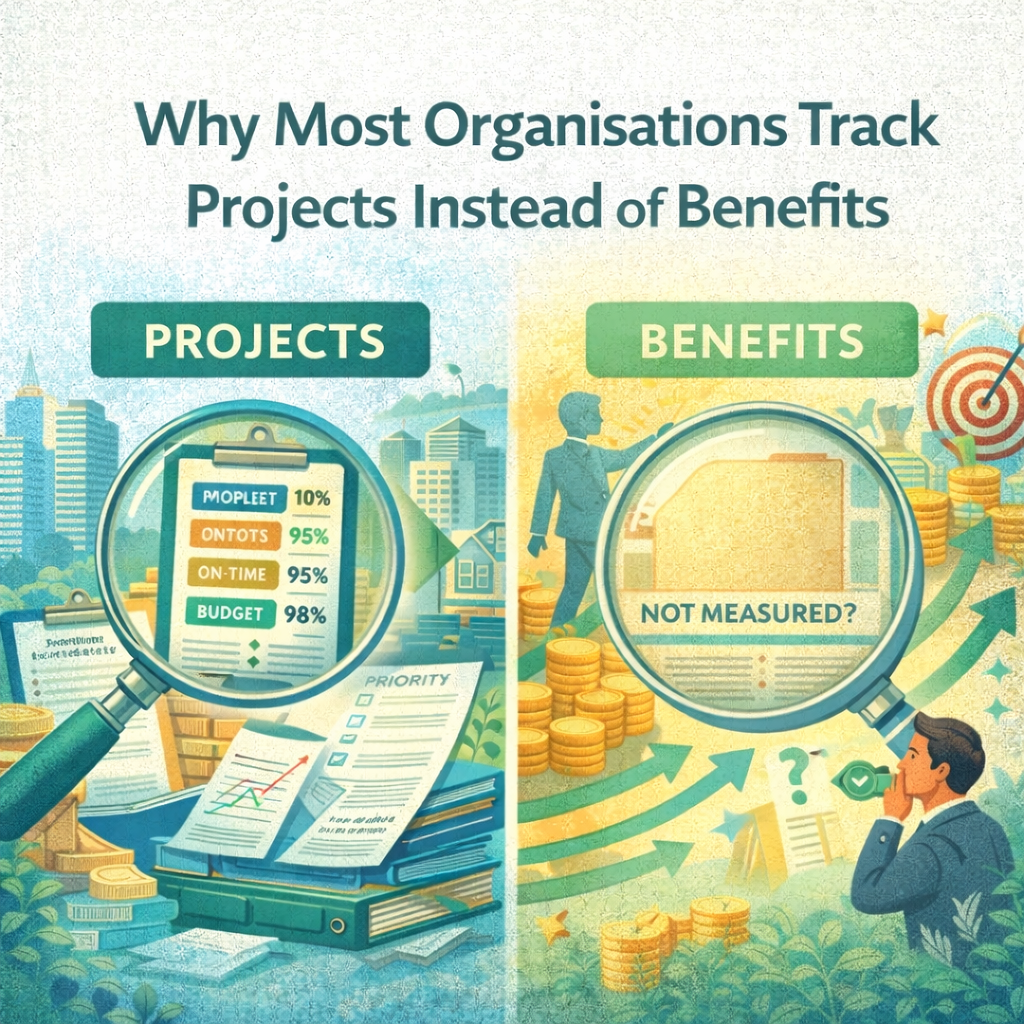
Modern organisations invest enormous resources in projects and transformation initiatives. They build sophisticated project management offices, implement advanced portfolio management tools, and generate detailed dashboards tracking delivery performance. Executives can easily see how many projects are underway, which milestones have been achieved, and whether initiatives are progressing according to schedule and budget.
Yet despite this extensive monitoring of delivery activity, a critical question often remains unanswered: are these projects actually creating the benefits they were intended to produce?
In many organisations, the answer is surprisingly unclear. While project delivery is measured with precision, the realisation of benefits — the improvement in business performance that justified the investment — is rarely tracked with the same discipline. The result is a paradox: organisations manage projects rigorously but manage value only loosely.
Understanding why this happens requires examining how organisational governance, reporting structures, and management habits have evolved over time.
The Historical Roots of Project Tracking
The widespread focus on tracking projects rather than benefits has deep historical roots. Modern project management practices emerged primarily in industries where the successful completion of complex deliverables represented the primary objective. Large construction projects, infrastructure development, aerospace programmes, and engineering initiatives all depended on the reliable delivery of physical assets.
In these environments, tracking schedule, cost, and scope was entirely appropriate. When a bridge, aircraft, or manufacturing facility was completed, the value of the project was largely embodied in the deliverable itself. If the structure was built correctly, the benefit was inherent in the outcome.
However, the nature of organisational change has evolved dramatically. Today many projects involve digital transformation, process redesign, customer experience improvements, or organisational capability development. In these contexts, the project deliverable is rarely the final source of value. Instead, value emerges only after the organisation adopts new behaviours and operational practices.
Despite this shift, many organisations still manage transformation initiatives using governance models designed for deliverable-focused projects. The metrics that once worked well in engineering environments are now applied to complex organisational change programmes where value emerges much later.
The Comfort of Delivery Metrics
Another reason organisations focus on projects rather than benefits is that delivery metrics are easier to measure. Schedule adherence, budget performance, and milestone completion can be tracked with relative clarity. Project management tools and reporting systems are designed to monitor these factors automatically.
Benefits, by contrast, are often more difficult to quantify. They may depend on behavioural change, market dynamics, or long-term performance improvements that cannot be measured immediately after a project ends.
Because delivery metrics provide quick and visible feedback, leadership teams often gravitate toward them. Dashboards showing project progress create a sense of control and predictability. Executives can see whether initiatives are moving forward and can intervene when delays occur.
However, this visibility can create a false sense of success. An organisation may proudly report that dozens of projects have been delivered on time while remaining uncertain whether those projects have improved performance or created meaningful value.
The Structural Boundary Between Projects and Operations
A structural separation between projects and operations also contributes to the problem. In many organisations, project teams operate within temporary structures while operational units are responsible for ongoing performance.
When a project ends, responsibility for the resulting capability typically transfers to the operational organisation. At that point, the project team disbands and the formal governance structure surrounding the initiative disappears.
This transition often marks the point where benefit tracking stops. Project governance frameworks are designed to monitor delivery activity, not long-term operational performance. Once the deliverable is handed over, the systems used to track progress may no longer apply.
Operational teams, meanwhile, may focus on daily performance targets rather than on the specific benefits originally promised in the project’s business case. Over time, the connection between the initiative and the intended outcomes becomes increasingly blurred.
The Disappearance of Benefits After Project Closure
Because benefit realisation frequently occurs after project completion, the moment when project governance ends can be precisely when benefit tracking should begin. Unfortunately, many organisations do the opposite.
Project closure is often treated as the final step of the initiative. Success is declared once deliverables have been implemented, documentation has been completed, and resources have been released. The organisation then moves its attention to the next set of projects in the portfolio.
If benefits emerge later, they may be attributed to general operational performance rather than to the transformation initiative that enabled them. If benefits fail to emerge, the absence may go unnoticed because no structured mechanism remains in place to track them.
This dynamic explains why organisations frequently struggle to evaluate the true impact of their transformation investments. They measure delivery success but rarely measure value creation with equal discipline.
The Reporting Bias of Portfolio Governance
Portfolio governance structures also contribute to the emphasis on projects. Portfolio reports typically summarise the status of initiatives across the organisation, highlighting progress against schedules and budgets.
These reports are designed to answer questions about resource allocation and delivery capacity. They help leaders understand which initiatives are underway and whether the portfolio is progressing according to plan.
However, they often say little about whether the portfolio is actually producing the strategic outcomes it was intended to deliver.
When portfolio governance focuses primarily on project execution, leadership discussions revolve around delivery challenges rather than value realisation. Meetings concentrate on schedule delays, budget overruns, or scope adjustments. While these issues are important, they do not necessarily indicate whether the organisation is achieving the strategic improvements that justified the investment.
The Cultural Preference for Tangible Outputs
Organisational culture also plays a role. Deliverables are tangible. They can be demonstrated, documented, and celebrated. A new system can be launched, a new process can be implemented, or a new facility can be opened. These events create visible milestones that organisations naturally recognise as achievements.
Benefits, by contrast, often emerge gradually. Improvements in efficiency, customer satisfaction, or market performance may develop over months or years. These changes are less dramatic and more difficult to attribute to a single initiative.
Because organisations naturally gravitate toward visible achievements, they tend to celebrate project completion more readily than benefit realisation. Over time, this cultural preference reinforces the idea that delivering projects is the primary measure of success.
The Consequences of Tracking the Wrong Thing
When organisations track projects instead of benefits, several consequences emerge.
First, they risk investing in initiatives that deliver outputs without producing meaningful outcomes. Projects may be completed successfully while the organisation’s overall performance remains unchanged.
Second, leaders may struggle to learn from past investments. If benefits are not measured systematically, it becomes difficult to determine which initiatives produced value and which did not. This limits the organisation’s ability to improve its investment decisions.
Third, the organisation may lose sight of the strategic purpose behind its transformation efforts. Projects become ends in themselves rather than mechanisms for achieving broader organisational goals.
Over time, this dynamic can create a portfolio filled with activity but lacking clear impact.
Shifting the Focus From Projects to Benefits
Addressing this problem does not mean abandoning project tracking. Delivery discipline remains essential for ensuring that initiatives are implemented effectively. However, delivery metrics must be complemented by mechanisms that track the realisation of benefits over time.
This shift requires extending governance beyond project completion. Instead of ending oversight when deliverables are implemented, organisations should continue monitoring the outcomes those deliverables were intended to produce.
Benefit owners should remain accountable for achieving the improvements defined in the business case. Portfolio reporting should include indicators showing whether benefits are emerging across the organisation.
Tools such as benefit maps, benefit profiles, and benefit realisation plans can help create this connection between delivery and value. These mechanisms ensure that transformation initiatives remain focused on the outcomes that justify their existence.
Reframing the Purpose of Projects
Ultimately, the purpose of projects is not simply to deliver outputs but to enable organisational improvement. Projects introduce new capabilities, but those capabilities only matter if they lead to measurable benefits.
When organisations shift their attention from projects to benefits, the role of project management becomes clearer. Projects are no longer the final objective but part of a broader system designed to create value.
Delivery success remains important, but it becomes one step in a longer journey toward strategic impact.
Conclusion
The tendency to track projects instead of benefits is not the result of negligence or incompetence. It reflects historical practices, structural boundaries, and cultural preferences that have shaped organisational governance for decades.
However, as transformation initiatives increasingly focus on digital capabilities, organisational change, and customer experience, the limitations of delivery-focused governance have become more visible.
Projects may introduce new systems and processes, but benefits emerge only when those capabilities change how the organisation operates and performs.
To ensure that transformation investments truly create value, organisations must extend their attention beyond project completion and begin tracking the outcomes those projects were intended to produce.
Only when benefits are monitored with the same discipline applied to delivery can organisations confidently say that their transformation initiatives are achieving their strategic purpose.
You may also like: Benefit Realisation Is Not Forcible Extraction
Reach a global audience of portfolio, program, and project managers, product leaders, and certification professionals. Explore advertising opportunities .
Sponsored