
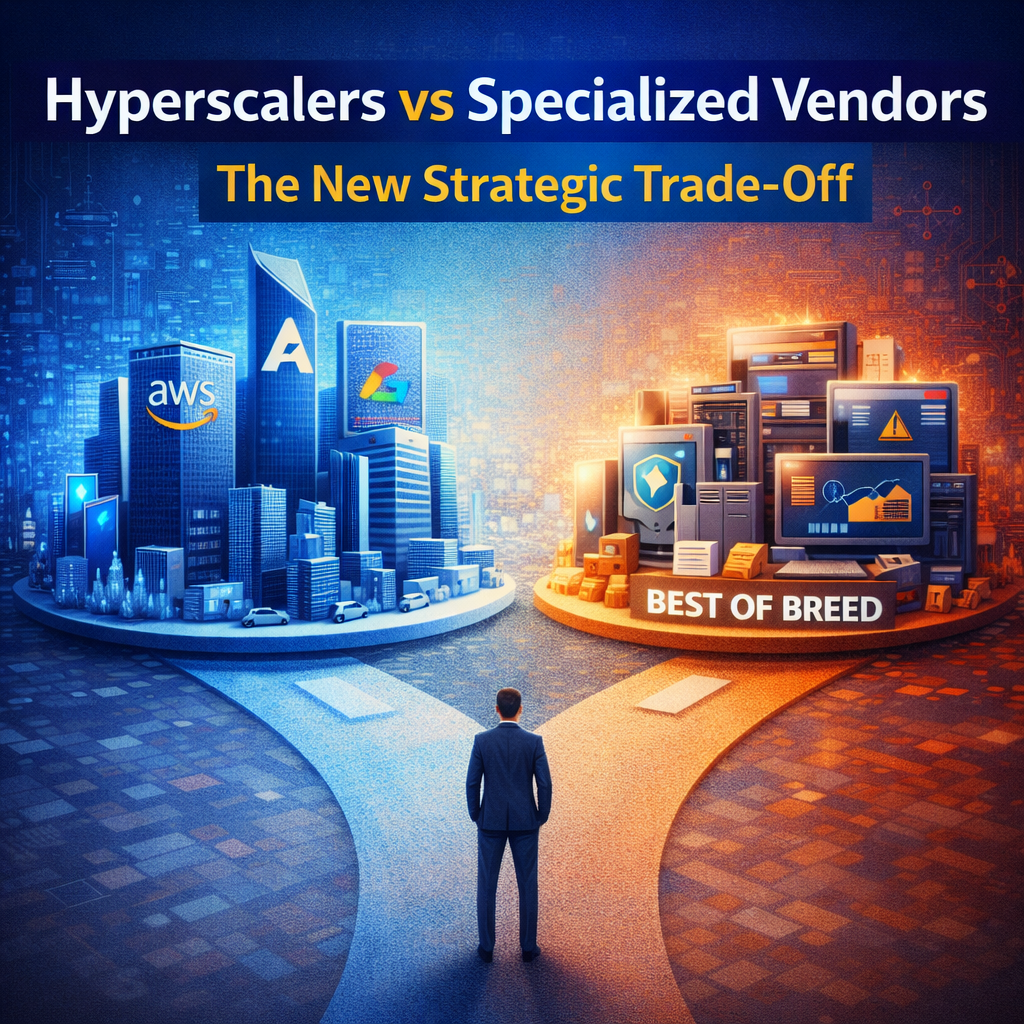
The Platform Era Is Redefining Technology Choices
Hyperscalers vs specialized vendors has become one of the most important strategic decisions in enterprise technology architecture. For decades, enterprise technology procurement followed a relatively straightforward principle: organizations selected the best product available in each category. Security, databases, analytics, networking, and monitoring were purchased independently, often from specialized vendors that focused deeply on a single domain. This model became widely known as the best-of-breed strategy, and it dominated enterprise technology architectures for more than twenty years.
However, the technology landscape is undergoing a structural transformation. The rise of hyperscale cloud providers — particularly platforms such as Amazon Web Services, Microsoft Azure, and Google Cloud — is fundamentally reshaping how organizations evaluate technology vendors. Rather than assembling dozens of specialized tools, enterprises are increasingly adopting integrated platform ecosystems.
This shift is not merely technological. It reflects a broader strategic trade-off between depth and integration, flexibility and simplicity, and optimization and governance.
As organizations migrate workloads to the cloud, platform providers are expanding their capabilities far beyond infrastructure. Hyperscalers now offer security platforms, data analytics stacks, AI services, identity systems, developer tooling, and operational monitoring — often integrated into a single ecosystem.
The result is a new question facing technology leaders:
Should organizations prioritize specialized innovation or platform consolidation?
The answer increasingly lies in strategic portfolio decisions rather than purely technical evaluations.
Why Hyperscalers Are Expanding Across the Technology Stack
Hyperscalers are not simply infrastructure providers anymore. They are becoming technology ecosystems.
Originally, cloud platforms focused on compute, storage, and networking. But as adoption increased, hyperscalers began expanding into adjacent domains to capture more of the enterprise technology stack.
Today, hyperscalers offer capabilities across multiple layers:
Infrastructure services
Platform services
Security tooling
Data platforms
Machine learning services
Application development frameworks
Observability and monitoring tools
Identity and access management
This expansion is driven by several strategic advantages.
First, hyperscalers benefit from massive scale economies. Their infrastructure footprint allows them to distribute costs across millions of customers, enabling rapid innovation and aggressive pricing.
Second, hyperscalers can integrate services natively within their platforms. When identity, compute, networking, and monitoring are designed within the same ecosystem, the result is often a simpler operational model.
Third, platform providers possess unmatched access to telemetry and operational data, enabling them to build increasingly intelligent automation across their services.
As a result, hyperscalers are not merely competing with infrastructure vendors — they are competing with specialized vendors across multiple technology categories.
The Enduring Strength of Specialized Vendors
Despite the rapid expansion of hyperscaler platforms, specialized vendors continue to play a critical role in enterprise technology ecosystems.
In many domains, specialized vendors still offer deeper functionality, faster innovation cycles, and stronger domain expertise than platform-native alternatives.
Examples include:
Cybersecurity platforms with advanced threat detection
Observability solutions with deep telemetry analytics
Data platforms optimized for specific workloads
DevOps tooling designed for complex development pipelines
AI solutions tailored to niche use cases
Specialized vendors often focus intensely on solving a single class of problems. This focus allows them to develop capabilities that may exceed the depth offered by platform-native tools.
In addition, specialized vendors typically operate in multi-cloud environments, making them attractive for organizations seeking to avoid platform lock-in.
Innovation frequently emerges from these specialized ecosystems, where startups and domain-focused companies experiment rapidly with new approaches.
However, these advantages come with trade-offs.
Specialized tools often require complex integrations, additional governance, and operational overhead.
What once appeared as technological flexibility can gradually evolve into architectural fragmentation.
The Hidden Cost of Best-of-Breed Architectures
Best-of-breed strategies rarely fail because the tools themselves are weak. They fail because integration complexity accumulates over time.
Modern enterprises frequently operate environments with dozens — sometimes hundreds — of independent technology vendors.
Each vendor introduces its own:
Security model
Data structures
APIs
Operational tooling
Licensing structures
Upgrade cycles
Individually, each tool may deliver strong capabilities. Collectively, however, they create a fragmented ecosystem that becomes difficult to manage.
Integration work increases exponentially as more systems are introduced. Security monitoring becomes fragmented. Data visibility becomes incomplete. Governance becomes more complex.
These challenges are particularly evident in areas such as cybersecurity, observability, and data management, where visibility across systems is essential.
Organizations often discover that the cost of integrating best-of-breed tools can exceed the value those tools provide.
This is one reason many enterprises are re-evaluating their vendor strategies.
The Strategic Advantage of Platform Consolidation
Hyperscaler platforms offer a different value proposition: operational coherence.
When services are built within a single ecosystem, they share identity models, logging frameworks, data pipelines, and security policies.
This integration can dramatically reduce operational complexity.
Platform-native services often integrate automatically with:
Identity and access management systems
Monitoring frameworks
Security policies
Infrastructure automation tools
This reduces the need for custom integration work and simplifies governance models.
From a portfolio management perspective, platform consolidation can produce several benefits:
Lower integration costs
Simplified operational models
Improved system visibility
Faster deployment cycles
Reduced vendor management overhead
These benefits become particularly important at enterprise scale, where managing dozens of vendors can introduce significant organizational complexity.
However, platform consolidation also introduces new strategic risks.
The Risk of Platform Dependency
The most frequently cited concern regarding hyperscaler adoption is vendor dependency.
When organizations build deeply integrated architectures within a single cloud ecosystem, switching costs increase significantly.
Applications become tightly coupled with platform-native services. Data pipelines rely on proprietary infrastructure. Operational workflows become embedded within specific ecosystems.
Over time, organizations may find themselves locked into a particular platform strategy.
This is not necessarily negative — many organizations intentionally choose deep platform alignment.
However, the decision should be recognized as a strategic commitment, not simply a technical convenience.
Technology leaders must evaluate the long-term implications of platform dependency, including:
Pricing power dynamics
Innovation pace of the platform provider
Strategic alignment with future technology roadmaps
Geopolitical or regulatory considerations
Managing platform dependency requires careful governance and architectural discipline.
Hybrid Vendor Strategies Are Emerging
In practice, most organizations are not choosing exclusively between hyperscalers and specialized vendors.
Instead, they are adopting hybrid vendor strategies.
These strategies typically follow several patterns.
Organizations often adopt platform-native services for foundational capabilities such as infrastructure, identity, monitoring, and baseline security.
Specialized vendors are then layered on top of the platform where deeper capabilities are required.
For example:
Platform-native identity management may be combined with specialized identity analytics tools.
Cloud-native monitoring may coexist with advanced observability platforms.
Platform security tools may be supplemented by specialized threat detection solutions.
This hybrid approach allows organizations to balance platform efficiency with domain specialization.
However, successful hybrid strategies require careful architectural governance.
Without discipline, hybrid environments can quickly revert to fragmented best-of-breed architectures.
The Portfolio Management Perspective
Ultimately, the hyperscaler versus specialized vendor debate should not be framed as a purely technical decision.
It is fundamentally a portfolio management problem.
Each technology vendor represents an investment in:
Capabilities
Operational complexity
Integration costs
Governance overhead
Strategic dependency
Technology leaders must evaluate vendor choices within the broader context of the organization’s technology portfolio.
This requires balancing multiple objectives:
Innovation speed
Operational simplicity
Strategic flexibility
Cost efficiency
Risk management
No single vendor strategy will optimize all of these dimensions simultaneously.
Instead, organizations must determine which trade-offs best align with their strategic priorities.
Strategic Questions for Technology Leaders
To navigate this evolving landscape, technology leaders should ask several key questions.
Which capabilities truly require specialized depth?
Which services benefit most from platform integration?
Where does vendor diversity create resilience versus unnecessary complexity?
Which parts of the technology stack are strategic differentiators versus commodity infrastructure?
How does the vendor portfolio align with long-term cloud and data strategies?
These questions shift the conversation from tool selection to portfolio design.
The Future: Platform Ecosystems with Strategic Specialization
The future enterprise technology landscape will likely be defined by platform ecosystems complemented by specialized innovation.
Hyperscalers will continue expanding their capabilities, offering increasingly sophisticated integrated services.
At the same time, specialized vendors will remain critical sources of innovation, particularly in areas such as cybersecurity, AI tooling, and advanced analytics.
The strategic challenge for organizations will be determining where platform integration creates value and where specialized innovation remains essential.
This balance will define the next generation of enterprise technology architectures.
Technology Strategy Is Becoming a Portfolio Discipline
The debate between hyperscalers and specialized vendors ultimately reflects a deeper shift in how organizations manage technology.
Technology strategy is evolving from tool selection to portfolio design.
The question is no longer simply which product performs best in isolation.
Instead, organizations must evaluate how technology investments interact across the broader ecosystem.
Platform consolidation, vendor diversity, and architectural flexibility must all be considered together.
In this environment, technology leadership increasingly resembles portfolio management — balancing competing objectives to produce a resilient, scalable, and strategically aligned technology ecosystem.
The organizations that master this balance will not simply deploy better tools.
They will build technology platforms capable of supporting continuous transformation.
You may also like: Why Technology Platforms Are Replacing Best-of-Breed Solutions
You may also like: Why Technology Decisions Are Never About Features
Reach a global audience of portfolio, program, and project managers, product leaders, and certification professionals. Explore advertising opportunities .
Sponsored