
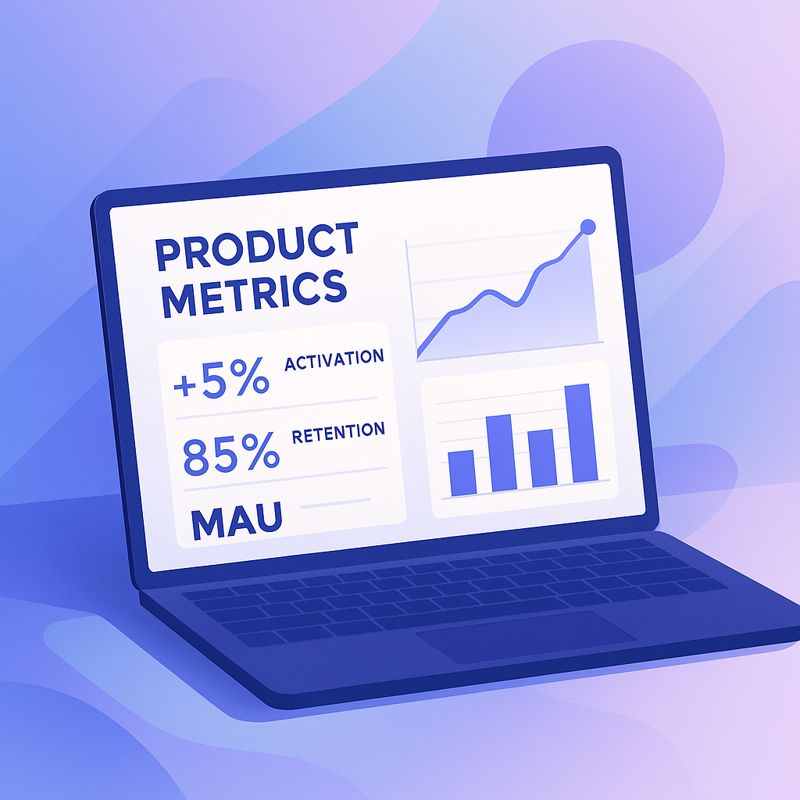
Metrics are the language of product management. They translate user behavior, business realities, and product performance into objective, actionable signals. In practice, they serve as the compass that tells a product manager whether their product is moving in the right direction, stagnating, or drifting into danger. Without metrics, decisions become guesswork. With good metrics, decision-making becomes a disciplined, structured, and evidence-based practice.
Peter Drucker famously said, “What gets measured gets managed.” In digital products, this principle is not just true — it’s foundational. Products evolve through countless experiments, iterations, and decisions. Every one of these steps is guided by a set of numbers that tell PMs how users behave, how the system performs, and how the business is growing. Whether you’re building a mobile app, a SaaS platform, or a consumer marketplace, metrics are what allow you to shift from assumptions to insights.
In this article, we’ll explore what metrics really are, why they matter, how they influence product strategy, and how they define success for product managers. This is the first article in a broader series that will dive deep into types of metrics, frameworks like HEART, and how to apply metrics in real-world scenarios.
1. What Are Metrics? A Clear Definition
If we strip away all the jargon, a metric is simply a measurable indicator that helps you understand what’s happening inside your product.
Metrics are quantifiable.
Metrics are observable.
Metrics are repeatable.
Metrics allow comparison over time.
In product management, metrics are often used interchangeably with the term KPIs — Key Performance Indicators. While KPIs usually represent the most important metrics your organization has committed to, the broader category of “metrics” includes everything you measure, analyze, and track to understand user behavior.
Metrics can answer essential questions such as:
- Are users finding value in the product?
- Are they returning?
- Are they completing the key actions you designed?
- Is the business model generating revenue?
- Where are users getting stuck or dropping off?
As soon as your product has users, metrics become a central source of truth.
2. Why Metrics Matter: The Foundation of Product Success
Metrics matter for three primary reasons:
a) They align the team around a common definition of success
Every product team has designers, engineers, marketers, analysts, stakeholders, and executives. Each of these individuals sees the product through a different lens. Metrics unify everyone around what the product should achieve.
For example:
If your team agrees the primary metric is activation rate, every discussion — onboarding, UI changes, technical improvements — connects back to increasing the number of users reaching activation.
Metrics are not just numbers; they are alignment tools.
b) They create feedback loops that drive improvement
Product management is, at its core, a continuous cycle:
Build → Measure → Learn → Improve
Metrics are the “Measure” part of this loop. Without them, you cannot learn effectively — and you certainly cannot improve intelligently.
The frequency and reliability of your feedback loops determine how fast and how effectively your product evolves.
Imagine wearing a fitness tracker:
- If it shows your steps accurately every day, you adjust behavior quickly.
- If it shows your data only once a month, it’s harder to stay consistent.
- If the data is inaccurate, your decisions might actually harm your results.
Product metrics work the same way. Accurate, frequent measurements lead to faster course correction and better outcomes.
c) They turn intuition into data-informed decisions
Great product managers use intuition, empathy, and vision. But these skills must be balanced with hard evidence.
When a PM says:
- “Users aren’t engaging with the new feature.”
- “The onboarding flow needs to be simplified.”
- “We’re losing users at the pricing page.”
These are hypotheses.
Metrics turn them into answers.
Metrics let you challenge assumptions and validate insights. They help you separate:
- what you believe is happening
- from what is actually happening
This prevents teams from wasting time building features nobody wants or optimizing parts of the product that do not impact outcomes.
3. Metrics in Product Management: Examples You See Everywhere
Every digital product uses metrics. Some common examples include:
- Monthly Active Users (MAU): How many people use your product each month.
- Returning Users: How many users keep coming back.
- Churn Rate: How many users stop using your product.
- App Store Reviews: Qualitative and quantitative sentiment.
- Social Mentions: Frequency and sentiment of posts on social networks.
These might look simple, but they carry deep insights. A change in one metric often ripples into many others. For instance, a sudden decrease in retention may hint at performance issues, bugs, competition, or lack of perceived value.
Well-designed metrics help PMs uncover root causes and respond quickly.
4. Metrics Are Not One-Size-Fits-All
One important nuance: the metrics you track depend on the type of product you manage, the stage of the product lifecycle, and the company strategy.
Different PM roles focus on different metrics
- A Growth PM will obsess over acquisition and activation.
- A Mobile PM will emphasize engagement and retention.
- A Platform PM may monitor API usage, uptime, and latency metrics.
- A Monetization PM will focus on revenue, conversion, and LTV.
Different product stages need different metrics
A brand-new app should focus on:
- new users
- activation
- onboarding completion
A mature SaaS platform should focus on:
- retention
- feature adoption
- revenue expansion
A monetizing mobile game might focus on:
- session frequency
- in-app purchases
- ads watched per session
Product managers must choose metrics that align with the product stage and company goals. Measuring the wrong things is almost as bad as measuring nothing at all.
5. Metrics Define Success for Product Managers
If you ask, “How do you evaluate a product manager’s performance?” the answer inevitably involves metrics.
PMs are accountable for moving the needle.
They do not write code.
They do not design the UI.
They do not run marketing campaigns.
But they orchestrate the strategy, decisions, and priorities that shape the product.
A product manager’s success is often linked to whether the product:
- grows its user base
- increases retention
- boosts engagement
- improves user satisfaction
- meets revenue targets
This is why PMs become, over time, experts in data interpretation. Their role revolves around identifying the right metrics, understanding why they move, and designing product strategies to influence them.
Metrics do not replace leadership or creativity — they amplify them.
6. Metrics Help You Manage Tradeoffs
Products are full of tradeoffs:
- Should you prioritize increasing new users or improving retention?
- Should you optimize for engagement or monetization?
- Should you add more features or simplify what already exists?
Metrics help resolve these tensions.
For example:
If your product sees high acquisition but poor retention, doubling down on marketing will not help — your onboarding and core value delivery need work. Metrics expose these mismatches.
In this sense, metrics help PMs answer the most important strategic question:
“Where should we focus next?”
7. Metrics Enable Predictability and Strategic Planning
Executives and stakeholders care deeply about predictability. They want to know:
- Where will the product be in six months?
- What is the expected growth?
- What revenue trajectory should they plan for?
Metrics allow PMs to forecast trends and outcomes.
For example:
- If your monthly growth rate is +10%, you can model different growth scenarios.
- If churn spikes, you can estimate future losses and prioritize retention improvements.
- If activation increases, you can predict improvements in long-term revenue.
Metrics turn product planning into a reliable, strategic discipline aligned with business goals.
8. The Role of Good Judgment in Metrics
One misconception is that metrics alone will tell you everything. That’s not true.
Metrics inform decisions — but they do not make decisions.
Two PMs may look at the same dashboard and come to different conclusions.
Good PMs interpret metrics with:
- context
- empathy
- product intuition
- user understanding
- competitive awareness
Metrics provide visibility, but PMs provide meaning.
9. The Risks of Poor or Misleading Metrics
Not all metrics are good metrics.
Some metrics look impressive but are completely useless for decision-making. These are known as vanity metrics, and they can mislead teams if not handled carefully.
Examples:
- Raw number of app downloads (without activation)
- Total pageviews (without session depth or conversion)
- Number of followers (without engagement)
Good metrics must be:
- actionable
- interpretable
- tied to behavior
- linked to business outcomes
You will learn more about this in the article “How to Pick Good Metrics.”
10. Conclusion: Metrics Are the Engine of Product Management
Product management is an intricate blend of creativity, leadership, strategy, and analysis. Metrics bring clarity to this complexity. They give teams the evidence they need to make good decisions, detect issues, validate hypotheses, and steer the product toward success.
To summarize:
- Metrics show what’s happening inside your product.
- Metrics define success and guide product decisions.
- Good metrics create fast, accurate feedback loops.
- Different PM roles and product stages require different metrics.
- Metrics help prioritize, plan, and align your organization.
More than numbers, metrics are the narrative of your product’s evolution. They tell the story of how users behave, how value is delivered, and how the product grows.
In the next article of this series, we’ll explore how the world’s most successful tech companies use metrics — and what you can learn from Twitter, YouTube, Facebook, and others when designing your own measurement strategy.
You may also like: Real-World Metrics: How Leading Tech Companies Track Growth and Engagement
Reach a global audience of portfolio, program, and project managers, product leaders, and certification professionals. Explore advertising opportunities .
Sponsored