
Metrics are everywhere in product management—but meaningful metrics are rare. Teams often measure what is easy instead of what is important, track vanity numbers that don’t drive decisions, or rely on fragmented KPIs that fail to tell a coherent story.
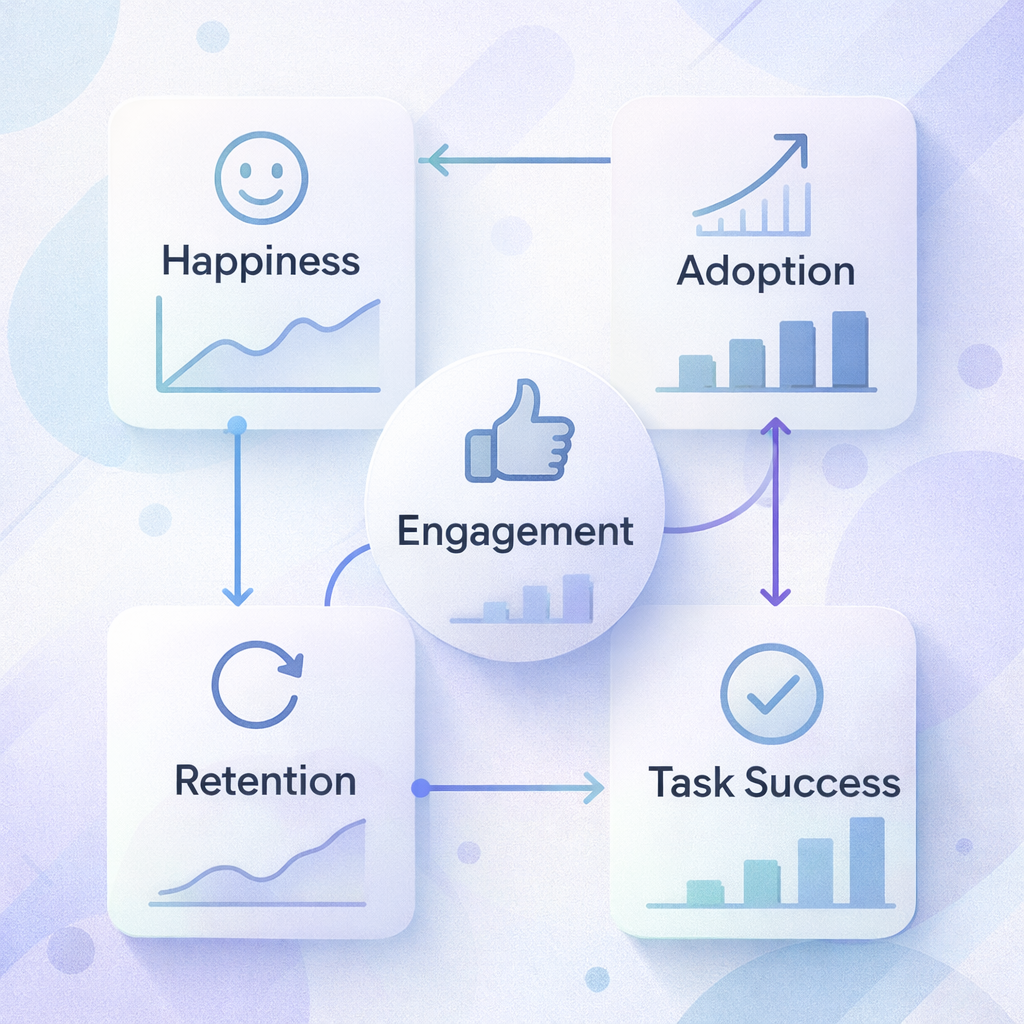
This is why frameworks matter. And among all metric frameworks, HEART stands out as one of the most practical, intuitive, and impactful. Originally developed at Google, the HEART framework offers a structured way to measure user experience and product performance through five lenses: Happiness, Engagement, Adoption, Retention, and Task Success.
In Article 5, we explored what HEART is and how to implement it.
In this article we will explore why the HEART framework works so well, and how you can apply it in complex real-world environments.
We will look at the underlying psychology, operational advantages, and strategic benefits that make HEART more than just a metric taxonomy—it’s a mindset shift in how teams approach product development.
1. HEART Solves the Biggest Problem in Product Metrics: Overcomplication
Product managers have access to too much data today.
Countless dashboards.
Real-time charts.
Behavioral analytics.
Funnel reports.
Heatmaps.
Most teams drown in data and starve for insights.
The HEART framework works because it fights unnecessary complexity. It forces teams to look at only five dimensions, which are broad enough to capture the entire user journey yet specific enough to shape metrics that matter.
HEART gives structure to the chaos.
It organizes a universe of potential signals into a small number of meaningful categories.
This simplicity prevents two common problems:
Problem 1: Tracking too many metrics
Teams often track 30–40 metrics and don’t know which ones matter.
Problem 2: Tracking the wrong metrics
Teams focus on pageviews, downloads, impressions—numbers that don’t reflect value or behavioral change.
HEART eliminates both problems by establishing a disciplined framework.
2. HEART Is User-Centered, Not Business-Centered
Most metric frameworks focus on:
- revenue
- conversion
- cost
- operational efficiency
- technical performance
These are important, but they reflect business success, not user success.
HEART flips this logic.
It measures the user’s experience first:
- Are they satisfied? (Happiness)
- Are they participating? (Engagement)
- Are they joining? (Adoption)
- Are they returning? (Retention)
- Are they accomplishing their goals? (Task Success)
Business success emerges from user success.
This is a powerful concept:
If the user’s experience improves across HEART dimensions, revenue will follow.
HEART helps PMs make decisions rooted in user value, not internal assumptions.
3. HEART Works at Any Product Stage
Not all products are at the same maturity level, and most metric frameworks fail because they assume a stable, scale-ready product.
HEART works for:
Early-Stage Products (MVP / Beta / Launch)
Focus on:
- Adoption
- Task Success
- Initial Engagement
At this stage, retention and happiness matter, but understanding whether users can complete the core task is far more important.
Growth-Stage Products
Focus on:
- Engagement
- Retention
- Happiness
Products with traction need to confirm they deliver long-term value.
Mature Products
Focus on:
- Retention
- Happiness
- Engagement depth
- Feature-level adoption
HEART accommodates this evolution naturally.
4. HEART Works at Multiple Levels: Company, Product, Feature, Flow
Another reason HEART works: it is hierarchical and scalable.
Company Level
Leadership may set HEART metrics for the entire product ecosystem.
Product Level
Product teams define HEART metrics for their domain.
Feature Level
HEART works perfectly when launching a new feature:
- Happiness → satisfaction with the feature
- Engagement → frequency of use
- Adoption → number of new users trying the feature
- Retention → returning users
- Task Success → does the feature work well?
Flow Level
Even specific flows—checkout, onboarding, search—can use HEART.
Few frameworks scale this naturally.
5. HEART Encourages Balanced Decision-Making
Teams often over-index on a narrow set of metrics:
- Marketing → growth
- Product → engagement
- Design → task success
- Support → happiness
HEART prevents single-metric blind spots.
For example:
- A product might have high adoption but low task success.
- A product might have high engagement but low happiness.
- A product might have high retention but low adoption.
HEART reveals imbalances clearly.
It pushes teams to see the full picture of user experience holistically.
6. HEART Creates a Universal Language Across Functions
Communicating metrics is notoriously difficult.
Designers speak one language.
Engineers another.
Executives another.
Data teams yet another.
HEART solves this by creating a shared framework that everyone can understand.
When you say:
- “Engagement is rising,” or
- “Retention is dropping,” or
- “Task Success is improving,”
everyone knows what that means—even if they don’t know the specific metric.
HEART becomes a shared mental model across the organization, improving collaboration and alignment.
7. HEART Works Perfectly with Goals → Signals → Metrics
This structure is one of the most powerful parts of the framework.
Goals
Define the desired outcome.
Signals
Identify the behaviors that indicate progress.
Metrics
Measure those behaviors over time.
This linear structure:
- prevents teams from jumping into metrics prematurely
- ensures metrics reflect real goals
- builds discipline and clarity
- supports better analytics instrumentation
Teams that adopt HEART often realize they’ve been collecting metrics without clear signals or goals. HEART fixes that.
8. HEART Bridges the Gap Between Qualitative and Quantitative Data
Most frameworks focus heavily on numbers, but HEART includes Happiness, which captures sentiment.
This allows HEART to integrate:
Quantitative Data
- retention
- engagement
- adoption
- task completion
Qualitative Data
- NPS
- satisfaction
- user feedback
This combination:
- identifies issues faster
- helps PMs detect emotional friction points
- provides context for behavioral changes
For example:
A drop in retention might not reveal why, but a drop in happiness gives you a clue.
9. HEART Prevents Vanity Metrics From Dominating Dashboards
Because it forces teams to classify metrics into five categories with explicit goals and signals, HEART naturally avoids:
- number of downloads
- number of pageviews
- total impressions
- likes without context
These metrics may look impressive but reveal little about value.
HEART metrics are:
- tied to goals
- tied to user experience
- tied to meaningful outcomes
This makes them powerful and trustworthy.
10. HEART Is Flexible Enough to Evolve Over Time
Unlike rigid metric frameworks, HEART can evolve as:
- the product evolves
- the business model changes
- the user base shifts
- the competitive landscape changes
You can:
- add new signals
- modify metrics
- adjust goals
- focus on different HEART dimensions at different times
HEART grows with the product.
11. HEART Supports Better Prioritization and Roadmapping
When teams understand:
- where happiness is lacking
- where adoption is weak
- where engagement is low
- where retention is declining
- where task success is failing
They can make strategically sound decisions about:
- what to build
- what to refine
- what to fix
- what to deprioritize
HEART guides roadmaps through user-centered evidence, not gut feeling.
12. Conclusion: HEART Is Powerful Because It Makes Metrics Human
The HEART framework succeeds because it brings humanity to product measurement. It doesn’t just ask:
“What is happening?”
It asks:
“How do users feel?”
“Are they engaged?”
“Are they succeeding?”
“Are they returning?”
“Are they adopting?”
These questions reflect the true heartbeat of a product.
In a world where product teams can measure almost anything, HEART gives PMs a structured way to measure what truly matters.
It remains one of the most valuable frameworks in the product manager’s toolkit—simple enough to understand, flexible enough to scale, and powerful enough to shape the future of any product.
You may also like: Using the AARRR (Pirate) Metrics Framework
Reach a global audience of portfolio, program, and project managers, product leaders, and certification professionals. Explore advertising opportunities .
Sponsored