
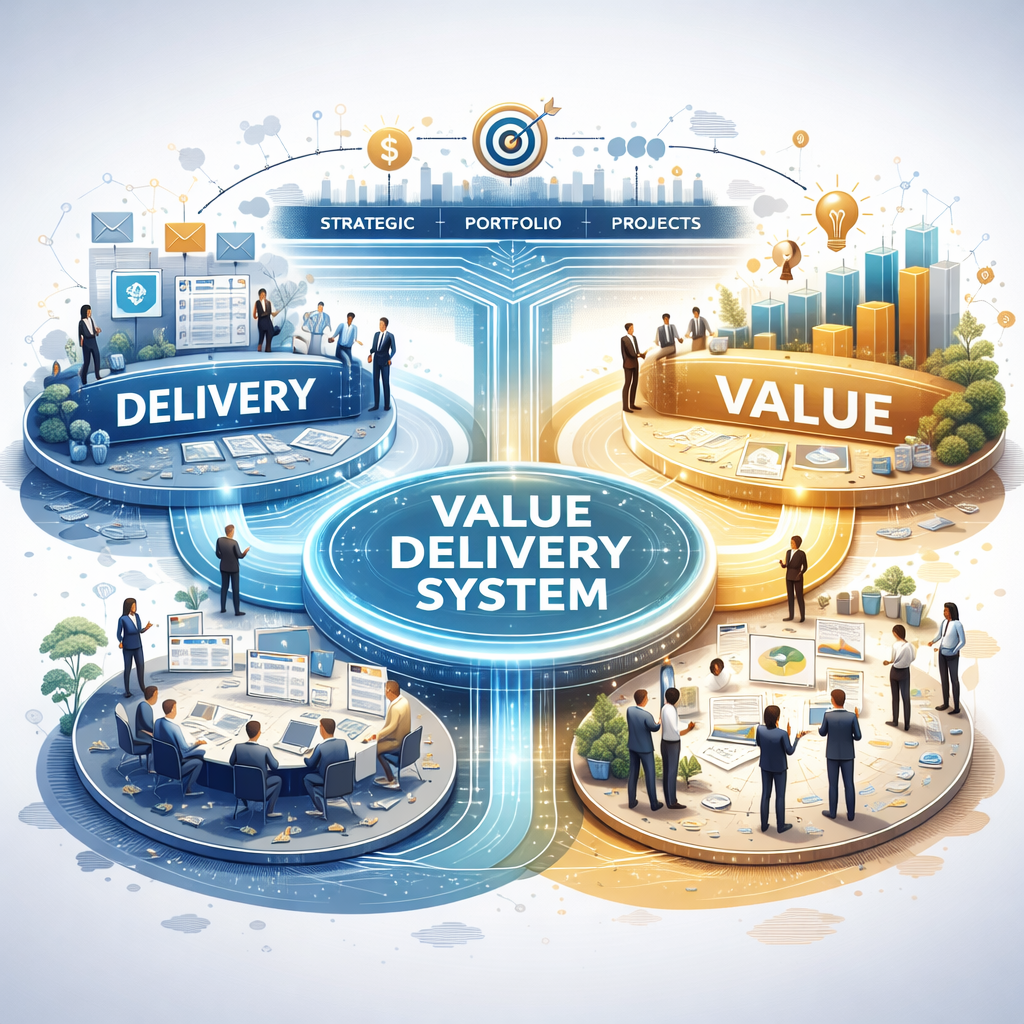
How the PMBOK 7 Value Delivery System Reframes the Meaning of Project Success
For decades, organizations have invested heavily in projects, programs, and transformations under a shared assumption: if we deliver well, value will follow.
Schedules are optimized.
Budgets are controlled.
Scopes are negotiated.
Governance mechanisms are reinforced.
Yet, despite increasingly sophisticated delivery practices, many organizations struggle to answer a deceptively simple question:
Where is the value?
The seventh edition of the PMBOK® Guide represents a decisive break from this historical assumption. Instead of treating projects as isolated delivery mechanisms, PMBOK 7 introduces a broader and more demanding perspective: the Value Delivery System.
This article explores what that shift truly means, why it matters, and how it challenges long-standing beliefs about success in project, product, and transformation environments.
The Structural Limitation of Delivery-Centric Thinking
Traditional project management frameworks were built in an era where predictability was achievable and environments were relatively stable. In such contexts, controlling scope, time, and cost was often sufficient to generate benefits.
However, as organizations became more digital, interconnected, and adaptive, this delivery-centric model revealed its limitations.
Projects began to succeed operationally while failing strategically. Systems were delivered on time but underused. Transformations were completed yet produced little behavioral change. Portfolios grew larger, but organizational impact remained stubbornly flat.
The core problem was not execution quality. It was the assumption that delivery equals value.
PMBOK 7 explicitly rejects this assumption.
Introducing the Value Delivery System
The Value Delivery System reframes the role of projects entirely.
Rather than positioning projects as the endpoint of value creation, PMBOK 7 places them within a continuous system that includes:
- organizational strategy,
- portfolios and products,
- governance structures,
- enabling capabilities,
- and, critically, benefit realization.
Projects are no longer the goal. They are vehicles.
Value, in this model, is defined not by outputs delivered, but by outcomes and benefits realized over time, in alignment with strategic intent.
This shift may appear subtle, but its implications are profound.
Value as a Flow, Not an Event
One of the most important conceptual changes introduced by PMBOK 7 is the idea that value is dynamic and emergent, not static or transactional.
Value does not occur at project closure.
It unfolds through usage, adoption, and sustained change.
This aligns closely with Benefit Realisation Management, which emphasizes that benefits:
- are owned by the business, not the project,
- often materialize after delivery,
- depend on behavioral and operational change,
- and require continuous monitoring and adjustment.
By integrating BRM concepts into the Value Delivery System, PMBOK 7 closes a long-standing gap between delivery and impact.
Repositioning the Role of the Project Manager
In a delivery-centric model, project managers are primarily accountable for execution efficiency.
In a value-centric model, their role expands.
Project leaders become:
- contributors to value hypotheses,
- facilitators of outcome ownership,
- participants in benefit tracking conversations,
- and partners in strategic sense-making.
This does not mean project managers suddenly own value realization. That responsibility remains with sponsors and the organization. But it does mean that projects can no longer operate in isolation from value discussions.
Execution without context becomes a liability.
Governance as a Value Enabler, Not a Control Mechanism
The Value Delivery System also redefines governance.
Traditional governance often focuses on:
- approval gates,
- compliance with plans,
- variance control,
- and risk containment.
PMBOK 7 encourages a different stance: governance as stewardship of value.
This means governance bodies are expected to ask:
- Are the expected benefits still relevant?
- What evidence do we have that outcomes are emerging?
- What assumptions are being tested?
- What should change based on what we now know?
Governance shifts from enforcing certainty to managing uncertainty responsibly.
Connecting Strategy, Portfolio, and Delivery
A critical strength of the Value Delivery System is its emphasis on alignment across layers.
Strategy defines intended value.
Portfolios prioritize investments that best support that intent.
Products and programs shape ongoing capabilities.
Projects deliver enabling components.
When these layers are disconnected, value leaks occur.
PMBOK 7 does not prescribe a single methodology, but it insists on coherence. Delivery choices must be traceable to strategic objectives, and success must be evaluated in terms of contribution to those objectives—not merely task completion.
This perspective is especially relevant in hybrid environments where agile, predictive, and operational work coexist.
Why This Shift Is So Difficult in Practice
Despite its conceptual clarity, adopting a value delivery mindset is challenging.
Organizations struggle because:
- value is harder to measure than outputs,
- accountability becomes distributed,
- success criteria evolve over time,
- and learning introduces discomfort.
Many organizations continue to declare success at delivery because it feels safer. It produces closure. It allows teams to move on without confronting whether anything truly changed.
PMBOK 7 removes that comfort.
It demands that organizations stay engaged with the consequences of their decisions long after delivery ends.
The Silent Impact on Portfolio Decisions
Perhaps the most underestimated implication of the Value Delivery System is its effect on portfolio management.
When value becomes the central lens, portfolios must be actively optimized—not just balanced.
This requires:
- stopping low-value initiatives early,
- reallocating funding dynamically,
- comparing initiatives based on marginal value contribution,
- and acknowledging opportunity cost explicitly.
In this context, cancelling a project can be a sign of maturity, not failure.
Value Delivery as an Organizational Capability
Ultimately, PMBOK 7 positions value delivery not as a project discipline, but as an organizational capability.
It emerges from:
- leadership behavior,
- governance design,
- incentive structures,
- measurement systems,
- and cultural attitudes toward learning.
Projects contribute to this capability, but they cannot substitute for it.
Organizations that adopt the Value Delivery System superficially—without changing how decisions are made—will see little benefit. Those that internalize it will fundamentally alter how they invest, prioritize, and adapt.
Closing Reflection
The PMBOK 7 Value Delivery System does not offer a new set of tools. It offers a new responsibility.
It asks organizations to stop hiding behind delivery success and start confronting value reality.
In a world defined by complexity, uncertainty, and continuous change, the question is no longer whether projects are delivered efficiently.
The real question is whether organizations are designed to turn delivery into value.
In the next article of this series, we will explore how Benefit Realisation Management operationalizes the Value Delivery System, turning principles into concrete practices and decision frameworks.
That is where value stops being an aspiration—and becomes a discipline.
Reach a global audience of portfolio, program, and project managers, product leaders, and certification professionals. Explore advertising opportunities .
Sponsored