
How Benefit Realisation Management Turns the PMBOK 7 Value Delivery System into Action
In the first article of this series, we explored how the PMBOK® Guide Seventh Edition reframes project success through the Value Delivery System, shifting the focus from delivery efficiency to value creation. That shift, however, raises an unavoidable question:
If value is not created at delivery, how is it actually realized?
This is where many organizations struggle. They understand the concept of value but lack a concrete discipline to manage it. They acknowledge that outcomes matter, yet they continue to operate as if delivery were the finish line.
Benefit Realisation Management (BRM) exists precisely to close this gap. It is the operational backbone that transforms the Value Delivery System from an aspirational model into a practical, decision-oriented capability.
Why Value Delivery Without BRM Remains Incomplete
The Value Delivery System defines what organizations should care about. BRM defines how they do it.
Without BRM, organizations tend to:
- define benefits vaguely,
- assume benefits will “emerge naturally” after delivery,
- delegate value realization implicitly,
- and stop measuring success once outputs are produced.
In such environments, value remains an expectation rather than a managed outcome.
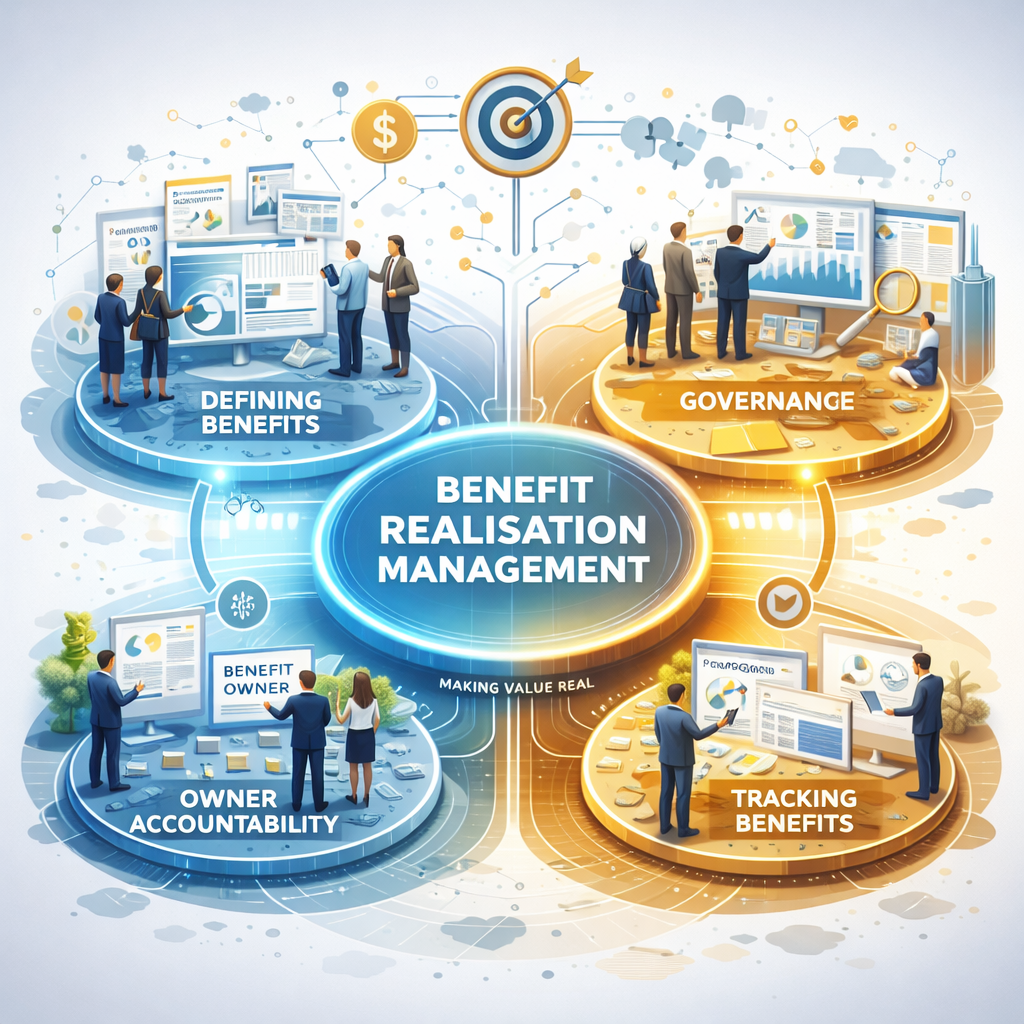
BRM introduces discipline where hope often substitutes for accountability. It forces organizations to explicitly define, track, and govern benefits across the full lifecycle of change.
The Core Principle of Benefit Realisation Management
At its core, BRM is built on a simple but disruptive principle:
Benefits do not belong to projects. They belong to the organization.
Projects deliver capabilities.
Benefits emerge when those capabilities are used effectively.
Usage depends on behavior, adoption, incentives, and operating models.
This distinction reshapes responsibility. Project teams are accountable for delivery quality, but business leaders are accountable for realizing benefits. BRM creates the bridge between these roles.
From Outputs to Benefits: Making the Causal Chain Explicit
One of the most valuable contributions of BRM is its insistence on making causal relationships explicit.
Rather than stopping at “what will be delivered,” BRM asks:
- What benefit is expected?
- Through which outcome?
- Enabled by which capability?
- Dependent on which behavioral change?
- Owned by whom?
This causal chain transforms abstract benefits into testable hypotheses. It also exposes weak assumptions early—before organizations commit years of effort and capital.
Benefits that cannot be causally linked to outcomes and behaviors are not benefits. They are aspirations.
Benefit Profiles: Turning Intent into Accountability
A key BRM artifact is the benefit profile.
A benefit profile typically clarifies:
- the nature of the benefit (financial, operational, strategic, experiential),
- how it will be measured,
- when it is expected to materialize,
- who owns it,
- and what risks threaten its realization.
More importantly, it creates explicit ownership.
When benefits are named, described, measured, and owned, they stop being abstract promises and become management commitments.
This single shift often reveals why value fails: many benefits have never had a real owner.
Benefits Do Not Appear at Project Closure
One of the most damaging misconceptions in delivery-centric cultures is the belief that benefits are realized when a project ends.
In reality, benefit realization often:
- begins after delivery,
- unfolds gradually,
- depends on reinforcement and adaptation,
- and may require additional investment.
BRM extends the lifecycle of accountability beyond project closure. It recognizes that value realization is an ongoing process, not an event.
Organizations that close projects without a benefit realization plan are effectively declaring success before value exists.
Integrating BRM into Governance and Decision-Making
BRM is not a reporting exercise. It is a governance mechanism.
When integrated properly, BRM reshapes decision-making by:
- informing investment prioritization,
- guiding incremental funding,
- enabling early termination of low-value initiatives,
- and supporting evidence-based governance.
Instead of asking whether a project is on time and on budget, governance forums begin asking:
- Are expected benefits still relevant?
- Are leading indicators moving?
- What evidence do we have of emerging outcomes?
- Should we continue, adapt, or stop?
This reframes governance from control to stewardship.
Portfolio-Level Benefits Thinking
BRM becomes particularly powerful at the portfolio level.
Rather than managing portfolios as collections of initiatives, organizations begin managing them as collections of benefits and value hypotheses.
This enables:
- comparison of initiatives based on value contribution,
- explicit discussion of opportunity cost,
- dynamic reallocation of funding,
- and clearer alignment with strategic objectives.
In this context, cancelling a project is not a failure—it is a rational value decision.
Why BRM Is Culturally Challenging
Despite its clarity, BRM is difficult to implement because it challenges deeply embedded organizational behaviors.
It:
- disrupts siloed accountability,
- exposes weak assumptions,
- demands cross-functional collaboration,
- and requires leaders to stay accountable after delivery.
BRM replaces comfortable narratives of success with measurable reality. For organizations accustomed to celebrating delivery milestones, this can feel threatening.
But discomfort is often a signal of maturity.
BRM as a Continuous Learning Discipline
The most mature organizations treat BRM as a learning system, not a control framework.
They use benefit tracking to:
- validate assumptions,
- adapt initiatives,
- refine strategy,
- and improve future investment decisions.
Benefits are not merely tracked—they are questioned, redefined, and sometimes abandoned as context evolves.
This transforms BRM into a feedback mechanism that continuously improves the Value Delivery System.
Aligning BRM with PMBOK 7 Principles
BRM aligns naturally with PMBOK 7’s principle-based approach.
It reinforces:
- value-focused thinking,
- stakeholder engagement,
- systems thinking,
- adaptability,
- and accountability.
Rather than prescribing processes, BRM provides structure for better conversations—about value, trade-offs, and learning.
Closing Reflection
The Value Delivery System defines the ambition: to move beyond delivery and focus on value.
Benefit Realisation Management provides the discipline to make that ambition real.
Organizations that adopt PMBOK 7 without BRM will understand value conceptually but struggle to realize it. Organizations that integrate BRM into governance, portfolios, and leadership behavior will transform value from an aspiration into an operational capability.
In the next article of this series, we will explore how value, governance, and measurement come together at the portfolio and board level, completing the transition from delivery-centric thinking to true value stewardship.
That is where strategy stops being declared—and starts being realized.
Reach a global audience of portfolio, program, and project managers, product leaders, and certification professionals. Explore advertising opportunities .
Sponsored