
How to Manage Benefits Without Drowning in Documents
One of the most common reactions executives and delivery leaders have when Benefit Realisation Management (BRM) is introduced is resistance disguised as pragmatism. “We already have too many documents.” “This will slow us down.” “We don’t want another layer of governance.” These concerns are understandable, especially in organizations that have lived through heavyweight PMOs or compliance-driven transformation programs.
Yet this reaction often misses a critical point: BRM does not fail because it introduces documentation. It fails when organizations mistake documentation for bureaucracy instead of decision support. The problem is not that there are too many artifacts, but that most organizations do not know which ones actually matter, how they should evolve, and—most importantly—what decisions they are meant to enable.
At its core, BRM is not about producing documents. It is about creating shared clarity around why change exists, what value it is expected to generate, and how that value will be sustained over time. The artifacts are simply the visible expressions of that clarity.
The Blueprint as a Value Alignment Tool
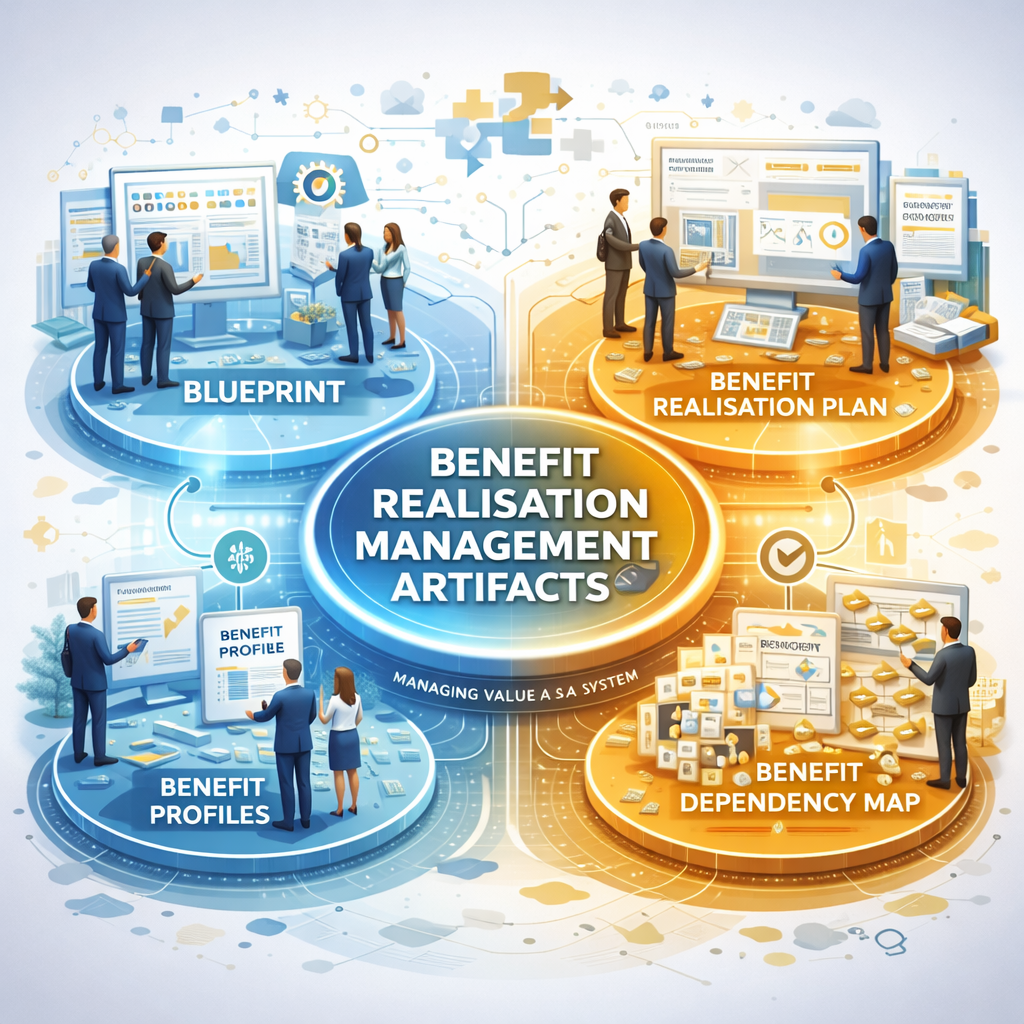
The first and most misunderstood artifact is the Blueprint. Many organizations associate blueprints with architecture diagrams or future-state org charts, but within BRM the Blueprint plays a much broader role. It represents a coherent description of the future business environment required to deliver the intended benefits. This includes changes in processes, roles, behaviors, information flows, and technology.
More importantly, the Blueprint is not static. It evolves as understanding deepens, assumptions are tested, and constraints emerge. Its true value lies in alignment. It connects strategy to execution and ensures that individual initiatives are not optimized in isolation.
Without a Blueprint, projects and products may deliver successfully on their own terms while collectively failing to move the organization toward its strategic objectives. In practice, organizations do not need a perfect Blueprint upfront. What they need is a credible, shared view of the future that can guide investment decisions and evolve through learning.
Why the Benefit Realisation Plan Is the Real Control Mechanism
Closely connected to the Blueprint is the Benefit Realisation Plan (BRP), which is arguably the heart of BRM. While strategies articulate intent, the BRP operationalizes value. It defines which benefits are expected, how they will be measured, when they should materialize, and who is accountable for realizing them.
This is where many organizations struggle, because the BRP forces uncomfortable conversations about ownership and outcomes. A well-constructed BRP does not attempt to predict the future with false precision. Instead, it establishes benefit trajectories—directional expectations that can be refined as evidence emerges.
Crucially, the BRP is not a project artifact. It survives beyond project closure and continues into business-as-usual operations. This continuity is what differentiates organizations that merely deliver change from those that actually capture value. When BRPs are archived at go-live, benefits almost inevitably decay.
Benefit Profiles and the Shift from Responsibility to Accountability
Supporting the BRP are Benefit Profiles, which provide depth without overwhelming the system. A Benefit Profile describes a single benefit in sufficient detail to make it actionable. It clarifies what the benefit is, why it matters, how it will be measured, when it is expected to emerge, and—most importantly—who owns it.
The power of Benefit Profiles lies in accountability. By assigning explicit ownership, organizations move benefits out of abstract strategy documents and into managerial reality. This is often where cultural resistance surfaces, as benefit ownership frequently cuts across traditional reporting lines.
Yet this discomfort is precisely what makes BRM effective. Value realization rarely fits neatly within organizational silos, and Benefit Profiles make that tension visible instead of hiding it.
Making Assumptions Visible with the Benefit Dependency Map
Another critical artifact is the Benefit Dependency Map (BDM), often underutilized or misunderstood. The BDM visualizes the causal relationships between initiatives, enabling capabilities, business changes, and benefits. It answers a deceptively simple question: what needs to change for this benefit to exist?
By making dependencies explicit, the BDM exposes hidden assumptions and sequencing risks that traditional plans overlook. It reveals where benefits depend on adoption, behavior change, or complementary initiatives that may sit outside a single project’s control.
In environments with multiple concurrent initiatives, the BDM becomes especially valuable. It helps leaders understand how delays or failures in one area ripple across the benefit landscape and supports more intelligent prioritization decisions.
Benefit Tracking as a Governance Conversation, Not a Status Report
While the previous artifacts focus on planning and alignment, Benefit Tracking Reports ensure that value realization remains visible over time. Unlike traditional project status reports, benefit tracking shifts the conversation from activity to impact.
Its purpose is not to punish teams for variance, but to support governance. When benefits underperform, leaders need to understand why. Is adoption lagging? Were assumptions flawed? Has the operating environment changed?
Effective benefit tracking focuses on a small number of meaningful measures tied directly to strategic objectives. Over-measurement can be as damaging as under-measurement, creating noise instead of insight.
BRM Artifacts as a System, Not a Toolkit
One of the most important insights from mature BRM implementations is that these artifacts do not work in isolation. They form a system. The Blueprint informs the BRP. The BRP is decomposed into Benefit Profiles. Benefit Profiles are connected through the BDM. Benefit Tracking feeds learning back into all of them.
When organizations treat these artifacts as templates to be filled, BRM becomes mechanical. When treated as an integrated management system, it becomes transformative.
This systems view also clarifies what BRM is not. It is not a documentation layer on top of Agile, product management, or portfolio management. Instead, it provides a value-oriented spine that allows these approaches to coexist coherently.
From “Done” to Sustained Performance
Perhaps the most important shift enabled by BRM artifacts is temporal. Traditional delivery focuses on getting to “done.” BRM reframes success as sustained performance after delivery.
This challenges deeply ingrained habits, but it is essential in environments where competitive advantage depends on continuous adaptation rather than one-off transformation. Organizations that succeed with BRM do not start by perfecting artifacts. They start by clarifying intent, simplifying language, and using documents as conversation tools rather than compliance outputs.
Looking Ahead: From Artifacts to Accountability
As we move forward in this series, the focus shifts from artifacts to accountability. In the next article, we will explore how governance structures, ownership models, and decision rights must evolve to support real value realization.
Without these elements, even the best-designed BRM artifacts risk becoming elegant descriptions of unrealized potential.
Reach a global audience of portfolio, program, and project managers, product leaders, and certification professionals. Explore advertising opportunities .
Sponsored