
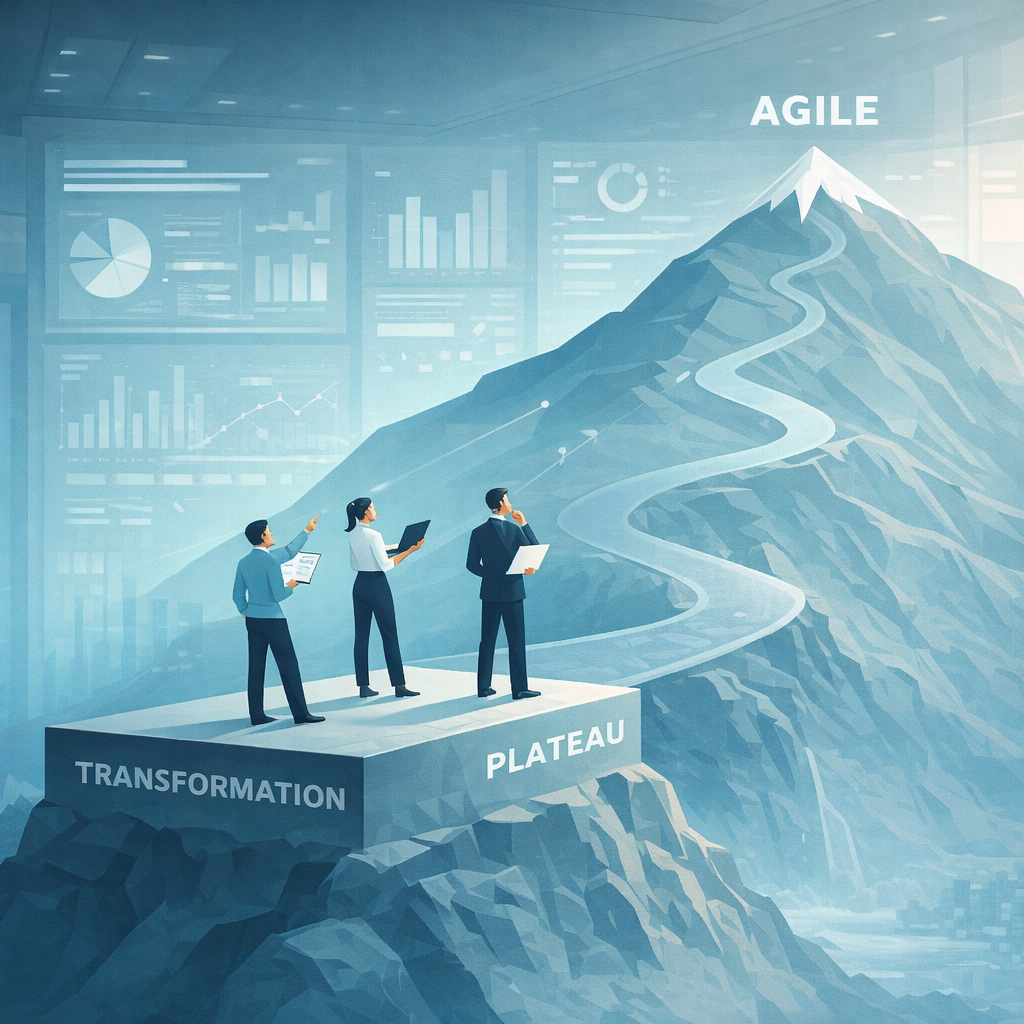
For more than a decade, organizations around the world have invested heavily in Agile transformation. They adopted Scrum. They hired coaches. They trained Product Owners. They reorganized into squads.
Yet many of them remain stuck.
Not because Agile does not work — but because their operating model never changed.
This is the silent crisis behind modern digital transformation: the illusion of progress without systemic alignment.
The Transformation Plateau
Many organizations move beyond waterfall. They introduce sprints, backlogs, stand-ups, and reviews. Teams start delivering more frequently. Vocabulary changes.
But behaviors do not.
What emerges is a “Sometimes Agile” environment:
- Sometimes decisions are evidence-based.
- Sometimes outcomes matter more than outputs.
- Sometimes leadership empowers teams.
- Sometimes.
This partial adoption creates what I call the Transformation Plateau — a state where organizations look Agile, speak Agile, and report Agile metrics… yet fail to achieve consistent business impact.
The problem is not capability.
It is systemic inconsistency.
Activity Is Not Maturity
In plateaued organizations, there is a lot of movement:
- Features are delivered.
- Roadmaps are updated.
- Sprint metrics are reported.
- OKRs are written.
But delivery rhythm does not equal strategic coherence.
Agile rituals without an aligned operating model produce local optimization. Teams improve their flow, but the enterprise does not improve its value realization.
The result?
- Conflicting roadmaps
- Competing priorities
- Fragmented portfolio decisions
- Leadership misalignment
- “Innovation theater”
Agile becomes a productivity layer on top of a traditional governance structure.
And governance always wins.
The Real Problem: The Operating Model
Most organizations treat Agile as a delivery methodology problem.
It is not.
It is an operating model problem.
An effective Agile Product Operating Model requires alignment across:
- Strategy
- Portfolio governance
- Funding mechanisms
- Leadership behavior
- Incentives
- Measurement systems
- Organizational structure
- Cultural norms
If any of these remain anchored in traditional command-and-control logic, Agile practices will eventually revert to compliance theater.
You cannot install agility into a system designed for predictability and control.
The Consistency Crisis
One of the most revealing patterns across organizations is not lack of adoption — it is lack of consistency.
Agile is applied situationally, not systematically.
Teams experiment — but only when convenient.
Leaders empower — but only under low risk.
Outcomes matter — but only in presentations.
This creates a dangerous illusion:
Progress appears real, because improvement happens locally.
But systemic maturity requires consistency across:
- Decision-making
- Prioritization
- Leadership behaviors
- Funding allocation
- Portfolio trade-offs
Without consistency, agility becomes episodic rather than structural.
And episodic agility cannot scale.
Why the Middle Layer Breaks the System
A recurring pattern in stalled transformations is the “missing middle.”
Executive teams may declare product-centric goals.
Delivery teams may embrace Agile principles.
But middle management often remains measured on utilization, predictability, and budget control.
When incentives remain industrial, behavior remains industrial.
Transformation stalls not because teams resist — but because the operating system of management was never rewritten.
Value vs. Features: The Strategic Tension
At the heart of the plateau lies a fundamental tension:
Are we optimizing for feature delivery — or for value creation?
Many organizations still treat product development as a cost center.
In that model:
- Roadmaps are commitments.
- Budget is fixed.
- Scope reduction is failure.
- Speed is confused with impact.
A value-first operating model reframes everything:
- Funding supports outcomes, not projects.
- Experimentation is a capability, not a risk.
- Portfolio decisions are dynamic.
- Success is measured by value realization, not output volume.
Without this shift, Agile becomes a faster way to build the wrong things.
The Governance Paradox
Ironically, many organizations try to “control” Agile through additional oversight.
More reporting.
More stage gates.
More alignment meetings.
But true alignment does not emerge from control — it emerges from shared principles and consistent measurement of value.
Evidence-Based Management is not about metrics dashboards.
It is about embedding learning loops into the operating model.
Governance should not restrict agility.
It should amplify it.
Moving Beyond the Illusion
Breaking the Transformation Plateau requires three structural shifts:
1. From Ritual Adoption to Systemic Alignment
Agile must extend beyond teams into strategy, funding, and governance.
2. From Feature Metrics to Outcome Metrics
Measure value creation, not output delivery.
3. From Situational Practice to Default Behavior
Agility must become the standard mode of operation, not an exception.
Consistency is the real maturity milestone.
Final Reflection
Agile did not fail.
Frameworks did not fail.
Training did not fail.
Organizations fail when they try to graft agility onto a traditional operating model.
If the system does not change, the behavior will not change.
And if behavior does not change, outcomes will not change.
The real transformation challenge is not implementing Scrum.
It is redesigning the operating model for complexity.
Agility is not a process upgrade.
It is a structural decision.
Reach a global audience of portfolio, program, and project managers, product leaders, and certification professionals. Explore advertising opportunities .
Sponsored