
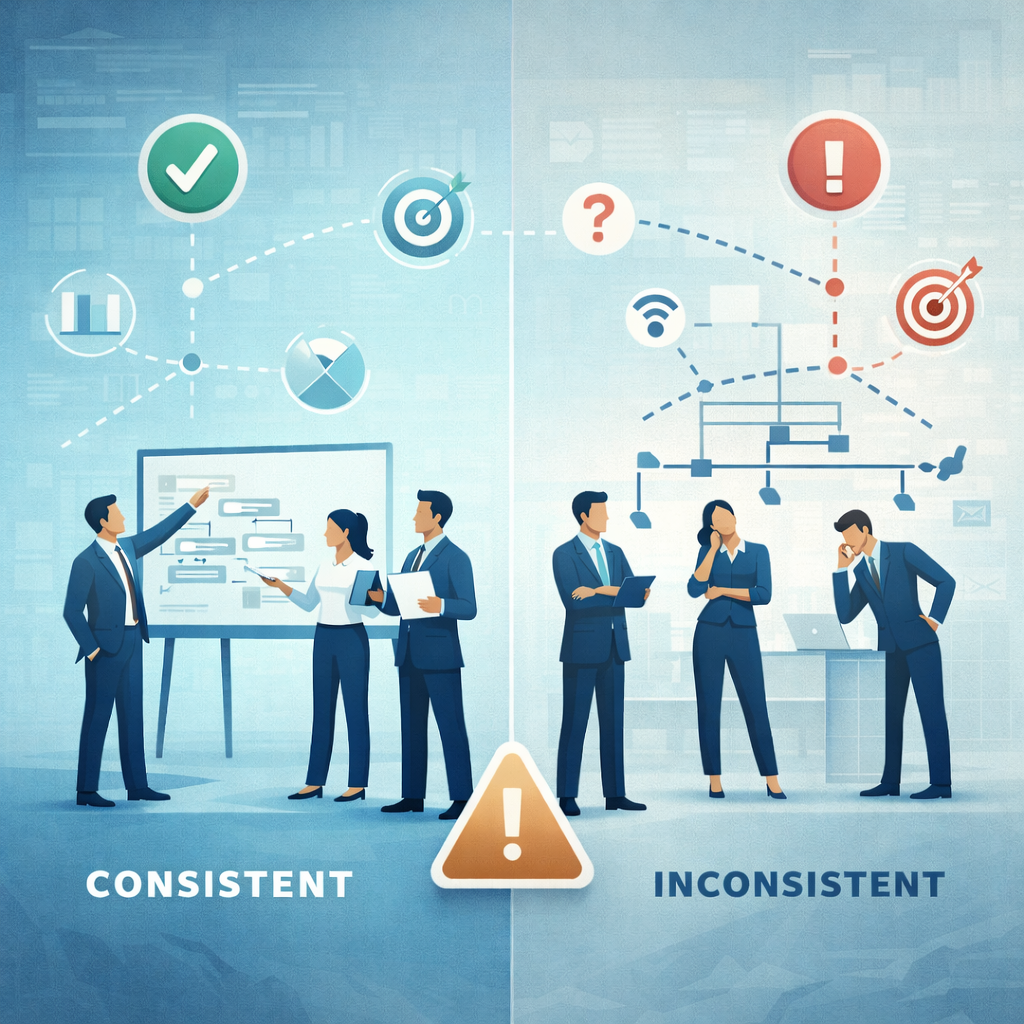
Most organizations do not fail at adopting Agile practices.
They fail at applying them consistently.
At first glance, this distinction may seem subtle. Teams run sprints. Backlogs are prioritized. Retrospectives happen. Metrics are reported. The mechanics are in place. Yet when we look at outcomes across the enterprise, performance remains unpredictable, value realization inconsistent, and strategic alignment fragile.
The issue is not adoption.
It is consistency.
Situational Agility Is Not Structural Agility
In many organizations, Agile behaviors are conditional. Teams experiment when time allows. Leaders empower when risk is low. Evidence matters when it supports existing narratives. Autonomy is encouraged until executive pressure increases.
Agility becomes situational.
But situational agility cannot scale.
True enterprise agility requires that certain principles operate as defaults rather than exceptions. Decision-making must routinely be evidence-based. Prioritization must consistently favor value over output. Leadership must reliably reinforce empowerment rather than revert to control when complexity increases.
When principles apply only “sometimes,” they are not principles. They are preferences.
And preferences collapse under pressure.
The Data Trap: “Sometimes” vs. “Always”
One of the most revealing patterns in organizational maturity assessments is the gap between “sometimes” and “always.”
Many organizations report that they apply Agile practices frequently. But few report that they apply them systematically. The difference is critical. A team that experiments occasionally may still build the wrong product. A portfolio that aligns quarterly may still fragment strategically. A leadership team that occasionally models servant leadership may still drive command-and-control behaviors through incentives and metrics.
Maturity is not measured by frequency.
It is measured by reliability.
If evidence-based decision-making is not embedded into funding mechanisms, performance evaluation, and portfolio governance, it remains fragile. If empowerment is not reflected in incentive systems and leadership behavior, it remains rhetorical.
Consistency is the real test of transformation.
Governance Is the Multiplier
The crisis of consistency is rarely caused by delivery teams. It is most often rooted in governance.
When governance structures reward predictability over learning, teams will optimize for predictability. When budgeting cycles reinforce fixed scope commitments, experimentation becomes politically risky. When executive dashboards track utilization rather than outcomes, leaders will manage capacity rather than value.
Governance is not neutral.
It shapes behavior.
If governance mechanisms remain industrial while teams attempt to operate adaptively, tension becomes structural. Teams are asked to be flexible within rigid systems. Over time, the system wins. Rituals remain, but behaviors revert.
Agility without governance alignment is unsustainable.
The Leadership Coherence Gap
A second driver of inconsistency is leadership incoherence. Executive teams may declare a product-centric vision, but middle management often operates under legacy expectations: hit the plan, reduce variance, control cost, avoid risk.
When leaders send mixed signals, organizations respond rationally. People optimize for what is measured and rewarded, not what is declared.
This creates a silent conflict. At the surface, organizations speak the language of empowerment and experimentation. Beneath the surface, they continue to manage through approval gates and detailed upfront commitments.
The result is cultural fatigue. Teams experience “Agile by rhetoric, traditional by consequence.”
Consistency requires leadership coherence. It requires that what is said, measured, rewarded, and escalated all reinforce the same behavioral model.
Without that coherence, transformation remains cosmetic.
Portfolio-Level Fragility
The consequences of inconsistency are amplified at scale. Individual teams may function well. However, without systematic portfolio practices, coordination breaks down. Cross-product dependencies increase. Priorities shift unpredictably. Roadmaps conflict. Funding decisions are reactive rather than strategic.
Local optimization thrives in inconsistent systems.
Enterprise optimization does not.
When each product area applies principles differently, strategic alignment becomes accidental. The organization may improve velocity but fail to improve strategic positioning. It may increase throughput but not increase competitive advantage.
Consistency is what converts local excellence into systemic performance.
Why Organizations Revert
Organizations revert to inconsistency under stress because consistency requires discipline. Evidence-based decision-making is uncomfortable. Dynamic prioritization creates trade-offs. Empowerment requires tolerance for variability. Portfolio alignment requires saying no.
These behaviors demand structural reinforcement.
Without embedded mechanisms that protect and reinforce agile principles, regression is predictable. Under pressure, leaders return to what feels controllable. Command-and-control offers psychological safety in complex environments. It creates the illusion of certainty.
But certainty and control are not the same as adaptability and resilience.
From Episodic Agility to Structural Agility
Moving beyond the Consistency Crisis requires reframing agility as an operating system, not a toolkit.
Structural agility means that evidence loops are embedded in funding cycles. It means that portfolio governance evaluates outcomes rather than compliance. It means that leadership behaviors are not optional but normative. It means that incentives reinforce learning, not just delivery.
Consistency is not rigidity.
It is alignment.
When principles become systemic rather than situational, organizations move beyond the Transformation Plateau. They no longer oscillate between empowerment and control. They operate coherently.
And coherence scales.
Final Reflection
Agile at scale does not fail because teams lack skill.
It fails because organizations lack consistency.
Transformation is not the introduction of new ceremonies. It is the establishment of new defaults. When agility becomes the default operating mode—across strategy, funding, governance, and leadership—results stabilize and value compounds.
Until then, organizations remain suspended between intention and execution.
They are Agile in language.
But not in structure.
Reach a global audience of portfolio, program, and project managers, product leaders, and certification professionals. Explore advertising opportunities .
Sponsored