
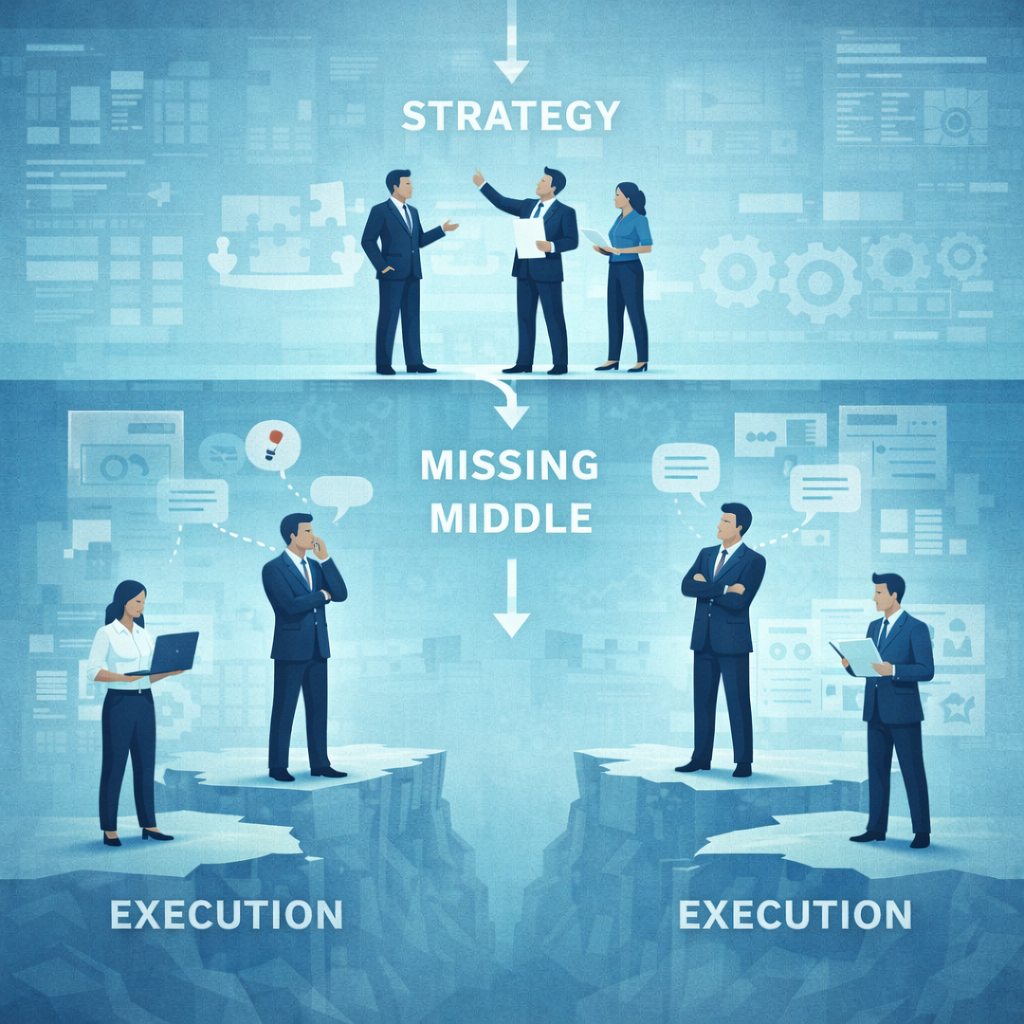
Most Agile transformations do not fail at the executive level.
They also do not fail at the team level.
They fail in between.
Executive teams articulate product-centric strategies. They speak about customer value, experimentation, and adaptability. Delivery teams adopt Agile practices. They run sprints, iterate quickly, and improve their workflows.
Yet organizational behavior does not fundamentally change.
This gap between strategic intent and operational reality is the Missing Middle.
It is where transformation loses coherence.
Strategy Evolves Faster Than Management
Senior leadership increasingly understands the need for agility. Market volatility, technological acceleration, and competitive pressure demand adaptability. Executives recognize that traditional planning models cannot fully anticipate complex environments.
At the same time, delivery teams embrace Agile practices because they improve local effectiveness. Teams experience greater autonomy, faster feedback cycles, and improved collaboration.
But middle management often remains anchored in legacy expectations.
They are still responsible for predictability. They are evaluated on variance reduction. They are expected to deliver against predefined plans. They are accountable for utilization, cost control, and timeline adherence.
This creates structural tension.
Strategy evolves toward adaptability.
Management systems remain optimized for predictability.
The Incentive Misalignment Problem
Behavior follows incentives, not declarations.
Even when organizations publicly promote agility, middle managers operate within performance systems designed for industrial stability. Their success depends on controlling outcomes, minimizing deviation, and ensuring compliance with predefined commitments.
Experimentation introduces uncertainty. Dynamic prioritization introduces variability. Evidence-driven adjustment introduces change.
All of these behaviors conflict with traditional management expectations.
As a result, middle managers rationally protect stability. They introduce additional approval layers. They require detailed upfront planning. They constrain team autonomy to preserve predictability.
These actions are not resistance.
They are structural alignment with existing incentives.
Transformation stalls not because managers oppose agility, but because the system still rewards industrial behavior.
The Translation Layer Between Strategy and Execution
Middle management functions as the translation layer between strategic vision and operational execution.
They interpret executive intent. They allocate resources. They resolve cross-team conflicts. They prioritize initiatives. They shape daily operational decisions.
If this layer operates using legacy assumptions, transformation cannot propagate.
Executives may promote empowerment, but middle managers implement governance. Teams may embrace experimentation, but middle managers approve funding. Strategic goals may emphasize value creation, but middle managers manage delivery commitments.
This layer determines whether agility becomes systemic or remains isolated.
Transformation succeeds when the middle layer evolves.
It stalls when it does not.
The Psychological Dimension of Control
Control provides psychological safety.
Traditional management models reduce uncertainty by increasing oversight. They provide the illusion of predictability. They create visible structure. They make performance easier to monitor.
Agility replaces upfront certainty with adaptive learning.
This transition requires tolerating ambiguity. It requires trusting evidence over plans. It requires accepting that initial assumptions may be wrong.
For middle managers trained in predictability-driven systems, this shift is deeply uncomfortable.
Without structural support, managers revert to familiar behaviors. They introduce governance mechanisms that restore perceived control, even if those mechanisms reduce adaptability.
This is not incompetence.
It is system preservation.
Structural vs. Behavioral Transformation
Many organizations attempt to solve the Missing Middle through training.
They educate managers about Agile principles. They promote servant leadership. They encourage coaching behaviors.
Training is necessary.
It is not sufficient.
Behavior is shaped by structure. Performance evaluation, funding mechanisms, escalation paths, and governance processes define how managers operate.
If managers are still evaluated on plan adherence, they will enforce plan adherence. If escalation mechanisms punish deviation, managers will avoid deviation. If funding models reward upfront certainty, managers will demand upfront certainty.
Structural transformation must accompany behavioral transformation.
Otherwise, training produces awareness without behavioral change.
The Portfolio and Resource Allocation Constraint
Middle management plays a central role in resource allocation.
They decide how teams are staffed. They determine priority sequencing. They manage dependencies. They balance operational stability with innovation investment.
If resource allocation remains static, agility becomes superficial.
Dynamic prioritization requires dynamic resource movement. Funding must follow validated opportunity. Talent must shift toward emerging value creation areas.
When middle management lacks authority or structural support to reallocate resources dynamically, prioritization becomes theoretical.
Agility exists in language, not in capital flow.
The Role Redefinition Challenge
True transformation redefines the role of middle management.
Instead of acting as controllers, managers become system designers. They focus on creating environments where teams can operate effectively. They manage constraints rather than tasks. They optimize systems rather than supervise individuals.
This role requires different capabilities.
Managers must understand value creation dynamics. They must interpret evidence. They must facilitate cross-system coordination. They must enable rather than direct.
This transition elevates management responsibility.
It does not eliminate it.
The Missing Middle is not a layer to remove.
It is a layer to evolve.
The Operating Model Determines Behavior
Ultimately, middle management behavior reflects operating model design.
If governance emphasizes compliance, managers enforce compliance. If governance emphasizes value realization, managers facilitate adaptability. If performance systems reward learning, managers promote experimentation.
The operating model determines management behavior more reliably than cultural messaging.
Transformation succeeds when operating model incentives align with strategic intent.
Without alignment, middle management becomes the stabilizing force that prevents change.
Final Reflection
Agile transformations do not fail because executives lack vision or teams lack capability.
They fail because the system that connects strategy to execution remains unchanged.
Middle management is not the problem.
It is the signal.
It reveals whether transformation has reached the structural layer.
When the Missing Middle evolves, strategy and execution align. Resource allocation becomes adaptive. Governance becomes enabling. Evidence shapes decisions.
Agility becomes systemic.
Until then, transformation remains suspended between intention and reality.
Reach a global audience of portfolio, program, and project managers, product leaders, and certification professionals. Explore advertising opportunities .
Sponsored