
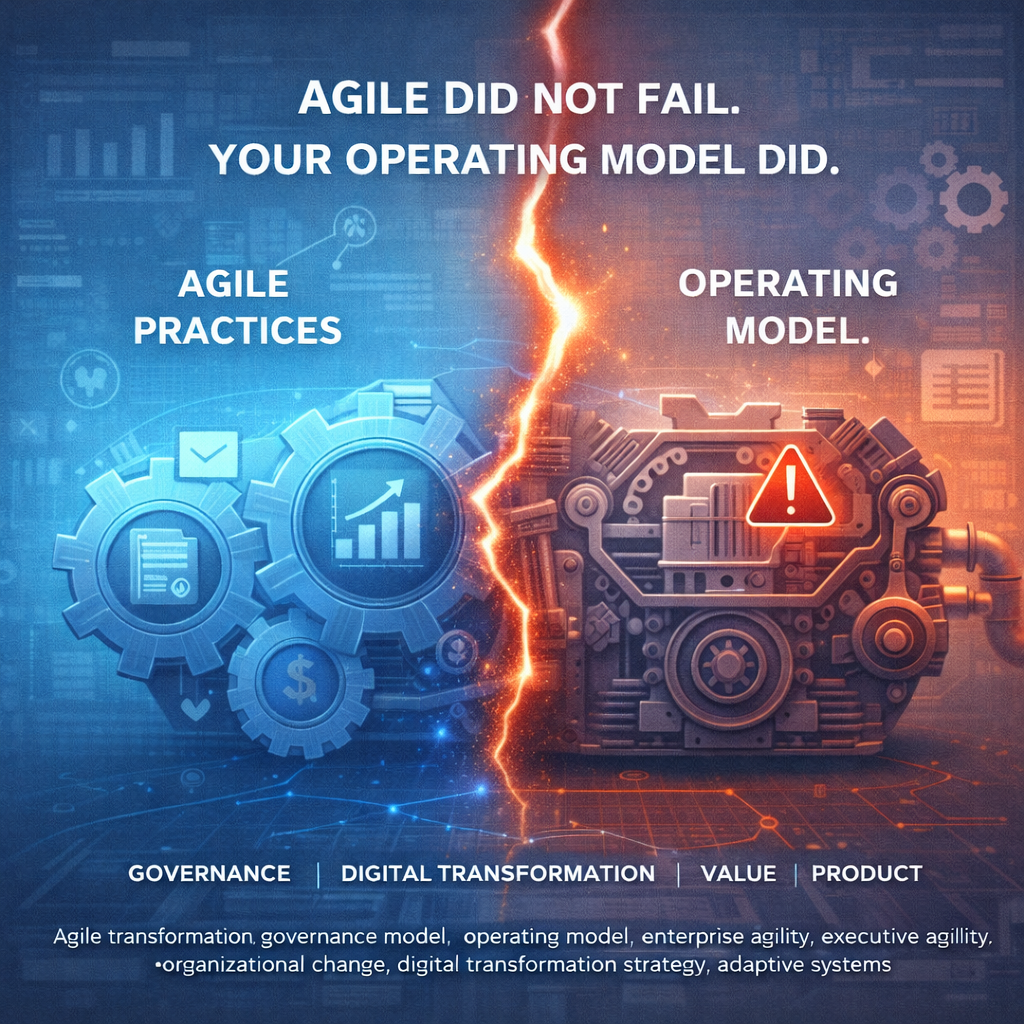
Agile is often described as a failed promise.
Organizations invested heavily. They trained teams. They hired coaches. They adopted frameworks. They restructured delivery organizations.
Yet the expected transformation did not fully materialize.
Strategic adaptability remains limited. Portfolio responsiveness remains constrained. Capital allocation remains rigid. Governance remains slow.
From this perspective, it is tempting to conclude that Agile itself failed.
This conclusion is incorrect.
Agile did not fail.
The operating model did.
Agile Was Designed for Adaptive Systems
Agile was never intended to be a delivery optimization technique.
It was designed as an adaptive system.
Its core principles emphasize empiricism, continuous learning, adaptive planning, and decentralized decision-making. It assumes that uncertainty is unavoidable and that value emerges through iterative discovery.
Agile enables organizations to respond dynamically to reality.
But Agile operates within the constraints of the broader operating model.
It cannot override governance.
It cannot reallocate capital.
It cannot redefine incentives.
It cannot redesign executive decision-making structures.
Agile can improve how teams work.
It cannot independently transform how organizations decide.
The Operating Model Defines Organizational Behavior
The operating model determines how strategy becomes execution.
It defines funding mechanisms. It shapes governance structures. It establishes performance metrics. It defines incentive systems. It determines decision authority.
These structural elements shape behavior more powerfully than any framework or methodology.
If funding remains static, investment remains static.
If performance metrics reward output, teams optimize output.
If governance prioritizes predictability, adaptability becomes constrained.
The operating model determines whether agility is possible.
Frameworks operate within its boundaries.
Agile Often Becomes a Local Optimization Layer
In many organizations, Agile improves local execution.
Teams deliver faster. Feedback cycles shorten. Transparency improves. Collaboration strengthens.
But portfolio decisions remain slow. Funding remains fixed. Governance remains rigid.
Agile becomes a local optimization layer on top of an industrial operating model.
Execution improves.
Strategy does not.
This structural misalignment creates frustration.
Organizations expected transformation.
They achieved efficiency.
Efficiency without adaptability does not create strategic advantage.
The Industrial Operating Model Assumes Predictability
Traditional operating models were designed for environments where the future could be forecasted with reasonable confidence.
Strategy was defined periodically. Plans were approved. Execution followed the plan.
This model optimized efficiency under stable conditions.
Modern environments are fundamentally different.
Technology evolves rapidly. Competitive landscapes shift unpredictably. Customer behavior changes continuously.
Value cannot be predicted reliably.
It must be discovered.
Operating models designed for predictability constrain organizations operating in uncertainty.
Agile cannot compensate for structural misalignment.
The Real Constraint Is Governance, Not Delivery
The fundamental constraint in most organizations is not delivery capability.
It is governance capability.
Governance defines how quickly organizations can adapt their investments, priorities, and strategic direction.
If governance cycles operate annually, strategic adaptation operates annually.
If capital allocation remains static, strategy remains static.
Agile delivery cannot overcome static governance.
Governance determines strategic responsiveness.
The Transformation Plateau Is Structural, Not Cultural
Many organizations interpret stalled transformations as cultural resistance.
They attribute failure to mindset. They invest in training. They promote Agile values.
These interventions are valuable.
They are insufficient.
Behavior is shaped by structural incentives.
If managers are rewarded for predictability, they enforce predictability.
If funding models reward upfront certainty, organizations demand upfront certainty.
If governance penalizes deviation, deviation disappears.
Structural constraints override cultural aspiration.
Transformation requires structural evolution.
Agile Reveals Operating Model Weakness
Agile did not create transformation failure.
It revealed operating model weakness.
Agile exposed the mismatch between modern uncertainty and industrial governance.
It highlighted the limitations of static capital allocation.
It exposed the inefficiency of output-based measurement.
It revealed the fragility of portfolio alignment mechanisms.
Agile made structural weaknesses visible.
It did not create them.
Agile became the diagnostic tool.
Not the failure.
The Future Belongs to Adaptive Operating Models
The next stage of organizational evolution is not framework adoption.
It is operating model redesign.
Adaptive operating models align governance, capital allocation, portfolio management, and performance evaluation with the realities of uncertainty.
They enable dynamic investment. They prioritize value realization. They support evidence-based decision-making.
They enable strategic adaptability.
Agile practices operate effectively within adaptive operating models.
Without operating model evolution, Agile remains constrained.
With operating model evolution, Agile becomes transformative.
Executive Leadership Owns the Operating Model
Operating model design is an executive responsibility.
Executives define governance structures. They determine capital allocation mechanisms. They shape performance systems. They define organizational incentives.
These decisions determine whether agility exists at the strategic level.
Transformation cannot be delegated exclusively to delivery organizations.
It must be led at the executive level.
Agility is not implemented.
It is enabled.
Final Reflection
Agile did not fail.
Organizations that adopted Agile without evolving their operating model experienced limited results.
Not because Agile was ineffective.
Because the system remained unchanged.
Agile improves execution.
Operating models determine strategy.
True transformation occurs when operating models evolve to support adaptive decision-making, dynamic capital allocation, and evidence-based governance.
Agile was never the destination.
It was the signal.
The signal that the operating model must evolve.
Reach a global audience of portfolio, program, and project managers, product leaders, and certification professionals. Explore advertising opportunities .
Sponsored