
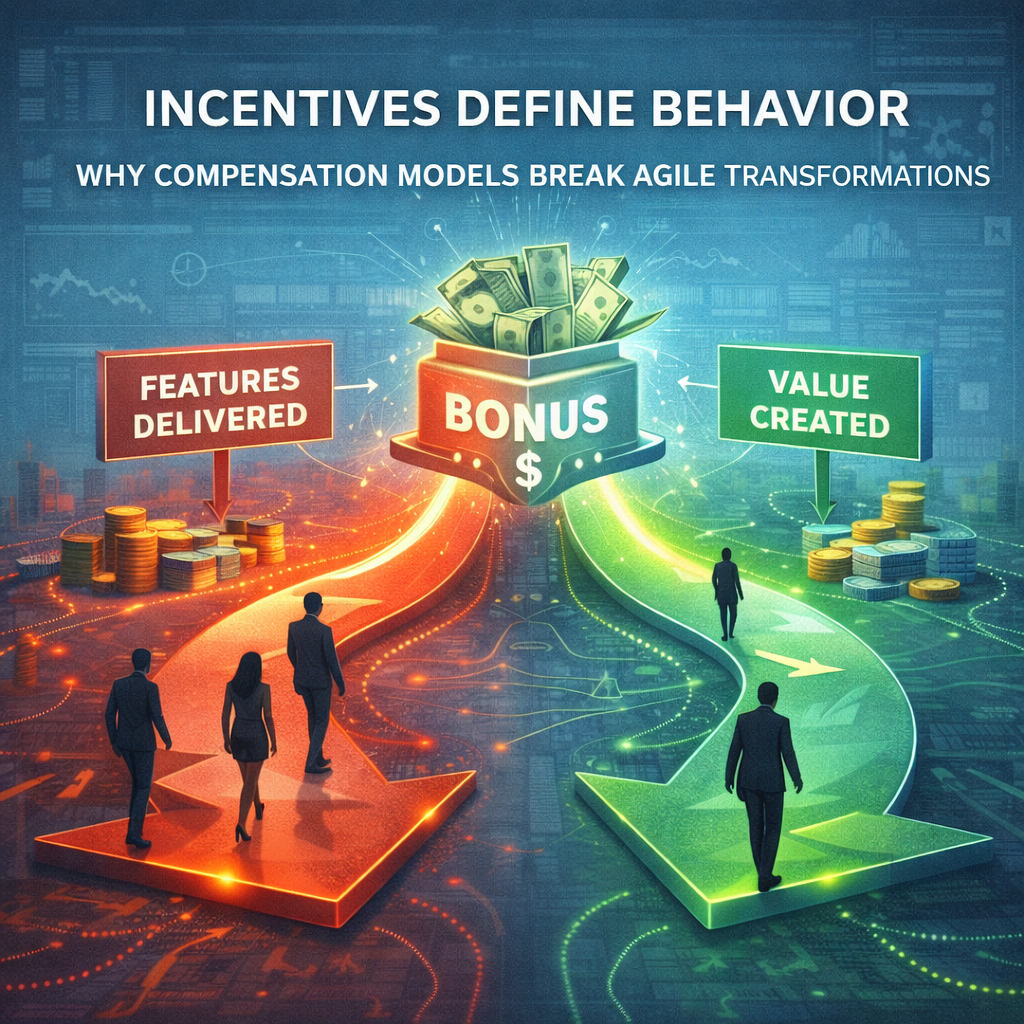
Most Agile transformations focus on process.
Organizations adopt Scrum. They implement Product Operating Models. They introduce OKRs. They restructure teams. They redesign workflows.
Yet behavior often remains unchanged.
Teams continue optimizing for delivery. Managers continue enforcing predictability. Roadmaps remain rigid. Value realization remains inconsistent.
This disconnect exists because organizations change how people work, but not how people are evaluated.
Compensation models remain anchored in delivery.
And incentives define behavior more powerfully than process.
People Optimize for What They Are Rewarded For
Organizational behavior follows a simple and predictable law: people optimize for how they are evaluated and compensated.
If employees are rewarded for delivering features, they will deliver features.
If managers are rewarded for predictability, they will enforce predictability.
If leaders are rewarded for budget adherence, they will protect budget commitments.
Even when these behaviors conflict with value creation.
This is not resistance.
It is rational adaptation to the incentive system.
Incentives shape behavior more reliably than cultural messaging, training, or leadership declarations.
The Output Incentive Trap
Most compensation systems reward output.
Performance evaluations emphasize roadmap completion, milestone delivery, and execution reliability. Bonus structures reward delivery success. Performance reviews reward adherence to plan.
These systems were designed for industrial environments, where value was created through execution efficiency and predictability.
In complex environments, value creation depends on learning.
Features are hypotheses. Their value cannot be guaranteed upfront. Their impact must be validated through observation.
Yet compensation systems reward delivering the hypothesis, not validating its outcome.
This creates structural misalignment.
Employees maximize delivery.
The organization fails to maximize value.
Why Output-Based Incentives Create Feature Factories
When compensation is tied to delivery, feature production becomes the safest path to success.
Employees avoid canceling initiatives, even when evidence suggests limited impact. They avoid revising plans, even when assumptions prove incorrect. They avoid experimentation that might invalidate commitments.
Delivery becomes a defensive behavior.
Learning becomes a risk.
This dynamic transforms organizations into Feature Factories. Teams produce output efficiently, but the connection between output and value weakens.
The organization becomes highly productive.
But not necessarily effective.
Outcome Requires Adaptation. Incentives Often Punish Adaptation.
Value creation requires adaptation.
Organizations must test assumptions, observe outcomes, and adjust direction based on evidence. They must terminate low-value initiatives and reallocate resources dynamically.
This adaptive behavior introduces uncertainty.
Traditional compensation systems punish uncertainty. Performance evaluation favors predictability. Bonus structures favor commitment adherence. Career progression favors execution reliability.
Adaptation introduces perceived instability.
Stability is rewarded.
Adaptation is discouraged.
This structural contradiction limits agility.
The Governance and Compensation Connection
Compensation systems are governance mechanisms.
They operationalize organizational priorities. They define what success means. They influence how decisions are made.
If compensation rewards output, governance becomes output-focused.
If compensation rewards value creation, governance becomes value-focused.
This alignment determines whether Agile practices generate real strategic benefit or remain confined to delivery efficiency.
Agility cannot emerge fully if compensation systems reward industrial behavior.
Incentives define operating model behavior.
Measuring Value Requires Different Performance Models
Value-oriented organizations evaluate performance differently.
They evaluate employees based on their contribution to business outcomes. They measure improvements in customer adoption, retention, revenue growth, and operational efficiency.
They reward learning, not just delivery.
They recognize that terminating a low-value initiative is a success, not a failure.
They reward decisions that improve portfolio performance, even when those decisions involve abandoning prior commitments.
Performance evaluation becomes aligned with value creation.
Behavior follows.
The Leadership Responsibility
Compensation model design is an executive responsibility.
Executives define bonus structures. They define performance evaluation criteria. They define promotion standards.
These decisions shape organizational behavior more directly than any Agile framework implementation.
Agile transformations fail when executives expect adaptive behavior while rewarding predictable delivery.
This contradiction cannot be resolved at the team level.
It must be resolved at the leadership level.
Agility requires alignment between operating model, governance, and compensation.
The Transition from Delivery Metrics to Value Metrics
This transition requires redefining success.
Success is no longer defined by completing planned work.
It is defined by creating measurable impact.
Employees must be evaluated based on outcome contribution, evidence-based decision-making, and value realization.
This shift encourages experimentation. It encourages learning. It encourages strategic adaptability.
It aligns individual incentives with organizational success.
Compensation becomes a driver of agility rather than a barrier to it.
The Strategic Advantage of Incentive Alignment
Organizations that align incentives with value creation gain structural advantage.
They adapt faster. They allocate resources more effectively. They reduce investment in low-value initiatives. They increase investment in validated opportunities.
Their portfolio evolves continuously.
Their strategy becomes adaptive.
Their operating model becomes coherent.
This alignment creates sustained competitive advantage.
Because incentives shape every decision within the organization.
Final Reflection
Agile transformations often focus on frameworks, processes, and structures.
But behavior is shaped by incentives.
If compensation rewards delivery, organizations will optimize delivery.
If compensation rewards value creation, organizations will optimize value creation.
Agility is not achieved by changing how teams work.
It is achieved by changing how success is defined.
Incentives define success.
And success defines behavior.
Reach a global audience of portfolio, program, and project managers, product leaders, and certification professionals. Explore advertising opportunities .
Sponsored