
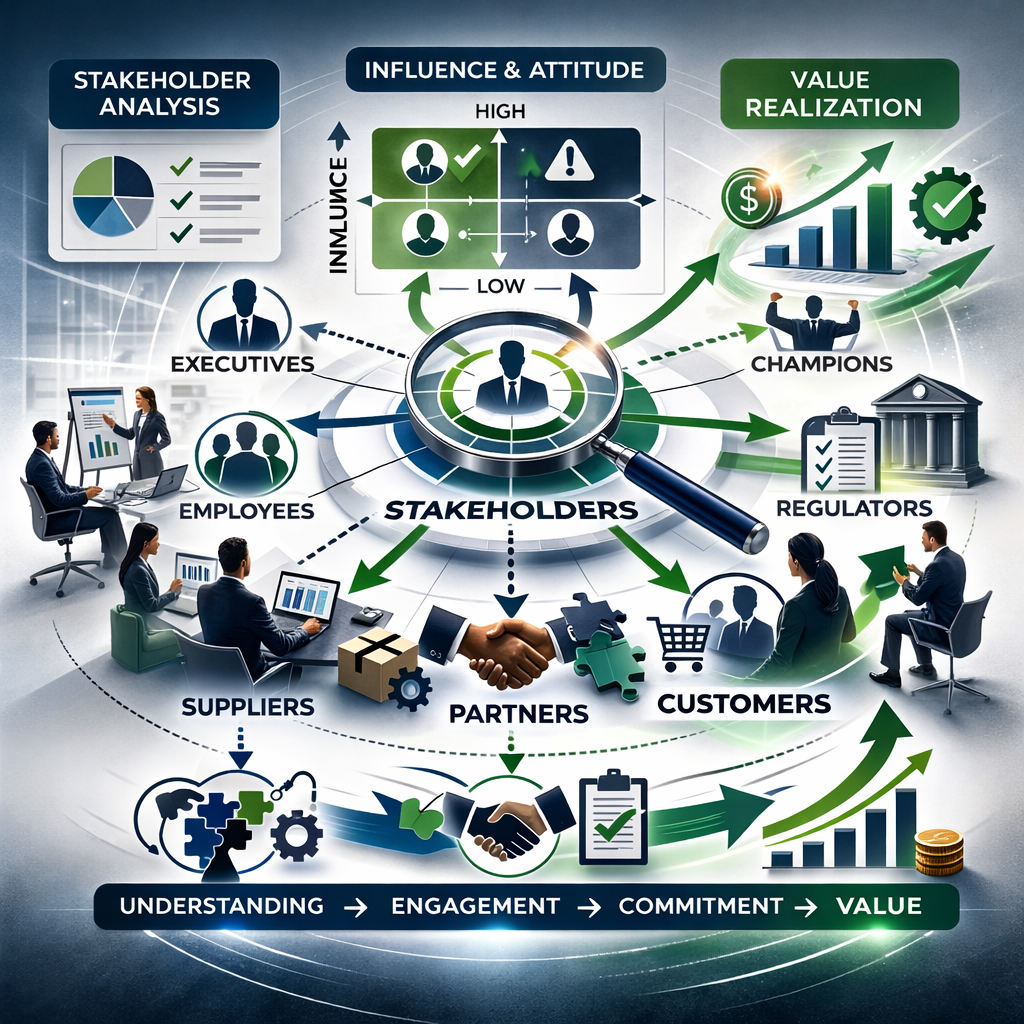
Most organizations can produce a stakeholder list within a few hours. A workshop is scheduled, participants brainstorm names, and the output is a long inventory of departments, roles, external partners, customers, regulators, and sponsors. The exercise feels complete, and the organization moves forward confident that stakeholders have been “identified.”
But identification is not understanding. And without understanding, engagement becomes superficial, risk increases, and value realization becomes uncertain.
In Benefit Realization Management, project delivery, portfolio governance, and product strategy, stakeholder identification is merely the entry point. Strategic work begins only when we understand influence, incentives, fears, motivations, and behavioral impact.
The Structural Trap: Organograms Are Not Stakeholder Analysis
A common mistake is to classify stakeholders structurally rather than strategically. Organizations map stakeholders according to reporting lines, job titles, or formal authority. This approach assumes that hierarchy defines influence and that role defines impact.
In reality, influence is often informal. Resistance can emerge from individuals with limited formal authority but high operational leverage. A frontline supervisor can slow adoption more effectively than a distant executive sponsor. A respected technical specialist can undermine confidence in a system more quickly than a senior leader can restore it.
Similarly, customers, suppliers, regulators, and even customers’ customers may carry decisive influence over outcomes without appearing in internal charts. Structural mapping may satisfy governance documentation requirements, but it rarely reveals behavioral risk or value drivers.
True stakeholder understanding requires moving beyond structure into economics and psychology.
Stakeholders as Economic Actors
Every stakeholder is an economic actor. They assess change through a lens of perceived benefit, cost, risk, and effort. If an initiative increases workload without visible reward, resistance is rational. If it introduces uncertainty without clarifying upside, skepticism is predictable.
Understanding stakeholders strategically means asking difficult questions:
- How does this initiative change their incentives?
- What risks do they perceive?
- What behaviors must they adopt for value to materialize?
- What do they gain—or lose—from supporting this change?
In product management, this perspective is second nature when analyzing customer behavior. Yet internally, organizations often ignore the same economic logic. Employees and managers respond to incentives just as customers do. When alignment is absent, adoption falters.
Stakeholder strategy must therefore incorporate incentive design, not merely communication plans.
Primary, Secondary, and Invisible Stakeholders
Many initiatives focus exclusively on primary stakeholders—the direct users of a system or participants in a process. However, value realization often depends on secondary and indirect stakeholders whose influence is less visible but equally powerful.
For example, a healthcare system upgrade may directly affect clinicians, but patient relatives, regulators, funding bodies, and suppliers also shape outcomes. In digital platforms, customer adoption may depend on ecosystem partners. In procurement transformation, supplier engagement may determine cost savings.
Even second-level stakeholders—such as customers’ customers or frontline support teams—can amplify or suppress value creation. Ignoring them creates blind spots that later manifest as resistance, delays, or underperformance.
Strategic stakeholder analysis requires broad vision and deliberate inclusion of indirect actors.
Influence Without Authority
Influence is rarely proportional to title. Organizations that equate authority with influence overlook critical dynamics. Informal leaders, cultural anchors, technical experts, and long-tenured employees often shape opinion more powerfully than formal sponsors.
In portfolio management, initiatives may receive executive approval yet fail at operational levels because informal influencers were not engaged. In product organizations, a small but vocal group of users can shape market perception disproportionately. In digital transformation, trusted internal skeptics can slow adoption more effectively than formal mandates can accelerate it.
Mapping influence—formal and informal—is therefore essential. Influence analysis should identify:
- Decision-makers
- Opinion leaders
- Gatekeepers
- Cultural influencers
- Veto holders
Only then can engagement strategies be calibrated effectively.
Understanding Attitude as a Strategic Variable
Attitude is not static. Stakeholders may initially appear neutral or supportive but shift as implementation progresses. Concerns about workload, competence, job security, or performance measurement can transform passive acceptance into active resistance.
This is why stakeholder analysis must be iterative. Early lifecycle identification may differ from mid-implementation dynamics. The Influence–Attitude Matrix becomes particularly powerful when updated continuously rather than treated as a one-time exercise.
In portfolio governance, monitoring stakeholder attitude should be considered a leading indicator of value realization risk. A technically on-track initiative with deteriorating stakeholder sentiment represents a strategic vulnerability.
Understanding attitude allows leaders to intervene before performance metrics decline.
From Stakeholder Lists to Stakeholder Intelligence
Strategic organizations move beyond static stakeholder registers toward stakeholder intelligence. This involves collecting qualitative and quantitative insight into stakeholder perception, readiness, commitment, and behavioral change.
Workshops, interviews, feedback loops, and structured engagement forums provide insight into expectations and anxieties. These mechanisms transform stakeholder engagement from compliance-driven documentation into adaptive leadership practice.
Stakeholder intelligence enables:
- Early detection of resistance
- Alignment of incentives
- Adjustment of communication strategy
- Refinement of benefit definitions
- Recalibration of implementation sequencing
Without this intelligence, leaders operate reactively, addressing issues only after value leakage becomes visible.
Implications for Projects, Programs, Portfolios, and Products
For project managers, stakeholder understanding determines adoption risk and training effectiveness. Technical readiness does not guarantee operational readiness.
For program leaders, cross-stakeholder coordination becomes critical. Benefits often require synchronized behavior across multiple groups. Misalignment between stakeholders can undermine program-level outcomes.
For portfolio executives, stakeholder readiness should inform investment prioritization. An initiative with strong financial projections but weak stakeholder alignment may represent higher risk than its business case implies.
For product leaders, stakeholder understanding translates directly into user adoption, retention, and revenue growth. Products succeed when they align with customer incentives, motivations, and workflows.
Across domains, the lesson is consistent: understanding stakeholders is not a soft skill—it is a strategic capability.
Stakeholder Understanding as a Competitive Advantage
Organizations that deeply understand their stakeholders design initiatives differently. They anticipate resistance rather than react to it. They align incentives early. They define benefits in terms that resonate with each stakeholder group. They treat engagement as an ongoing process rather than a launch activity.
In increasingly complex environments, where transformations span technologies, geographies, and organizational boundaries, stakeholder dynamics become even more decisive. Technical excellence is necessary but insufficient. Behavioral alignment is the multiplier.
Identifying stakeholders is easy. Understanding them is strategic work.
And strategic work is what ultimately determines whether value is realized—or merely projected.
Reach a global audience of portfolio, program, and project managers, product leaders, and certification professionals. Explore advertising opportunities .
Sponsored