
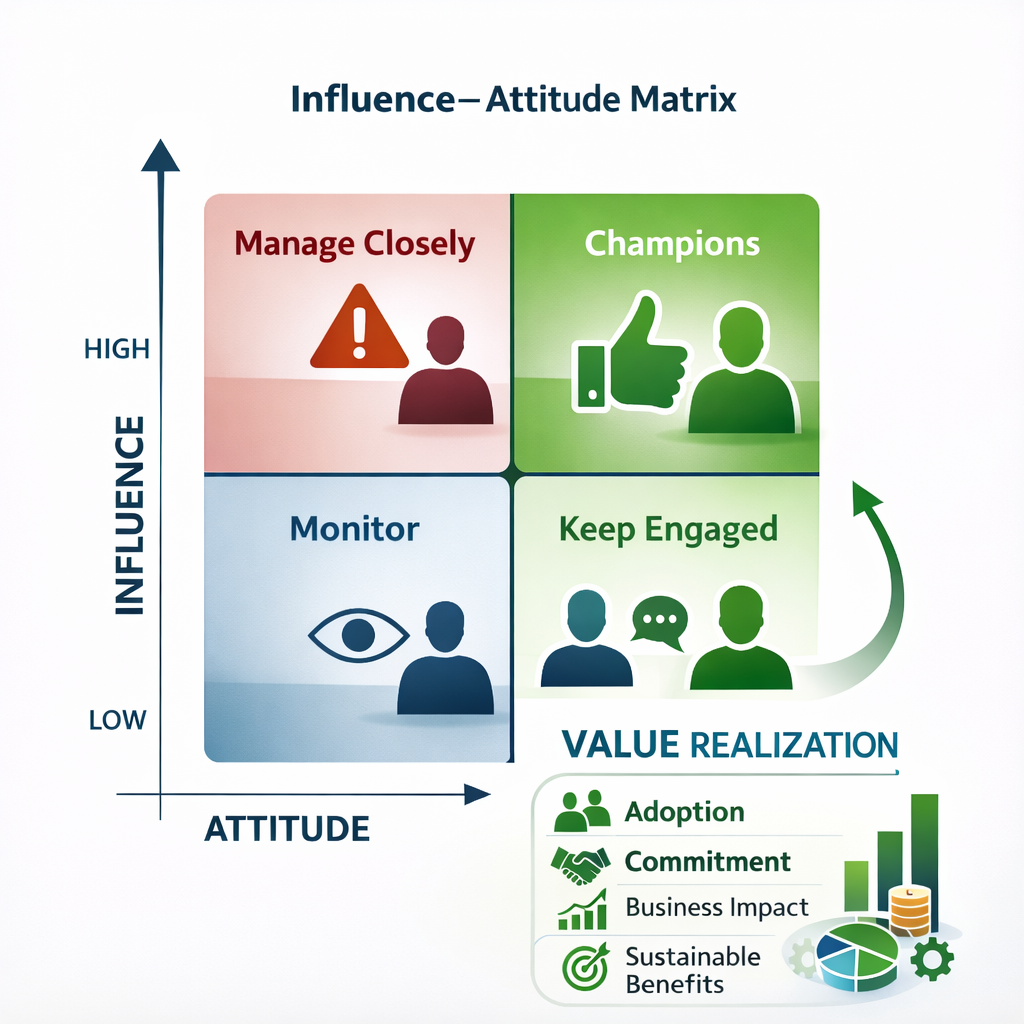
Organizations invest enormous effort in financial modeling, strategic alignment scoring, and prioritization frameworks when selecting initiatives for their portfolios. Net Present Value, Internal Rate of Return, strategic alignment scores, and risk assessments are rigorously analyzed. Yet despite this sophistication, many initiatives fail to deliver expected benefits—not because the financial logic was flawed, but because stakeholder dynamics were misunderstood.
Portfolio strategy is not executed in spreadsheets. It is executed in human systems. Stakeholders ultimately determine whether capabilities are adopted, whether processes change, and whether value materializes. The Influence–Attitude Matrix provides one of the simplest and most powerful tools for understanding this reality, yet it remains one of the most underused instruments in portfolio governance.
When properly applied, it transforms stakeholder management from an operational exercise into a strategic capability.
The Missing Variable in Portfolio Decision-Making
Portfolio management is fundamentally about allocating scarce resources to initiatives that maximize strategic value. However, most prioritization frameworks assume that once approved, initiatives will execute as planned and produce expected outcomes. This assumption introduces a critical blind spot.
Stakeholder behavior is rarely neutral. Individuals and groups interpret change through their own incentives, risks, and interests. Their reactions influence adoption, execution speed, and ultimate value realization. Two initiatives with identical financial projections may produce radically different outcomes depending on stakeholder support or resistance.
Ignoring stakeholder attitude and influence introduces hidden execution risk. The Influence–Attitude Matrix exposes this risk by making stakeholder dynamics visible and actionable.
Understanding the Two Dimensions: Influence and Attitude
The matrix evaluates stakeholders across two dimensions: their level of influence over the initiative and their attitude toward it.
Influence reflects a stakeholder’s ability to accelerate, delay, modify, or obstruct progress. This influence may be formal, such as executive authority, or informal, such as cultural credibility, technical expertise, or operational control. Influence determines the magnitude of a stakeholder’s impact.
Attitude reflects a stakeholder’s level of support, neutrality, or resistance toward the initiative. Stakeholders may actively champion change, passively accept it, or actively resist it. Attitude determines the direction of their influence.
These two dimensions combine to create four distinct stakeholder categories, each requiring a different strategic response.
High Influence, Negative Attitude: The Greatest Threat to Value Realization
Stakeholders with high influence and negative attitudes represent the most significant risk to any initiative. Their ability to shape decisions, influence others, and control operational execution makes their resistance particularly damaging.
These stakeholders may delay approvals, question priorities, reduce cooperation, or undermine confidence in the initiative. Even subtle resistance—such as deprioritizing adoption or withholding informal support—can significantly reduce value realization.
Portfolio leaders must prioritize engagement with these stakeholders early. Ignoring or minimizing their concerns rarely neutralizes resistance. Instead, understanding their incentives, addressing perceived risks, and aligning the initiative with their interests can transform potential blockers into neutral or supportive actors.
Managing this quadrant effectively often determines whether an initiative succeeds or fails.
High Influence, Positive Attitude: The Multipliers of Strategic Value
Stakeholders with high influence and positive attitudes are powerful accelerators of value realization. These individuals serve as champions, sponsors, and advocates who actively promote the initiative and facilitate adoption across the organization.
Their support reduces organizational friction. They remove barriers, reinforce alignment, and create legitimacy for the change. Their influence extends beyond formal authority, shaping perception and behavior throughout the stakeholder network.
Portfolio governance should actively cultivate and empower these stakeholders. Providing them with visibility, involvement, and ownership strengthens their commitment and amplifies their impact.
These stakeholders are not merely supporters. They are strategic assets.
Low Influence, Negative Attitude: The Silent Sources of Execution Risk
Stakeholders with low formal influence but negative attitudes may appear less critical at first glance. However, their collective impact can be significant, particularly when they represent operational users or frontline personnel.
Their resistance may manifest as slow adoption, procedural workarounds, reduced engagement, or passive noncompliance. While individually their influence is limited, collectively they shape operational reality.
Monitoring this group is essential. Understanding their concerns early allows leaders to address friction points before resistance spreads or becomes institutionalized.
Neglecting this quadrant often results in technically successful implementations that fail operationally.
Low Influence, Positive Attitude: The Foundation of Sustainable Adoption
Stakeholders with low influence and positive attitudes form the foundation of long-term success. These individuals often represent the majority of users and operational participants. Their willingness to adopt and integrate new capabilities enables sustained value realization.
While they may not shape strategic decisions, their behavior determines whether change becomes embedded in daily operations.
Engagement strategies for this group should focus on enablement, training, and reinforcement. Maintaining their positive attitude ensures stable and scalable adoption over time.
These stakeholders sustain the value that champions initiate.
From Stakeholder Mapping to Portfolio Strategy
The Influence–Attitude Matrix is not merely a communication tool. It is a strategic decision instrument that should inform portfolio prioritization, risk assessment, and resource allocation.
Initiatives with strong stakeholder support and engaged champions represent lower execution risk. Initiatives facing resistance from influential stakeholders require additional investment in engagement, alignment, and change management.
Portfolio leaders should incorporate stakeholder analysis alongside financial and strategic evaluation. This provides a more complete picture of execution feasibility and expected value realization.
Capital allocation decisions become more informed when stakeholder dynamics are explicitly considered.
Stakeholder Attitude as a Leading Indicator of Portfolio Risk
Traditional portfolio metrics focus on financial performance, schedule adherence, and scope delivery. While these metrics are important, they often detect problems only after value realization has already been compromised.
Stakeholder attitude provides an earlier signal. Negative sentiment among influential stakeholders often precedes delays, adoption failures, and benefit shortfalls.
Regular assessment of stakeholder influence and attitude enables proactive intervention. Leaders can address concerns, adjust engagement strategies, and reinforce alignment before performance metrics deteriorate.
This transforms governance from reactive oversight into proactive value protection.
Implications for Portfolio, Product, and Transformation Leaders
For portfolio executives, the matrix provides a structured method to evaluate execution risk beyond financial projections. It enables more realistic prioritization and more effective resource allocation.
For product leaders, it identifies internal and external stakeholders whose support is essential for successful product adoption and growth. Champions accelerate adoption, while resistance can limit product success regardless of technical quality.
For transformation leaders, it provides a roadmap for engagement, enabling targeted efforts that maximize adoption and minimize resistance.
Across all domains, the matrix enables strategic clarity.
Stakeholder Strategy Is Portfolio Strategy
Portfolio strategy is often framed as a financial optimization exercise. In reality, it is a behavioral alignment exercise. Initiatives succeed when stakeholders support, adopt, and reinforce change. They fail when stakeholders resist, ignore, or undermine it.
The Influence–Attitude Matrix makes this dynamic visible. It provides leaders with a practical framework for aligning stakeholder behavior with strategic objectives.
Organizations that integrate stakeholder analysis into portfolio governance increase the probability that their investments produce meaningful outcomes. They recognize that value realization depends not only on selecting the right initiatives, but on ensuring that the right stakeholders support them.
Portfolio strategy does not succeed because initiatives are approved. It succeeds because stakeholders enable value realization.
Reach a global audience of portfolio, program, and project managers, product leaders, and certification professionals. Explore advertising opportunities .
Sponsored