
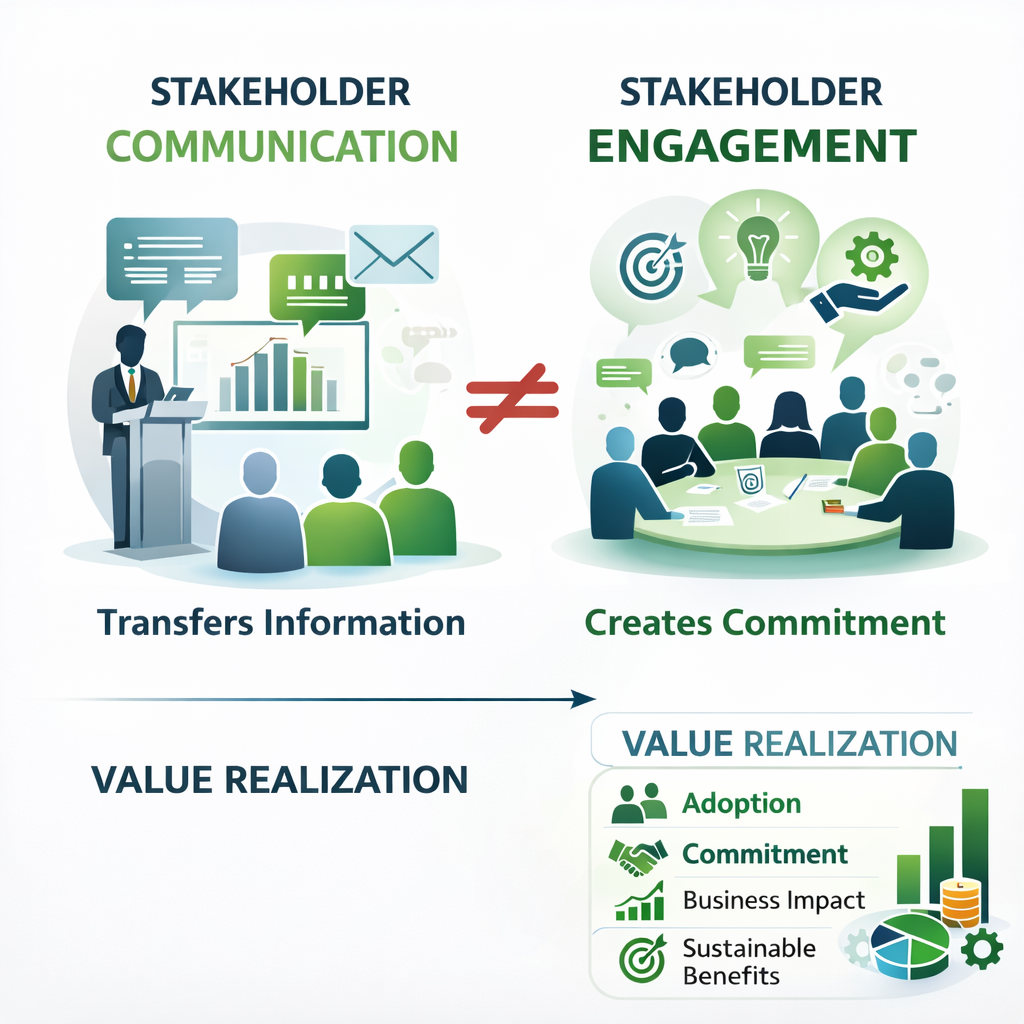
In many organizations, stakeholder engagement is treated as a communication activity. Emails are sent, presentations are delivered, newsletters are published, and town halls are organized. Leaders assume that once stakeholders have been informed, engagement has been achieved. Yet despite these efforts, initiatives continue to encounter resistance, adoption remains low, and expected benefits fail to materialize.
The problem is not communication failure. The problem is conceptual misunderstanding. Stakeholder engagement is not about informing stakeholders. It is about influencing behavior. And influencing behavior is not a communication activity—it is a value engineering discipline.
Value is realized only when stakeholders adopt new capabilities and integrate them into their decisions and workflows. Stakeholder engagement is the mechanism through which this behavioral transformation occurs.
Communication Transfers Information. Engagement Creates Commitment.
Communication is a one-directional transfer of information. Engagement is a two-directional process that creates alignment, ownership, and commitment. This distinction is fundamental, yet frequently overlooked.
An organization can communicate perfectly and still fail to engage stakeholders. Stakeholders may understand what is changing and why, yet remain unconvinced, skeptical, or unwilling to adjust their behavior. Understanding does not guarantee commitment.
Commitment emerges when stakeholders participate in shaping the change. When stakeholders contribute to defining objectives, identifying benefits, and addressing risks, they develop psychological ownership. The initiative becomes something they support, not something imposed upon them.
This transition—from recipient to participant—is where value realization begins.
Value Exists in Behavioral Systems, Not Technical Systems
Technology enables capability. Stakeholders enable value.
This principle applies across projects, programs, portfolios, and products. A new system can be technically complete, but if stakeholders continue operating as before, value remains unrealized. A product feature may be fully functional, but if customers do not adopt it, it generates no economic return.
Stakeholder engagement must therefore focus on behavioral integration. Leaders must ensure that stakeholders not only understand the change but also incorporate it into their daily decisions and routines.
In Benefit Realization Management, benefits are explicitly linked to stakeholder behavior. Increased revenue, improved efficiency, reduced risk, and enhanced customer satisfaction all emerge from stakeholders doing something differently.
Engagement is the process that enables this behavioral shift.
Engagement Reduces Adoption Risk, the Most Critical Execution Risk
Most organizations actively manage technical risk, financial risk, and schedule risk. However, adoption risk—the risk that stakeholders will not adopt or sustain new capabilities—is often underappreciated.
Adoption risk is fundamentally a stakeholder problem. It cannot be solved through technical excellence alone. It requires trust, alignment, and perceived value from the stakeholder perspective.
Effective engagement identifies resistance early. It surfaces concerns that may otherwise remain hidden. It enables leaders to adjust design, sequencing, training, and incentives before resistance becomes institutionalized.
By reducing adoption risk, stakeholder engagement protects value realization.
In portfolio governance, this makes engagement a risk mitigation function as much as a communication function.
Stakeholders Must See Value for Themselves
Stakeholders do not resist change arbitrarily. They resist change when they perceive risk, loss, or uncertainty without corresponding benefit. Engagement must therefore address stakeholder incentives directly.
Each stakeholder group evaluates change differently. Executives evaluate strategic alignment and financial impact. Operational teams evaluate workload and efficiency. Customers evaluate usability and benefit. Regulators evaluate compliance and risk.
Engagement must align the initiative with each stakeholder’s perspective. Leaders must answer the implicit question every stakeholder asks: What does this mean for me?
When stakeholders perceive clear personal or organizational benefit, engagement accelerates naturally.
When they do not, resistance becomes rational.
Engagement Must Begin Before Delivery, Not After
A common mistake is treating engagement as an implementation-phase activity. Organizations develop solutions first and attempt to engage stakeholders later. This sequence reduces stakeholder ownership and increases resistance.
Effective engagement begins during strategy formation and continues throughout the lifecycle. Stakeholders should participate in defining objectives, identifying benefits, and shaping solution design.
Early involvement produces two critical effects. First, it improves solution quality by incorporating stakeholder expertise. Second, it creates commitment by giving stakeholders ownership in the outcome.
When stakeholders help design change, they help implement it.
Engagement is therefore not an implementation activity. It is a strategy activity.
Engagement Is a Leadership Responsibility, Not a Project Activity
Stakeholder engagement is often delegated to project managers or communication teams. While these roles are essential, executive leadership must actively participate in engagement.
Stakeholders take cues from leadership behavior. Visible executive support reinforces legitimacy and signals strategic importance. Conversely, passive or inconsistent executive engagement creates uncertainty and weakens adoption.
Portfolio leaders, product leaders, and executives must engage directly with key stakeholders. Their involvement accelerates alignment, builds trust, and reinforces organizational commitment.
Engagement cannot be outsourced. It must be led.
Engagement as a Continuous System, Not a One-Time Event
Engagement is not a meeting, workshop, or announcement. It is a continuous system of interaction, feedback, and alignment.
Stakeholder attitudes evolve over time. Initial support may weaken if challenges emerge. Initial resistance may soften as stakeholders see value. Continuous engagement allows leaders to monitor sentiment and adjust strategy proactively.
This requires structured mechanisms, including feedback loops, workshops, executive interactions, and adoption monitoring.
Organizations that institutionalize engagement improve transformation success rates significantly.
Engagement is not an event. It is an operating discipline.
Implications for Portfolio, Product, and Transformation Leaders
For portfolio leaders, engagement determines whether investments produce expected returns. Financial projections assume adoption. Engagement ensures adoption occurs.
For product leaders, engagement determines whether features translate into usage and revenue. Customer engagement drives product success.
For transformation leaders, engagement determines whether organizational behavior evolves. Without engagement, transformation remains superficial.
Across domains, engagement connects capability to value.
Engagement Is the Mechanism of Value Realization
Benefit Realization Management provides a clear principle: value emerges when stakeholders adopt and sustain new behaviors. Stakeholder engagement is the mechanism that enables this adoption.
Communication informs stakeholders. Engagement transforms stakeholders.
Organizations that treat engagement as communication achieve awareness. Organizations that treat engagement as value engineering achieve results.
The difference between delivery and value realization is not technical execution. It is stakeholder engagement.
Stakeholder engagement is not communication.
It is value engineering.
Reach a global audience of portfolio, program, and project managers, product leaders, and certification professionals. Explore advertising opportunities .
Sponsored