
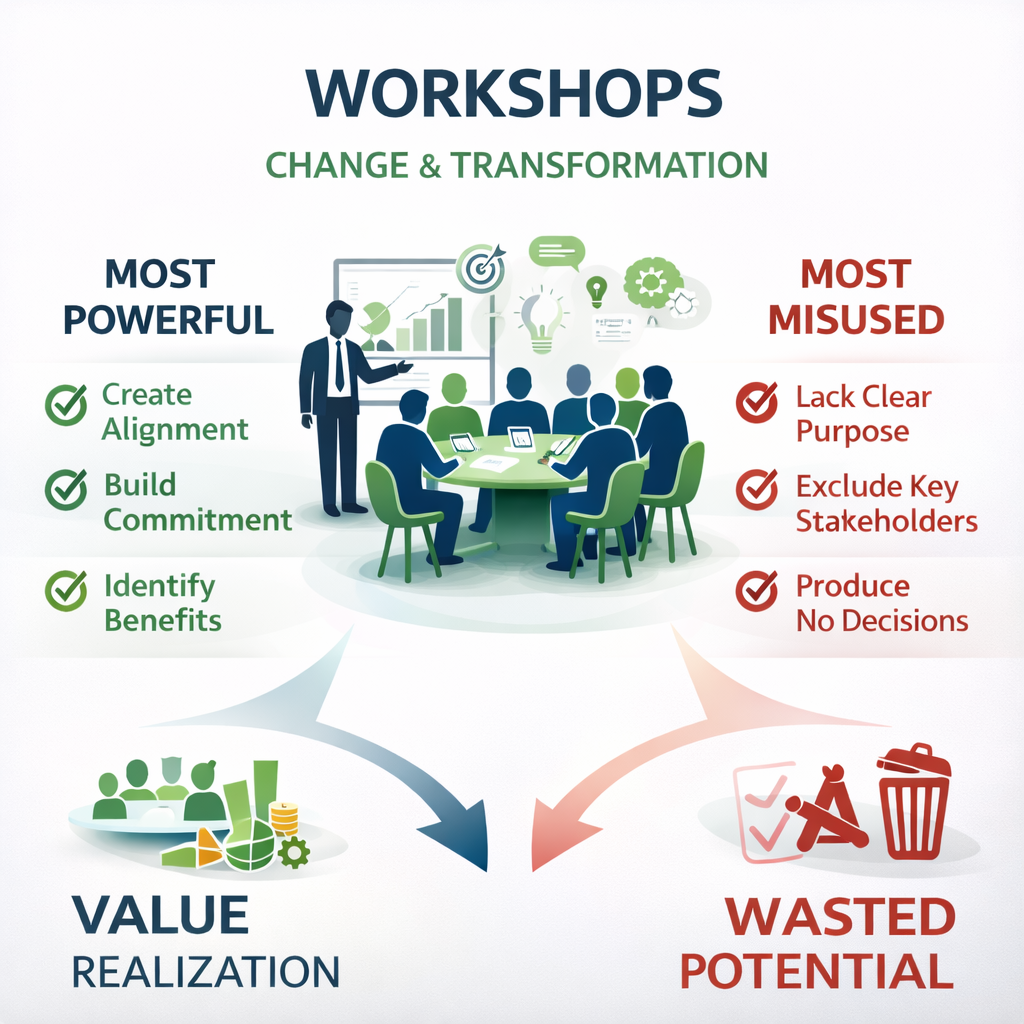
In almost every major transformation initiative, workshops appear somewhere in the execution plan. They are scheduled to gather requirements, align teams, review strategy, or discuss benefits. Flipcharts are filled, slides are presented, and action items are captured. Yet despite this apparent activity, many workshops fail to produce meaningful impact.
The problem is not the workshop format itself. The problem is how organizations conceptualize and design them. Workshops are often treated as administrative events rather than strategic instruments. When properly structured, workshops are among the most powerful tools for driving alignment, commitment, and value realization. When poorly designed, they become performative exercises that consume time without producing change.
Workshops, when used correctly, are not meetings. They are value acceleration mechanisms.
Why Workshops Matter in Benefit Realization
Benefit Realization Management emphasizes that value emerges from stakeholder behavior. Workshops create structured environments where stakeholders collectively define objectives, identify benefits, clarify dependencies, and surface risks. This shared process builds alignment and psychological ownership.
When stakeholders participate in articulating the purpose of change and the benefits expected, they are more likely to support and adopt the resulting initiatives. The workshop becomes the moment where strategic intent is translated into collective understanding.
Without this alignment, initiatives often suffer from fragmented interpretations of objectives. Teams operate with inconsistent assumptions about priorities and outcomes. Workshops, when designed strategically, prevent this fragmentation.
They align interpretation before execution begins.
Workshops as Alignment Engines
One of the most underestimated benefits of workshops is their ability to synchronize diverse perspectives. In transformation initiatives, stakeholders often represent different functions, incentives, and cultural contexts. Misalignment between these groups can silently erode value.
A well-designed workshop creates a shared frame of reference. It clarifies terminology, reconciles assumptions, and exposes conflicting expectations. It surfaces hidden risks and dependencies that might otherwise remain undiscovered until later stages of implementation.
This alignment is particularly critical in programs and portfolios, where multiple initiatives intersect. Workshops provide a mechanism to coordinate interdependencies and ensure that benefits are defined consistently across stakeholder groups.
Alignment reduces execution friction. Reduced friction accelerates value realization.
The Most Common Workshop Failure: Lack of Clear Purpose
Many workshops fail because their objectives are unclear. Participants are invited without a precise understanding of expected outcomes. Discussions drift into operational detail or abstract debate without producing decisions or clarity.
A successful workshop requires clear objectives aligned with strategic intent. Is the purpose to define benefits? To prioritize initiatives? To map dependencies? To resolve stakeholder conflict? Each objective demands a different structure and facilitation approach.
Without defined purpose, workshops devolve into conversations rather than decision-making environments. Participants leave uncertain about next steps or unclear about conclusions. The opportunity to build commitment is lost.
Strategic workshops are designed backward from desired outcomes.
The Right Participants: Influence Over Representation
Another frequent mistake is equating representation with effectiveness. Organizations invite participants based on organizational charts rather than influence or relevance. This may satisfy governance expectations but fail to include critical voices.
Workshops must include stakeholders who influence adoption and value realization. This may mean involving informal leaders, frontline operators, customers, or ecosystem partners—not just senior executives.
Including high-influence stakeholders early creates alignment and reduces downstream resistance. Conversely, excluding them increases the probability of later friction or rework.
Workshop design is therefore not only about agenda. It is about stakeholder strategy.
From Information Gathering to Commitment Creation
Workshops are often framed as information-gathering exercises. While collecting input is valuable, this framing underestimates their potential. Workshops are opportunities to build commitment.
Commitment emerges when participants contribute to defining solutions and objectives. It is reinforced when concerns are acknowledged and addressed transparently. It strengthens when decisions are made collaboratively.
In transformation initiatives, commitment is the bridge between capability deployment and value realization. Workshops can serve as commitment inflection points, where stakeholders transition from passive observers to active contributors.
This shift transforms execution dynamics.
Workshops as Governance Instruments
In portfolio and program governance, workshops serve as structured decision environments. They allow leadership teams to evaluate trade-offs, assess risk exposure, and prioritize investments collaboratively.
Rather than relying solely on financial metrics or executive intuition, workshops introduce diverse perspectives into governance decisions. This improves decision quality and increases alignment across leadership layers.
When used in benefits mapping, workshops clarify the relationship between initiatives, enabling capabilities, and expected outcomes. This strengthens the logic underpinning investment decisions and enhances accountability.
Governance becomes more robust when decision-making is informed by structured stakeholder dialogue.
The Cost of Poorly Designed Workshops
When workshops are poorly designed, the consequences extend beyond inefficiency. Participants may experience frustration, skepticism, or fatigue. Repeated ineffective workshops can reduce engagement in future initiatives.
Poor design may also produce false alignment—an illusion of agreement without genuine commitment. Decisions may be documented but not internalized. This creates a disconnect between strategic intent and operational behavior.
The opportunity cost is significant. Time invested without meaningful output reduces momentum and weakens trust.
Effective workshop design is therefore a leadership responsibility, not an administrative detail.
Designing Workshops for Value Realization
Strategic workshops share several characteristics. They have clearly defined objectives aligned with business outcomes. They include the right stakeholders, particularly those with influence over adoption. They are facilitated to encourage balanced participation and focused decision-making.
They produce tangible outputs—defined benefits, clarified dependencies, prioritized initiatives, or aligned commitments. They also generate intangible outputs—trust, shared understanding, and psychological ownership.
Importantly, they are embedded within a broader engagement strategy rather than treated as standalone events.
Workshops are not endpoints. They are catalysts within a continuous transformation process.
Implications for Portfolio, Product, and Transformation Leaders
For portfolio leaders, workshops enhance prioritization quality and reduce execution risk by aligning influential stakeholders early. They ensure that investment decisions consider behavioral realities alongside financial logic.
For product leaders, workshops accelerate discovery, clarify customer needs, and strengthen cross-functional alignment. They reduce the risk of building features disconnected from stakeholder value.
For transformation leaders, workshops serve as the structured forums where alignment, commitment, and shared vision are built.
Across domains, workshops act as accelerators of adoption.
Workshops as Strategic Leverage
In complex organizations, alignment is expensive and fragile. Workshops provide leverage—concentrated moments where alignment can be engineered deliberately rather than assumed.
When designed strategically, workshops compress decision cycles, clarify intent, and strengthen commitment. They reduce downstream friction and accelerate benefit realization.
The difference between a workshop and a meeting is strategic intent.
Workshops are powerful. But only when they are treated as instruments of value engineering rather than administrative rituals.
Used correctly, they are among the most effective tools in change and transformation.
Misused, they are wasted potential.
Reach a global audience of portfolio, program, and project managers, product leaders, and certification professionals. Explore advertising opportunities .
Sponsored