
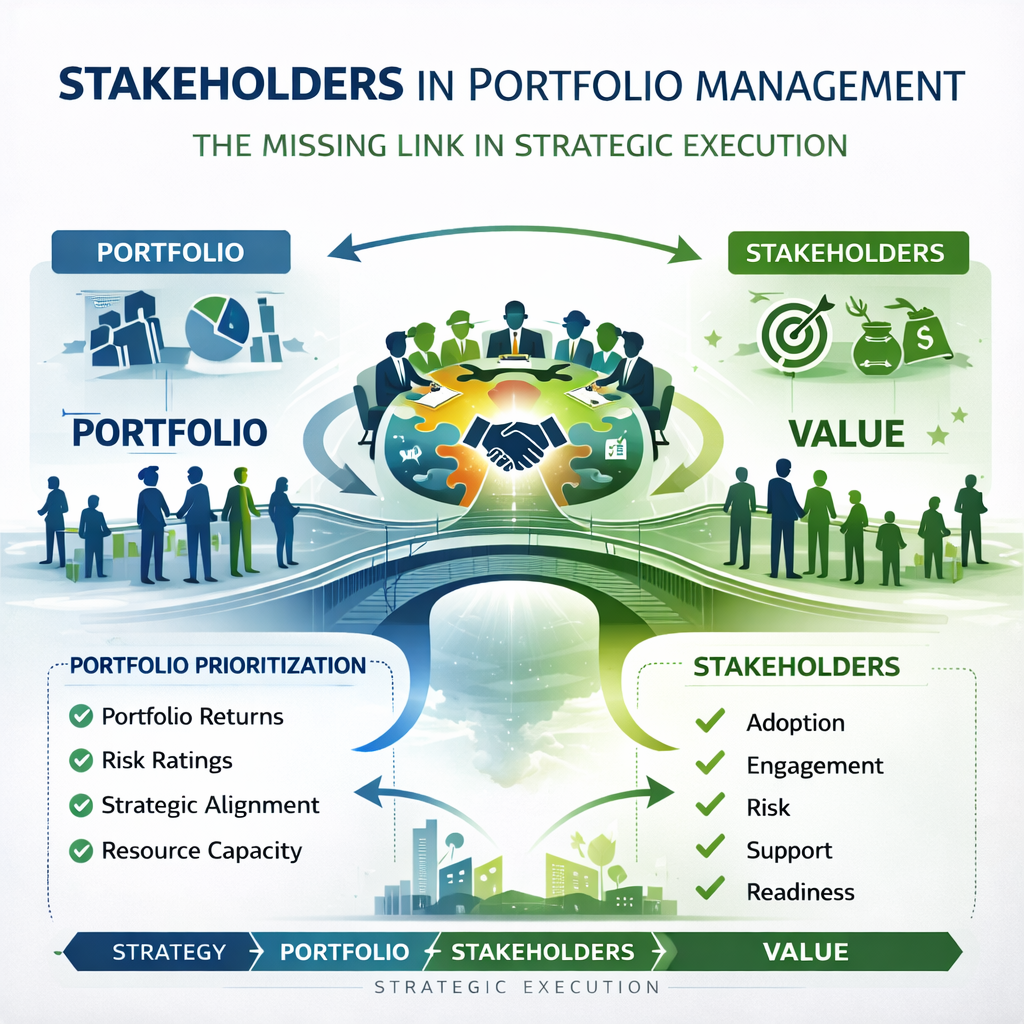
Portfolio management is often presented as a financial optimization exercise. Organizations evaluate initiatives using strategic alignment scores, expected returns, cost structures, risk ratings, and capacity constraints. Sophisticated dashboards provide visibility into capital allocation and delivery performance. On paper, the system appears rigorous and objective.
Yet despite this sophistication, many portfolios fail to deliver expected strategic outcomes. Investments are approved. Initiatives are executed. Capabilities are deployed. But the anticipated business value does not fully materialize.
The missing link is often stakeholder alignment.
Portfolio strategy is not executed through financial models alone. It is executed through stakeholder behavior. Without stakeholder engagement and commitment, even well-prioritized portfolios struggle to translate strategy into sustained value.
Portfolio Success Depends on Behavioral Adoption
Portfolio management allocates resources to initiatives intended to advance strategic objectives. However, initiatives produce capabilities—not value. Value emerges only when stakeholders adopt those capabilities and change behavior accordingly.
For example, a portfolio may prioritize digital self-service channels to reduce operational costs. The financial case may be strong. The technology may be robust. But if customers continue using traditional channels, or internal teams fail to promote digital alternatives, cost savings will not materialize.
Similarly, an innovation portfolio may fund new products designed to enter adjacent markets. Yet without customer adoption and internal enablement, projected growth remains theoretical.
Portfolio outcomes depend on stakeholder adoption.
Financial Logic Is Necessary but Not Sufficient
Financial evaluation remains essential in portfolio governance. Return projections, cost-benefit analysis, and risk assessments provide structured decision-making frameworks. However, financial models often assume successful execution and adoption.
This assumption introduces hidden risk.
Stakeholder resistance, misalignment, or indifference can undermine even the strongest business case. Conversely, strong stakeholder commitment can accelerate value realization beyond initial projections.
Portfolio decisions must therefore incorporate stakeholder readiness and engagement analysis. Ignoring stakeholder dynamics creates execution blind spots that financial models cannot detect.
Stakeholder Readiness as a Portfolio Filter
One of the most underutilized criteria in portfolio prioritization is stakeholder readiness. Initiatives differ not only in financial return but also in the degree of stakeholder support or resistance they face.
An initiative with moderate financial return but strong stakeholder alignment may deliver value more reliably than a high-return initiative facing significant resistance. Adoption risk must be considered alongside financial risk.
Portfolio leaders should assess:
- Executive sponsorship strength
- Operational stakeholder support
- Customer readiness for change
- Ecosystem partner alignment
- Cultural compatibility with the initiative
Incorporating these variables improves portfolio realism and reduces execution volatility.
Stakeholders Influence Interdependencies
Portfolios consist of interconnected initiatives. Dependencies across programs, products, and functions create complexity. Stakeholders often operate across multiple initiatives simultaneously.
Misalignment in one initiative can cascade across others. For example, if operational teams resist adopting a new data platform, analytics-driven initiatives elsewhere in the portfolio may stall. If customers reject a new digital interface, related efficiency initiatives may fail to achieve projected impact.
Stakeholder alignment reduces systemic risk across the portfolio. It stabilizes interdependencies and increases coherence between initiatives.
Portfolio strategy must account for these behavioral interconnections.
Governance Must Include Stakeholder Intelligence
Portfolio governance typically focuses on financial tracking, milestone reviews, and resource allocation. While these controls are important, they often overlook stakeholder sentiment as a strategic variable.
Stakeholder intelligence—insight into commitment levels, influence dynamics, and adoption trends—should be integrated into governance dashboards.
This may include:
- Stakeholder attitude assessments
- Adoption metrics
- Engagement indicators
- Sponsor visibility and support
- Resistance tracking
Early detection of declining stakeholder commitment allows leaders to intervene before performance metrics deteriorate.
Governance becomes proactive rather than reactive.
Stakeholders as Strategic Risk Multipliers
Stakeholder dynamics amplify or mitigate portfolio risk. High-influence stakeholders with negative attitudes can significantly increase execution risk. Conversely, influential champions can accelerate value realization.
The Influence–Attitude Matrix becomes particularly relevant at the portfolio level. It allows leaders to assess whether critical initiatives are supported by key stakeholders or exposed to resistance.
Portfolio leaders should allocate engagement resources strategically. Initiatives with elevated stakeholder risk may require enhanced executive involvement, targeted communication, or phased rollout strategies.
Stakeholder strategy is risk strategy.
Product Portfolios and Customer Behavior
In product portfolios, customer behavior determines return on investment. New features, platforms, or services must achieve adoption to generate revenue and retention.
Portfolio prioritization should consider not only market opportunity but also customer readiness. Are customers prepared to shift to digital channels? Are they willing to adopt subscription models? Do they perceive sufficient value in premium offerings?
Ignoring customer behavior in portfolio decisions results in misaligned investments.
Customer stakeholders shape product portfolio performance.
Strategic Execution Requires Stakeholder Alignment
Strategy defines direction. Portfolio management translates strategy into coordinated initiatives. Stakeholders execute those initiatives through behavior.
If stakeholder alignment is weak, strategic execution falters. If alignment is strong, execution accelerates.
Portfolio leaders must therefore view stakeholder engagement not as an operational detail but as a strategic enabler. Investment decisions should be accompanied by engagement strategies. Governance processes should monitor stakeholder alignment alongside financial metrics.
Strategic execution is behavioral execution.
Integrating Stakeholder Analysis into Portfolio Design
Stakeholder analysis should occur during portfolio design, not only during initiative execution. Leaders should evaluate how proposed initiatives affect key stakeholder groups and how those stakeholders are likely to respond.
Questions to consider include:
- Which stakeholders are most affected by this initiative?
- What behaviors must change to realize expected benefits?
- What resistance may emerge?
- What incentives must align to support adoption?
- Which stakeholders hold veto power or informal influence?
These questions transform portfolio design into a more comprehensive strategic exercise.
Stakeholders as the Bridge Between Strategy and Value
Portfolio management connects strategy to execution. Stakeholders connect execution to value.
Without stakeholder adoption, initiatives remain isolated technical accomplishments. With stakeholder alignment, initiatives produce measurable business outcomes.
Organizations that integrate stakeholder intelligence into portfolio governance improve strategic predictability. They reduce adoption risk, strengthen execution coherence, and enhance value realization.
Portfolio optimization without stakeholder alignment is incomplete.
Stakeholders are not peripheral to portfolio management.
They are the missing link in strategic execution.
Reach a global audience of portfolio, program, and project managers, product leaders, and certification professionals. Explore advertising opportunities .
Sponsored