
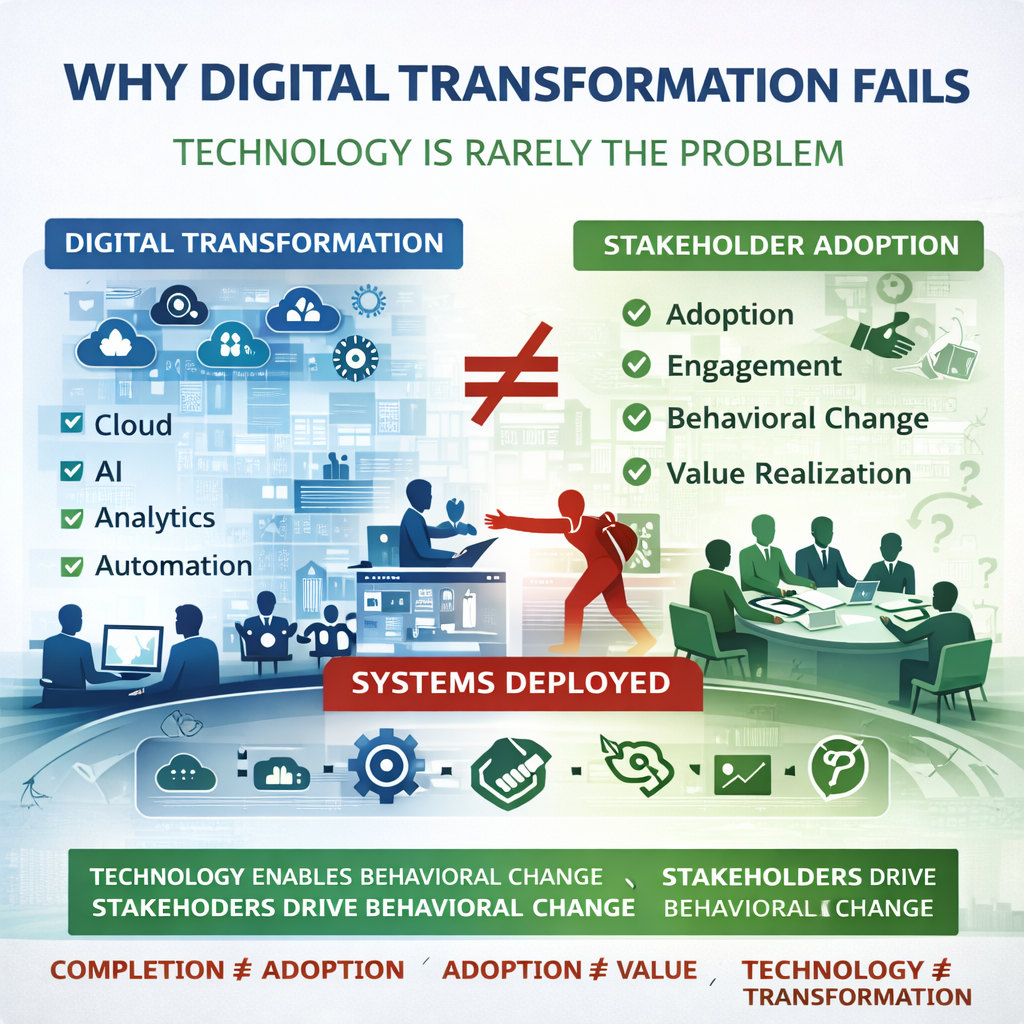
Digital transformation has become one of the defining strategic priorities of modern organizations. Companies invest billions in cloud platforms, artificial intelligence, automation, advanced analytics, and digital customer experiences. Technology vendors promise efficiency gains, cost reductions, and competitive advantage. Transformation roadmaps are developed, and implementation programs are launched with urgency and optimism.
Yet despite these investments, many digital transformation initiatives fail to deliver their expected value. Systems are deployed successfully. Platforms operate as designed. Technical milestones are achieved. But business performance improvements fall short of expectations.
The reason is not technological failure.
Technology is rarely the problem. Stakeholder adoption is.
Digital Transformation Is a Behavioral Transformation
Digital transformation is often framed as a technological upgrade. Organizations replace legacy systems, deploy new platforms, and modernize infrastructure. While these technical changes are necessary, they are not sufficient.
Transformation occurs when stakeholders change how they work, how they make decisions, and how they interact with customers. Technology enables new possibilities, but stakeholders must adopt those possibilities for value to emerge.
For example, deploying advanced analytics does not improve decision-making unless managers incorporate data into their decisions. Implementing digital customer channels does not reduce operational costs unless customers adopt those channels.
Transformation success depends on behavioral change.
Technology enables transformation. Stakeholders execute transformation.
Capability Deployment Does Not Guarantee Value Realization
Organizations frequently measure transformation progress by technical completion. Systems implemented, applications deployed, integrations completed, and infrastructure modernized are treated as indicators of success.
These are indicators of capability deployment, not value realization.
Value is realized only when capabilities are used effectively. If stakeholders continue relying on legacy processes, avoid new systems, or adopt them only superficially, expected benefits remain unrealized.
This gap explains why many organizations achieve technical success but strategic disappointment.
Completion is not adoption. Adoption is not optimization. Optimization is not value realization.
Each step requires stakeholder engagement and commitment.
Resistance Is Often Rational, Not Emotional
Stakeholder resistance is commonly viewed as an emotional or cultural barrier. In reality, resistance is often a rational response to perceived risk, uncertainty, or insufficient benefit.
Digital transformation frequently introduces new workflows, new tools, and new expectations. Stakeholders must invest time and effort to learn new systems. They may fear reduced productivity during transition or loss of expertise relevance.
If the perceived benefits do not clearly outweigh these costs, resistance becomes logical.
Organizations must address stakeholder incentives directly. Transformation must be positioned not only as an organizational benefit but as a stakeholder benefit.
Stakeholders adopt change when they perceive value for themselves.
Technology Adoption Is the True Transformation Milestone
Many organizations celebrate system go-live as the transformation milestone. In reality, go-live marks the beginning of transformation, not its completion.
Transformation milestones should focus on adoption metrics:
- Percentage of users actively using new systems
- Frequency of digital channel utilization
- Reduction in legacy system reliance
- Improvements in decision speed and quality
- Customer adoption of digital capabilities
These indicators reflect behavioral change. Behavioral change reflects transformation progress.
Technology deployment enables transformation potential. Adoption converts potential into reality.
Leadership Alignment Determines Transformation Credibility
Stakeholders observe leadership behavior to assess transformation seriousness. If executives actively use new systems, reinforce new behaviors, and align incentives with transformation objectives, stakeholders interpret transformation as genuine.
If executives continue relying on legacy reports, tolerate inconsistent adoption, or send mixed signals, stakeholders perceive transformation as optional.
Leadership behavior establishes organizational norms.
Transformation requires visible executive commitment, consistent messaging, and aligned incentives.
Leadership signals shape stakeholder behavior.
Transformation Fails When Treated as an IT Initiative
One of the most common causes of digital transformation failure is treating it as a technology initiative rather than a business initiative.
Technology teams may successfully implement platforms, but without operational ownership and business engagement, adoption remains limited.
Transformation must be owned by business leaders, supported by technology teams, and embraced by stakeholders across the organization.
Technology provides tools. Business stakeholders create value.
Transformation is not an IT project. It is an organizational evolution.
Customer Adoption Determines External Value Realization
Digital transformation often aims to improve customer experience, reduce service costs, and enable new business models. These outcomes depend on customer adoption.
Organizations may launch digital channels, self-service platforms, or mobile applications. However, if customers continue using traditional channels, expected efficiency gains and growth opportunities will not materialize.
Customer engagement strategies must accompany technological deployment. Customers must perceive clear benefits, ease of use, and trust in digital channels.
External stakeholders determine external value realization.
Governance Must Monitor Adoption, Not Just Delivery
Traditional governance focuses on delivery metrics: timelines, budgets, and technical milestones. While these metrics are necessary, they do not measure transformation success.
Governance must include adoption metrics, stakeholder engagement indicators, and value realization tracking.
Portfolio and transformation leaders should monitor:
- Stakeholder commitment levels
- Adoption rates
- Usage patterns
- Behavioral change indicators
- Benefit realization progress
This shifts governance focus from delivery oversight to value realization oversight.
Governance becomes outcome-driven rather than activity-driven.
Transformation Requires Stakeholder Engineering
Successful digital transformation requires deliberate stakeholder engagement. Organizations must identify affected stakeholders, understand their incentives, and align transformation objectives with stakeholder priorities.
This process includes:
- Early stakeholder involvement
- Clear articulation of benefits
- Training and enablement
- Incentive alignment
- Continuous engagement and feedback
Stakeholder engagement is not a support activity. It is a core transformation discipline.
Transformation success depends on stakeholder engineering as much as technology engineering.
Technology Enables. Stakeholders Decide.
Digital transformation investments create potential. Stakeholders determine whether that potential becomes value.
Organizations that focus exclusively on technology underestimate the behavioral dimension of transformation. They invest in systems without investing equally in adoption.
Organizations that integrate stakeholder engagement into transformation strategy achieve stronger outcomes. They recognize that transformation is ultimately a human process enabled by technology.
Technology rarely causes transformation failure.
Failure occurs when stakeholders do not adopt, commit to, or sustain new behaviors.
Digital transformation is not primarily a technology challenge.
It is a stakeholder challenge.
Reach a global audience of portfolio, program, and project managers, product leaders, and certification professionals. Explore advertising opportunities .
Sponsored