
Modern organizations are increasingly comfortable speaking the language of value. Boards ask for measurable outcomes. Executives demand quantified benefits. Business cases are expected to show return on investment, payback periods, and cost reduction targets. On paper, everything appears disciplined and rational. Yet, despite this maturity in financial framing, many initiatives still fail to produce the benefits they promised. Not because the math was wrong — but because the underlying assumption was flawed.
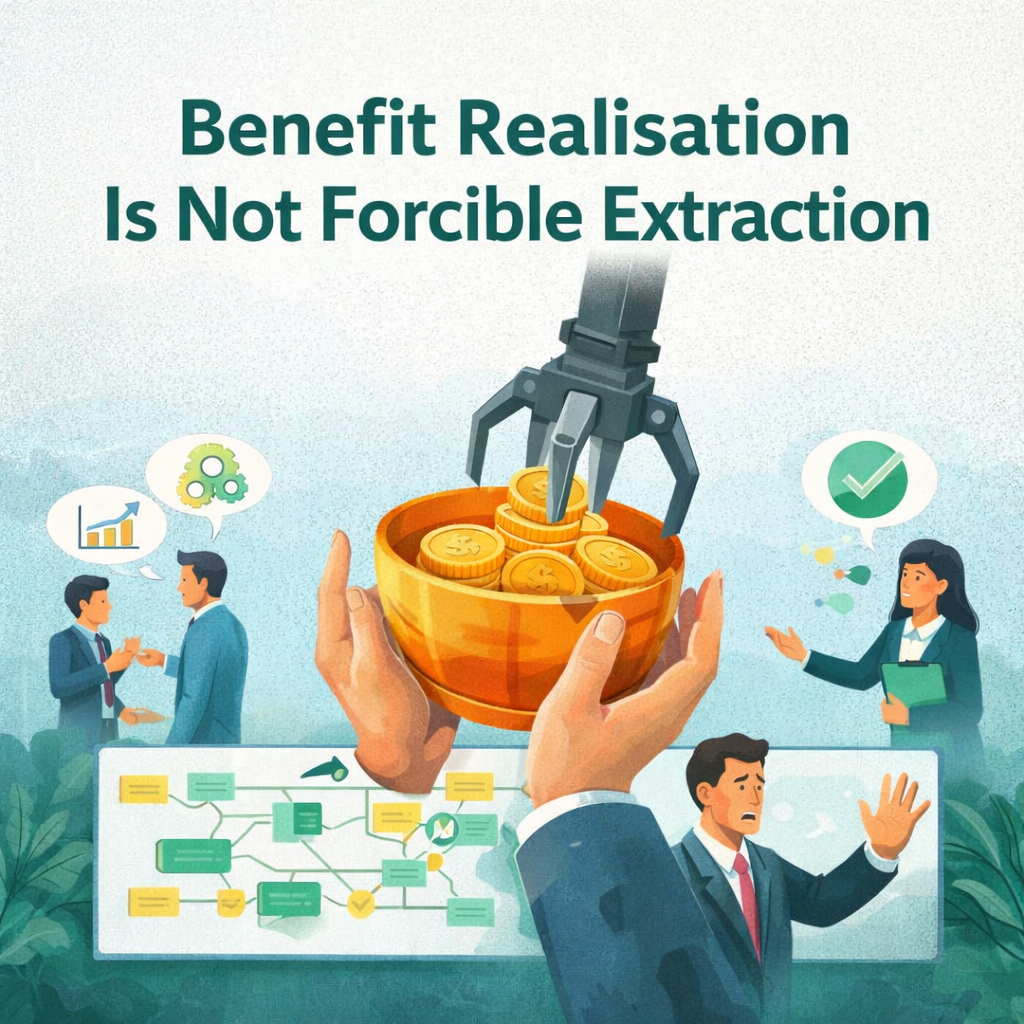
The assumption is this: if a benefit is defined, approved, and monitored, it can be extracted. As if value were a mineral embedded inside a project, waiting to be mined through governance, dashboards, and pressure. This mindset treats benefit realisation as a mechanical act — something that can be forced into existence through control. In reality, benefit realisation is not extraction. It is emergence. And emergence cannot be coerced.
The Dangerous Illusion of Control
Many organisations behave as though benefits sit at the end of a delivery pipeline. Once the system is implemented, the process redesigned, or the technology deployed, benefits are assumed to automatically materialise. When they do not, the reaction is predictable: increase oversight, tighten reporting, add more KPIs, escalate accountability. The logic is simple — if results are not appearing, pressure must be insufficient.
However, benefits are rarely the direct output of a deliverable. They are the result of behavioural change within a system of people. A new digital platform does not reduce costs by itself. A redesigned workflow does not increase productivity on its own. A new CRM does not improve customer retention simply because it was installed. These outcomes depend on how people adopt, interpret, and integrate the change into daily practice. No governance mechanism can force genuine adoption.
When organisations attempt to “forcibly extract” benefits, they often create the opposite effect. Managers chase targets disconnected from operational reality. Employees comply superficially while preserving old habits. Measurement becomes an exercise in narrative rather than truth. Instead of realising value, the organisation begins manufacturing the appearance of value.
Benefits Are Not Outputs
A fundamental misunderstanding sits at the heart of many failed initiatives: the confusion between outputs and benefits. Outputs are deliverables. Benefits are the positive consequences that arise when those deliverables are effectively embedded into organisational life. Outputs are tangible and controllable. Benefits are contextual and conditional.
A project can guarantee outputs. It cannot guarantee benefits.
For example, a hospital may implement a new scheduling system designed to reduce patient waiting times. The system may go live on schedule and within budget. That is an output. Reduced waiting times, however, depend on staff using the system correctly, adjusting booking practices, and managing capacity differently. If behaviours do not shift, waiting times remain unchanged — even though the project was technically successful.
In such cases, organisations sometimes attempt to “enforce” the intended benefit by mandating compliance. Yet compliance does not equal commitment. And commitment is what benefits require.
Realisation Is a Human Process
Benefit realisation occurs through people doing things differently. It manifests in changed attitudes, new decisions, revised priorities, and altered interactions. It requires managers to relinquish familiar routines and teams to experiment with unfamiliar practices. These transitions involve uncertainty and discomfort. They cannot be imposed purely through formal authority.
When benefits are treated as extractable commodities, the human dimension is ignored. The organisation focuses on the business case while neglecting the behavioural contract implicit in the change. Leaders may approve projected savings without ensuring that operational managers agree with — or even believe in — the assumptions underlying them. As a result, benefits remain theoretical.
Realisation requires ownership. Not in the abstract sense of assigning a name to a spreadsheet column, but in the practical sense of someone actively believing in, advocating for, and working toward the intended outcome. Without genuine ownership, benefits remain aspirations documented in governance artefacts.
The Myth of Immediate Financial Conversion
Another common distortion of benefit realisation is the premature conversion of outcomes into financial figures. Organisations often feel compelled to quantify benefits in monetary terms before they are understood operationally. While financial modelling is important for investment decisions, it can create false certainty about how value will actually emerge.
Not all benefits are immediately measurable in currency. Improved customer trust, enhanced reputation, or increased staff morale are often precursors to financial improvement rather than direct financial events. Attempting to force these into early monetary metrics can distort behaviour. Managers may prioritise short-term measurable gains over longer-term structural improvements.
This does not mean financial discipline should be abandoned. It means sequencing matters. Benefits must first be clearly conceived, then operationally defined, then behaviourally embedded — and only then financially realised. Skipping steps in this progression is one of the most common reasons organisations struggle to see tangible returns from transformation efforts.
Accountability Without Coercion
There is a subtle but critical difference between accountability and coercion. Accountability ensures clarity about who is responsible for nurturing a benefit into existence. Coercion assumes that pressure alone can cause it to appear. When leaders blur this distinction, they undermine both trust and effectiveness.
True accountability involves alignment between authority and influence. A benefit owner must have the ability to influence the conditions necessary for the benefit to occur. If a sales manager is held accountable for increased revenue but has no control over pricing strategy, marketing investment, or product quality, accountability becomes symbolic. The result is frustration, not performance.
Forcible extraction typically arises when accountability is misaligned. Senior executives, under pressure to deliver promised returns, push responsibility downward without ensuring structural alignment. The organisation responds with defensive reporting, inflated narratives, or selective metrics. The appearance of control increases while actual realisation declines.
The Role of Benefit Mapping
One of the most powerful antidotes to forcible extraction is the explicit mapping of cause-and-effect relationships. A benefit map makes visible the chain of dependencies linking enablers, changes, intermediate outcomes, and ultimate strategic objectives. It demonstrates that benefits are not isolated events but interconnected consequences.
When organisations skip this mapping exercise, they underestimate the complexity of realisation. They assume a linear path from project completion to financial improvement. In reality, benefits often require multiple behavioural shifts across different stakeholder groups. Without understanding these dependencies, leaders may push for results that cannot logically occur yet.
Benefit mapping reframes the conversation from “Why have the benefits not appeared?” to “Which dependencies have not yet been fulfilled?” This shift moves the organisation away from blame and toward systemic analysis. It replaces pressure with insight.
The Cultural Dimension
Forcible extraction is often a symptom of a deeper cultural issue — the belief that performance is primarily driven by targets rather than by shared understanding. In such environments, metrics dominate conversations, and qualitative factors are dismissed as secondary. While measurement is essential, culture ultimately determines whether measurement leads to improvement or distortion.
If employees believe that benefit reporting is primarily about satisfying senior leadership, they will optimise for optics. If they believe it is about learning and collective progress, they will engage authentically. The difference lies in whether realisation is framed as enforcement or as shared ambition.
A culture that supports benefit realisation emphasises clarity of purpose, psychological safety, and transparent dialogue about assumptions. It recognises that unexpected obstacles are part of change and that honest reporting is more valuable than short-term reassurance.
Rewarding the Right Things
Incentive structures can either support or sabotage realisation. Many organisations attempt to reward benefit achievement by linking bonuses directly to projected outcomes. While this may appear logical, it can create unintended consequences. If outcomes depend on multiple external variables, individuals may feel punished for factors outside their control.
Moreover, if incentives are tied to premature financial targets, managers may prioritise accounting adjustments over operational transformation. Short-term savings can be claimed through cost deferrals or reclassifications without addressing root causes. This creates the illusion of benefit while undermining long-term performance.
Effective reward structures recognise shared responsibility and staged progression. They reward the fulfilment of enabling conditions and intermediate outcomes, not only the final financial metric. This approach reinforces collaboration rather than competition and reduces the temptation to manipulate data.
Realisation as Progressive Commitment
Benefit realisation should be understood as a progressive commitment rather than a single milestone. It evolves through stages: conception, clarification, operationalisation, embedding, and measurement. Each stage requires deliberate attention and leadership. Attempting to jump directly from approval to financial reporting bypasses the necessary cultural and behavioural work.
This progressive view also acknowledges uncertainty. Not every intended benefit will materialise exactly as predicted. Market conditions change. Customer expectations evolve. Operational constraints surface. Treating the business case as immutable discourages adaptation. Treating it as a hypothesis encourages learning.
When organisations view benefits as hypotheses to be validated rather than promises to be enforced, they create space for intelligent adjustment. Realisation becomes a process of refinement rather than extraction.
From Pressure to Stewardship
Ultimately, the difference between forcible extraction and authentic realisation lies in leadership posture. Extraction is driven by pressure. Realisation is driven by stewardship. Pressure seeks immediate confirmation. Stewardship nurtures conditions for sustainable impact.
Leaders who adopt a stewardship mindset recognise that benefits cannot be commanded into existence. They must be cultivated through alignment, clarity, and trust. This does not mean lowering expectations. On the contrary, it means raising the quality of thinking about how value emerges.
Organisations that master benefit realisation understand that value is not buried inside a project waiting to be mined. It is created when people interpret change as meaningful, integrate it into practice, and sustain it over time. No dashboard can substitute for this process.
Conclusion
Benefit realisation is not forcible extraction. It is the disciplined orchestration of behavioural change aligned to strategic intent. Projects can deliver systems. Governance can monitor metrics. Finance can model returns. But only people, acting with ownership and understanding, can turn change into tangible advantage.
When organisations abandon the illusion of extraction and embrace the reality of emergence, they move from performative value management to authentic value creation. They replace pressure with alignment, compliance with commitment, and reporting with learning.
In doing so, they transform benefit realisation from a post-project accounting exercise into what it was always meant to be: a deliberate, human-centered pathway from aspiration to sustainable impact.
Reach a global audience of portfolio, program, and project managers, product leaders, and certification professionals. Explore advertising opportunities .
Sponsored