
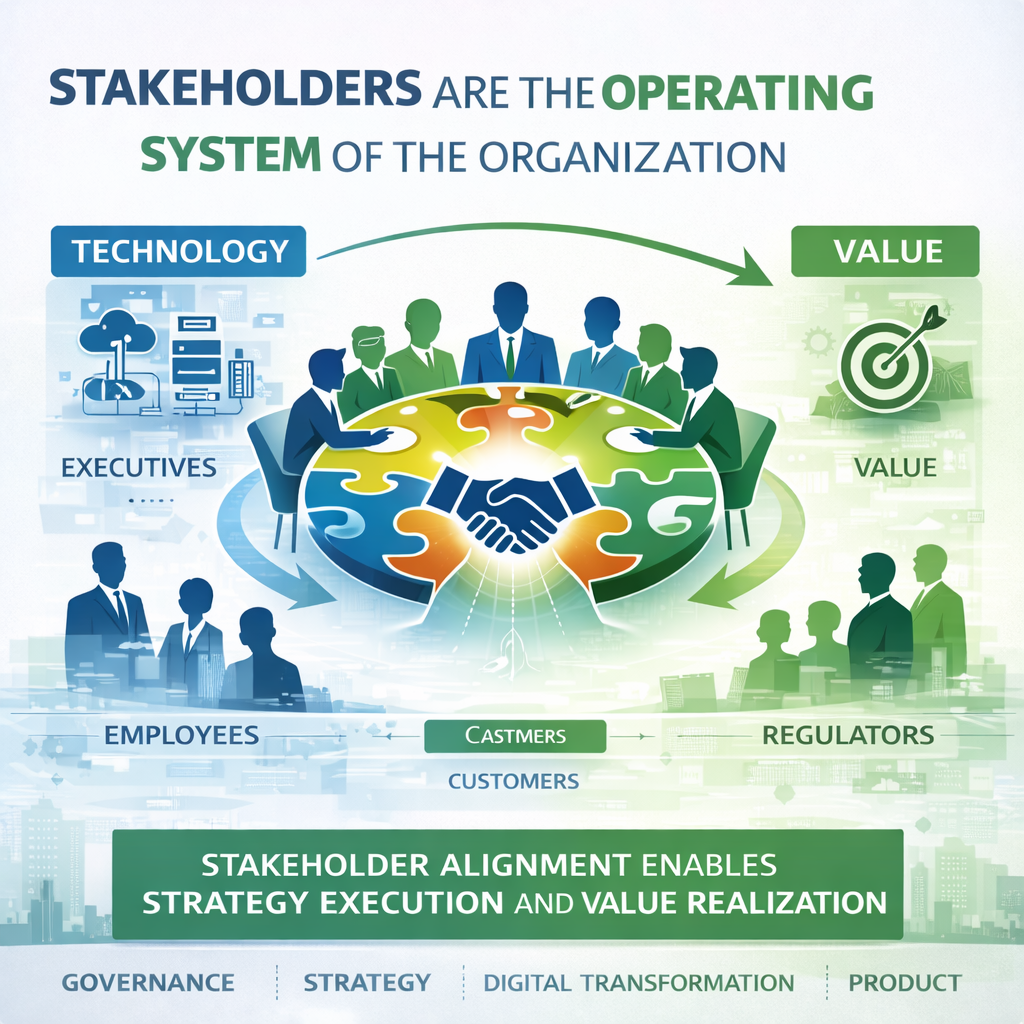
Every modern organization invests heavily in infrastructure. It deploys enterprise platforms, integrates systems, builds digital products, and implements sophisticated technology stacks. These systems are often described as the backbone of the organization—the foundation upon which operations depend.
Yet technology alone does not determine how an organization behaves.
The true operating system of any organization is not its technology. It is its stakeholders.
Stakeholders—executives, employees, customers, partners, and regulators—determine how systems are used, how decisions are made, how priorities are interpreted, and how strategies are executed. Technology provides capability. Stakeholders provide direction.
Without stakeholders, technology is inert. With aligned stakeholders, technology becomes transformative.
Technology Executes Instructions. Stakeholders Define Them.
An operating system enables a computer to function. It manages resources, coordinates processes, and provides the environment in which applications operate. Without it, hardware remains unusable.
Stakeholders perform an analogous function in organizations. They interpret strategy, allocate attention, and translate abstract objectives into operational behavior. They decide which systems to use, which priorities to pursue, and which initiatives to support.
Even the most advanced systems require stakeholder interpretation and action. A data platform does not improve decision-making unless stakeholders choose to use data. A customer platform does not improve experience unless stakeholders use it to engage customers differently.
Technology executes instructions. Stakeholders define them.
Stakeholders Determine Organizational Behavior
Organizational behavior emerges from collective stakeholder decisions. Processes may be documented, and policies may be defined, but stakeholders determine how these structures function in practice.
Two organizations may deploy identical systems and processes but produce radically different outcomes. The difference lies in stakeholder behavior—how individuals prioritize tasks, respond to change, and align with strategic objectives.
Stakeholders influence culture, responsiveness, innovation, and adaptability. Their beliefs, incentives, and commitments shape organizational performance.
Systems enable consistency. Stakeholders determine effectiveness.
Misaligned Stakeholders Create Organizational Instability
In computing, an unstable operating system produces unreliable behavior. Applications crash, processes conflict, and performance deteriorates. A similar phenomenon occurs in organizations with misaligned stakeholders.
When stakeholders interpret strategy differently, priorities fragment. Teams pursue conflicting objectives. Resources are allocated inconsistently. Execution becomes inefficient.
Misalignment creates friction. Friction slows execution. Slow execution reduces competitiveness.
Technology cannot compensate for stakeholder misalignment. It may even amplify the problem by increasing complexity.
Organizational stability depends on stakeholder alignment.
Aligned Stakeholders Amplify Organizational Capability
When stakeholders are aligned, organizational capability increases dramatically. Decisions are consistent. Priorities are clear. Execution accelerates.
Aligned stakeholders reinforce each other’s actions. Executives provide direction. Teams execute confidently. Customers respond positively. Partners integrate effectively.
This alignment creates momentum. Strategic initiatives progress faster. Value realization accelerates. Competitive advantage strengthens.
Stakeholder alignment multiplies the effectiveness of organizational resources.
Digital Transformation Is a Stakeholder Operating System Upgrade
Digital transformation is often described as technology modernization. In reality, it is an operating system upgrade for stakeholders.
New systems introduce new capabilities, but stakeholders must adopt new behaviors to realize their potential. They must change how they work, how they collaborate, and how they make decisions.
If stakeholder behavior remains unchanged, digital transformation produces limited impact. Legacy behaviors persist despite modern technology.
Transformation success depends on upgrading stakeholder operating patterns, not just technological infrastructure.
Behavioral change is the true transformation.
Stakeholders Determine Whether Strategy Becomes Reality
Strategy defines intended direction. Stakeholders determine actual direction.
Executives may define strategic objectives, but execution depends on thousands of daily decisions made by stakeholders throughout the organization. These decisions collectively determine whether strategy succeeds or fails.
If stakeholders understand and support strategy, their actions reinforce strategic objectives. If they misunderstand or resist strategy, their actions undermine it.
Strategy exists in documents. Execution exists in stakeholder behavior.
Stakeholders translate strategy into reality.
Governance Is the Mechanism That Aligns the Operating System
Governance structures provide mechanisms to align stakeholder behavior. They define accountability, incentives, and decision authority. They reinforce strategic priorities and enable coordinated execution.
Effective governance ensures that stakeholders interpret strategy consistently. It aligns incentives with strategic objectives. It provides feedback mechanisms to detect misalignment early.
Governance maintains operating system stability.
Without governance, stakeholder behavior becomes fragmented. Strategic execution becomes unpredictable.
Governance aligns stakeholders with strategy.
Customers Are External Components of the Operating System
Customers are not external observers. They are integral components of the organizational operating system.
Customer behavior determines revenue, growth, and market position. Their adoption decisions influence product success. Their feedback shapes future strategy.
Organizations cannot control customers directly. They must design products, experiences, and value propositions that align with customer needs and incentives.
Customer alignment is essential for value realization.
The organizational operating system extends beyond internal stakeholders.
Stakeholder Commitment Determines Organizational Performance
Stakeholder commitment determines whether stakeholders actively support organizational objectives or passively comply. Commitment influences effort, persistence, and adaptability.
Committed stakeholders invest energy in overcoming obstacles. They contribute ideas, support change, and reinforce alignment.
Uncommitted stakeholders follow minimum requirements. They avoid risk and resist change.
Commitment determines execution quality.
High commitment strengthens organizational capability. Low commitment weakens it.
Stakeholder commitment is organizational energy.
Stakeholders Are the Foundation of Value Realization
Organizations create capabilities. Stakeholders create value.
Benefit Realization Management recognizes this principle. Benefits emerge when stakeholders use capabilities to produce improved outcomes.
Technology enables potential. Stakeholders convert potential into value.
Organizations that recognize stakeholders as their operating system invest accordingly. They align stakeholders, engage stakeholders, and support stakeholder commitment.
They understand that strategic success depends not only on technology or strategy but on stakeholder alignment.
Technology is infrastructure.
Stakeholders are the operating system.
And the operating system determines how everything functions.
Reach a global audience of portfolio, program, and project managers, product leaders, and certification professionals. Explore advertising opportunities .
Sponsored