
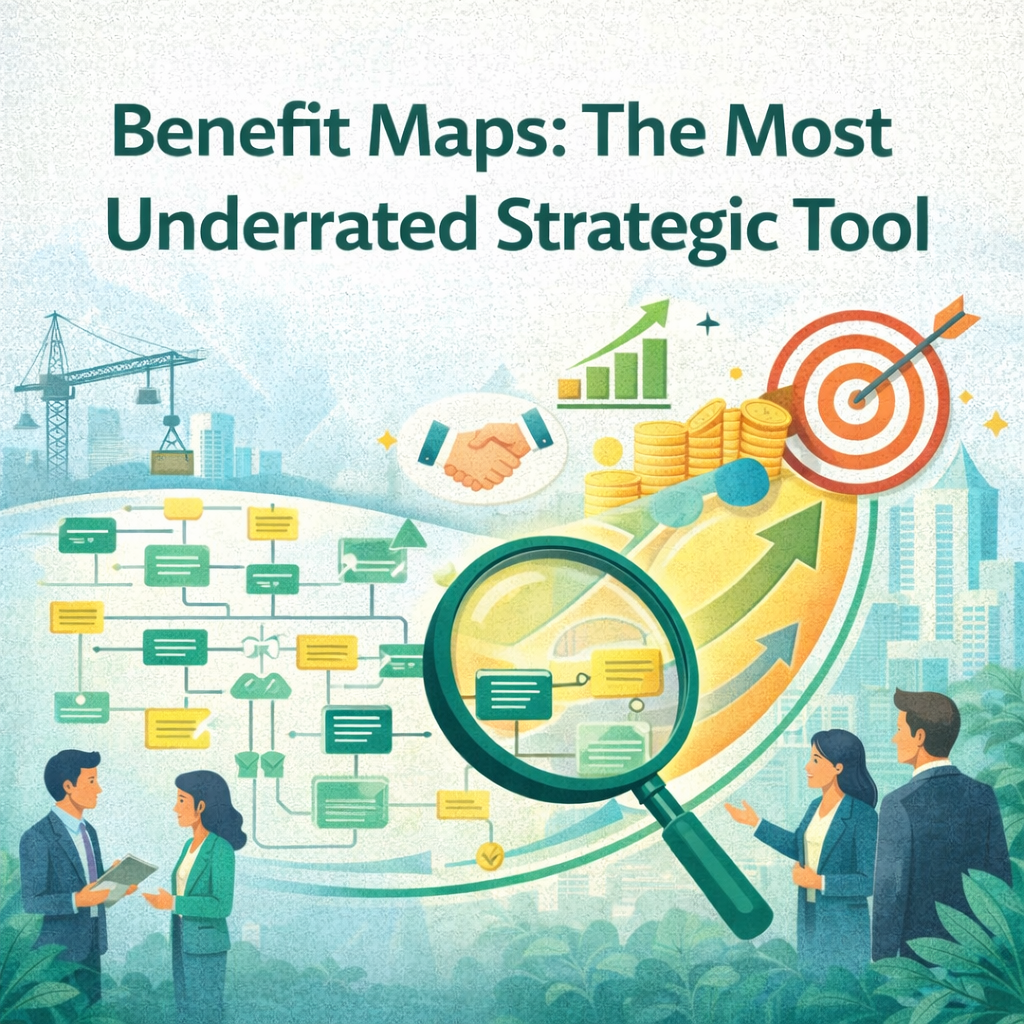
In many organisations, strategy is presented as a set of ambitions. Executives define growth targets, operational improvements, customer experience goals, or digital transformation initiatives. These ambitions are then translated into programmes and projects designed to implement systems, redesign processes, or deploy new technologies. The expectation is that these initiatives will naturally lead to the desired outcomes.
However, between the intention of strategy and the reality of outcomes lies a critical challenge: understanding how change actually produces value. Many organisations assume that once a project is completed, the benefits will follow. Yet the path from deliverables to value is rarely direct. It is a chain of interconnected changes involving people, processes, behaviours, and dependencies.
Benefit maps provide a structured way to visualise this chain. Despite their power, they remain one of the most underused tools in strategic execution. While organisations invest significant effort in planning projects and measuring results, far fewer invest the time needed to map the causal relationships that connect the two. As a result, many transformation initiatives struggle not because they lack ambition, but because they lack clarity about how benefits will emerge.
The Missing Link Between Strategy and Execution
One of the most common challenges in organisational transformation is the gap between strategic intent and operational reality. Strategy documents often describe high-level outcomes such as increased revenue, improved customer satisfaction, or greater efficiency. These outcomes are then associated with specific initiatives, but the intermediate steps that connect them are rarely articulated in detail.
Without this intermediate logic, initiatives become isolated efforts. Projects deliver outputs, but the organisation struggles to understand how those outputs translate into strategic value. When expected benefits fail to appear, the response is often confusion or blame. Leaders ask why the project did not deliver value, while project teams point out that they delivered exactly what was requested.
Benefit maps address this problem by making the logic of value creation explicit. They show how enabling changes lead to behavioural changes, which in turn produce measurable outcomes and ultimately strategic benefits. This structured visibility transforms strategy from a statement of intent into a coherent pathway of cause and effect.
Understanding the Structure of a Benefit Map
At its core, a benefit map represents the relationships between four key elements: enablers, changes, intermediate outcomes, and ultimate benefits. Each element represents a stage in the journey from initiative to value.
Enablers are the capabilities introduced by a project or programme. These may include new technologies, redesigned processes, improved infrastructure, or updated organisational structures. Enablers create the conditions for change but do not produce value on their own.
Changes represent the behavioural or operational adjustments required to take advantage of the new capability. Employees may need to adopt new workflows, managers may need to make decisions differently, or customers may interact with the organisation through new channels.
Intermediate outcomes capture the early effects of these behavioural changes. These outcomes often serve as leading indicators that the transformation is progressing in the intended direction. Examples might include faster response times, reduced error rates, or improved process visibility.
Finally, benefits represent the strategic outcomes that justify the initiative in the first place. These may include increased profitability, improved customer loyalty, enhanced market share, or stronger organisational resilience.
By connecting these elements in a logical chain, benefit maps illustrate how strategic objectives depend on a series of coordinated changes.
Revealing Hidden Dependencies
One of the greatest strengths of benefit maps is their ability to reveal dependencies that might otherwise remain invisible. In complex organisations, benefits rarely emerge from a single change. Instead, they depend on multiple adjustments across different parts of the organisation.
For example, a company may introduce a new digital sales platform with the goal of increasing revenue. At first glance, the technology itself may appear to be the primary driver of the benefit. However, a benefit map may reveal that revenue growth also depends on several other factors. Sales teams must be trained to use the platform effectively. Marketing must generate digital leads. Customer service must support new online interactions. Pricing strategies may need adjustment to reflect digital channels.
Without recognising these dependencies, organisations may assume that the project alone will deliver the benefit. When revenue fails to increase, the technology is often blamed. In reality, the broader ecosystem of change was never fully addressed.
Benefit maps help prevent this misunderstanding by showing how multiple changes contribute to the same outcome. They shift the conversation from “Did the project succeed?” to “Have all the conditions required for the benefit been fulfilled?”
Aligning Stakeholders Around Value
Another important function of benefit maps is their ability to align stakeholders. In many transformation initiatives, different groups hold different assumptions about what success looks like. Executives may focus on financial returns, operational leaders may prioritise efficiency improvements, and project teams may concentrate on delivering technical capabilities.
Without a shared framework, these perspectives can become fragmented. Each group measures success according to its own criteria, leading to confusion and misaligned expectations. Benefit maps provide a common language that connects these viewpoints.
By visually representing the path from initiative to outcome, benefit maps help stakeholders understand how their actions contribute to the broader objective. Operational leaders can see how behavioural changes affect strategic results. Project teams can understand how the capabilities they deliver enable business improvements. Executives gain visibility into the assumptions underlying projected benefits.
This shared understanding strengthens commitment across the organisation. When stakeholders see how their contributions fit into the larger system of value creation, collaboration becomes more natural and effective.
Improving Strategic Decision-Making
Benefit maps are not only useful for understanding existing initiatives; they also improve decision-making during planning. When organisations evaluate potential investments, they often rely on financial models or high-level projections. While these tools are valuable, they sometimes conceal unrealistic assumptions about how value will emerge.
Creating a benefit map during the planning stage forces leaders to articulate the causal logic behind projected benefits. If a proposed outcome depends on behavioural changes that seem unlikely or difficult to achieve, this becomes visible immediately. Leaders can then reconsider the initiative, adjust the design, or invest in additional support mechanisms.
In this way, benefit maps act as a form of strategic stress testing. They expose weak assumptions before resources are committed. This not only improves the quality of investment decisions but also increases the likelihood that approved initiatives will deliver real value.
Supporting Benefit Ownership
Benefit maps also play a critical role in clarifying ownership. As discussed in previous discussions on benefit realisation, benefits are not delivered by projects but owned by business leaders responsible for operational performance. Yet assigning ownership is difficult when the relationships between initiatives and outcomes are unclear.
By identifying the chain of dependencies that produce each benefit, benefit maps make it easier to determine who should take responsibility for different parts of the transformation. Operational leaders can see where their decisions influence outcomes. Project sponsors can understand which organisational units must adopt new behaviours.
This clarity prevents the common situation in which benefits are assumed to belong to the project team simply because the project initiated the change. Instead, responsibility is distributed according to where influence actually resides within the organisation.
Preventing Double Counting and Misinterpretation
Benefit maps also help organisations avoid a common analytical error: double counting benefits. In complex programmes, multiple initiatives may contribute to the same outcome. Without a clear understanding of these relationships, the same benefit may be attributed to several projects simultaneously, creating inflated expectations about overall impact.
A benefit map clarifies how different initiatives interact. It shows whether projects contribute independently to separate outcomes or jointly to the same outcome. This transparency prevents unrealistic benefit forecasts and supports more accurate portfolio management.
In addition, benefit maps reduce the risk of misinterpreting results. When outcomes are linked to multiple changes, the organisation can analyse which factors actually influenced performance. This allows leaders to learn from transformation initiatives rather than relying solely on surface-level metrics.
A Tool for Learning, Not Just Planning
Perhaps the most overlooked advantage of benefit maps is their role as learning tools. Organisations often treat transformation plans as static documents that remain unchanged after approval. Yet the environment in which initiatives operate is constantly evolving. Market conditions shift, customer expectations change, and internal capabilities develop.
Benefit maps can be updated as these changes occur. If an expected outcome fails to appear, the organisation can revisit the map and examine which dependencies were not fulfilled. If a new opportunity emerges, the map can be expanded to include additional pathways to value.
This iterative approach transforms benefit maps from planning artefacts into living models of organisational value creation. Instead of treating transformation as a one-time event, organisations begin to see it as an ongoing process of learning and adaptation.
Why Benefit Maps Remain Underrated
Given their advantages, it may seem surprising that benefit maps are not more widely used. One reason is that they require cross-functional collaboration. Creating a meaningful map involves discussions between strategy leaders, operational managers, project teams, and subject matter experts. These conversations take time and challenge assumptions that may have gone unquestioned.
Another reason is that benefit maps expose complexity. They reveal that achieving strategic outcomes often requires coordinated changes across multiple areas of the organisation. This complexity can feel uncomfortable for leaders seeking quick answers or simple solutions.
Yet avoiding this complexity does not eliminate it. It merely hides it until the initiative is underway, when the consequences become more difficult and costly to address. Benefit maps bring complexity into the open early, when it can still be managed effectively.
Conclusion
Benefit maps are among the most powerful yet underutilised tools in strategic execution. By making the logic of value creation visible, they connect strategy, transformation initiatives, and operational behaviour in a coherent framework. They reveal dependencies, align stakeholders, clarify ownership, and strengthen decision-making.
Most importantly, they shift the focus of transformation from delivering outputs to creating outcomes. Projects may introduce new capabilities, but benefits emerge only when those capabilities trigger meaningful organisational change. Benefit maps help organisations understand and manage this process deliberately rather than leaving it to assumption or chance.
In a world where organisations invest billions in transformation initiatives each year, the ability to clearly map the path from change to value is not merely a planning exercise. It is a strategic necessity.
Reach a global audience of portfolio, program, and project managers, product leaders, and certification professionals. Explore advertising opportunities .
Sponsored