
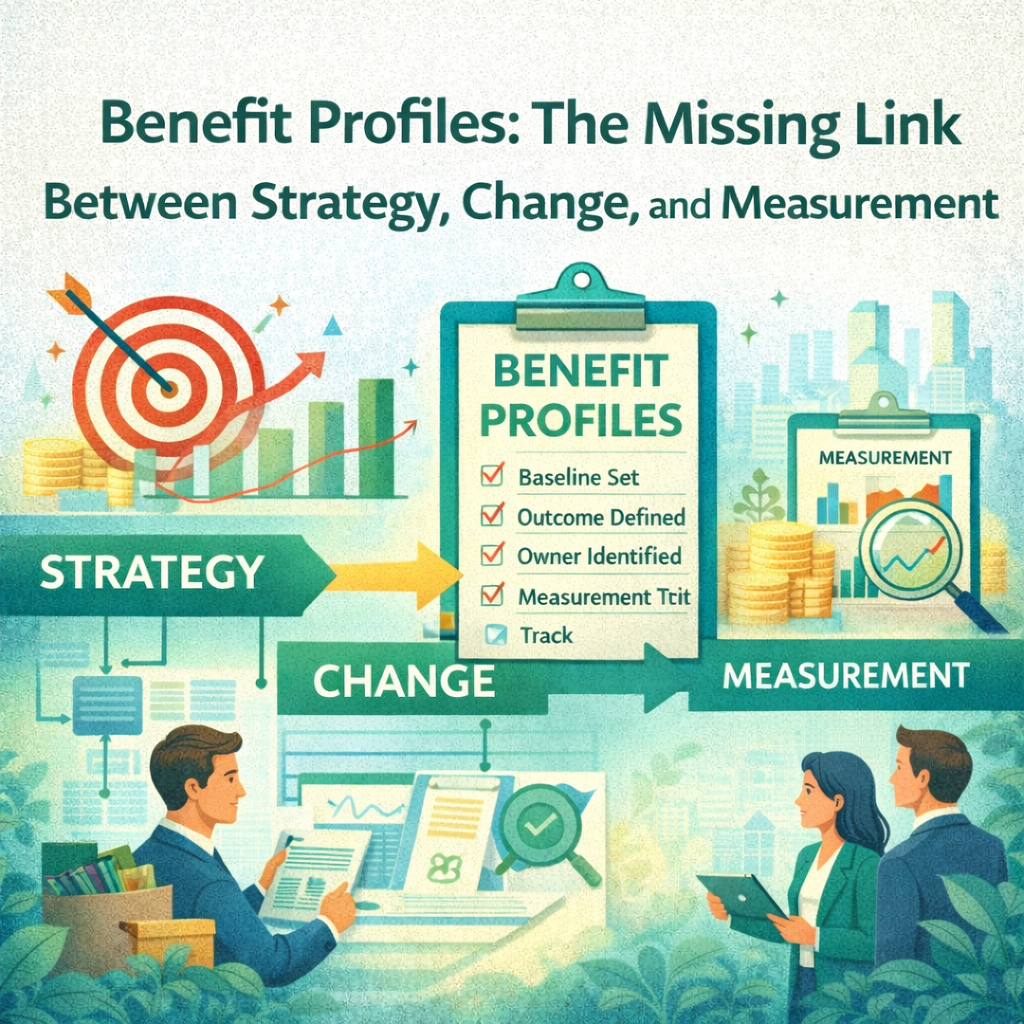
Organisations invest enormous effort in defining strategy. Leadership teams identify priorities, set ambitious objectives, and approve transformation initiatives intended to move the organisation toward those goals. At the same time, organisations invest heavily in measurement systems. Performance dashboards, KPIs, financial reports, and analytics platforms are designed to monitor progress and provide visibility into results.
Yet between strategy and measurement there is often a missing layer — the structured definition of the benefits that connect change initiatives to strategic outcomes. Many organisations move directly from strategic ambition to project delivery, assuming that measurement systems will eventually reveal whether value has been created. Unfortunately, by the time measurement begins, the assumptions behind the expected benefits are often vague, inconsistent, or poorly documented.
Benefit profiles exist to fill this gap. They provide a structured description of each benefit an organisation expects to realise from its investments, linking strategy, organisational change, and measurable outcomes. Despite their importance, benefit profiles remain one of the most overlooked elements of transformation governance.
The Gap Between Strategy and Measurement
Strategic objectives typically describe broad outcomes. An organisation may aim to increase revenue, improve customer experience, enhance operational efficiency, or strengthen market position. These goals provide direction but rarely specify how change initiatives will generate the desired results.
Measurement systems, on the other hand, focus on observable performance indicators. They track financial performance, operational efficiency, and customer metrics. However, these systems usually measure outcomes after they occur rather than explaining how they were produced.
Between these two layers lies a conceptual gap. Strategy defines what the organisation wants to achieve. Measurement reveals what has happened. What often remains unclear is how the organisation expected change initiatives to produce those results in the first place.
Benefit profiles provide this missing connection. They document the logic linking strategic intent to measurable improvement. By clarifying how a benefit should emerge and how it will be measured, benefit profiles transform strategic assumptions into structured governance artefacts.
What a Benefit Profile Actually Is
A benefit profile is a detailed description of a specific benefit expected from a transformation initiative or programme. It defines not only the nature of the benefit but also the conditions required for it to occur and the mechanism through which it will be measured.
Unlike high-level statements in a business case, benefit profiles are operational documents. They translate strategic aspirations into measurable and manageable outcomes. A well-developed benefit profile typically includes several key elements.
First, it identifies the benefit itself in clear and concise terms. The description should explain the improvement expected and the organisational area it affects. This clarity ensures that stakeholders share a common understanding of what success looks like.
Second, it defines the baseline — the current level of performance before the change occurs. Without a baseline, it becomes impossible to determine whether the benefit has actually been achieved.
Third, it specifies the target or expected level of improvement. This provides a concrete objective against which progress can be measured.
Fourth, it identifies the owner responsible for realising the benefit. As discussed in previous discussions on benefit realisation, benefits must be owned by leaders responsible for operational outcomes rather than by project teams alone.
Finally, it explains how the benefit will be measured and tracked over time. This includes the metrics, data sources, and reporting mechanisms that will provide evidence of progress.
Together, these elements transform benefits from abstract expectations into structured commitments.
Clarifying the Relationship Between Change and Outcomes
One of the most valuable functions of benefit profiles is that they clarify how organisational change is expected to generate value. In many transformation initiatives, this relationship remains implicit. Leaders assume that implementing new systems or processes will automatically lead to improved performance.
Benefit profiles make these assumptions explicit. They require the organisation to articulate how a particular capability or change initiative will produce a specific improvement. This process often reveals hidden dependencies or unrealistic expectations.
For example, a company implementing a new digital customer service platform may expect improved customer satisfaction. A benefit profile would require leaders to explain how the new platform will change service operations, reduce response times, and improve the customer experience. It would also identify the metrics used to measure satisfaction and the baseline against which improvement will be assessed.
This level of clarity ensures that benefits are not treated as automatic consequences of technology implementation. Instead, they are recognised as outcomes that depend on behavioural and operational change.
Supporting Benefit Ownership
Benefit profiles also reinforce the principle that benefits must be owned rather than merely delivered. When benefits are defined only at a high level in a business case, it is often unclear who is responsible for ensuring they actually occur.
A benefit profile explicitly identifies the owner responsible for realising the benefit. This individual is accountable for ensuring that the organisational changes required to produce the benefit are implemented and sustained.
Ownership does not mean the individual performs all the work required to realise the benefit. Rather, it means they have the authority and responsibility to ensure that the necessary changes occur across the organisation.
This clarity prevents the common situation in which benefits are assumed to belong to a project simply because the project initiated the change. Instead, responsibility resides with those who control the operational environment in which the benefit must emerge.
Strengthening Governance and Accountability
Benefit profiles also strengthen governance by providing a consistent structure for monitoring value realisation. When benefits are defined in a standardised way, leadership teams can compare progress across multiple initiatives and identify where interventions may be required.
Governance bodies such as transformation boards or portfolio committees can review benefit profiles to understand the expected impact of initiatives and track whether those impacts are emerging over time. If performance deviates from expectations, leaders can investigate the underlying causes and adjust strategies accordingly.
This structured oversight transforms benefit realisation from an informal expectation into a managed organisational process.
Benefit profiles also support transparency. Because each benefit is clearly defined, stakeholders can see how investments are expected to create value and how that value will be measured. This transparency strengthens trust between leadership teams, operational managers, and project stakeholders.
Connecting Benefit Profiles to Benefit Realisation Plans
While benefit profiles describe individual benefits, they rarely exist in isolation. Most transformation initiatives produce multiple benefits that interact with one another. To manage these relationships, organisations often consolidate benefit profiles into a broader governance structure known as a Benefit Realisation Plan (BRP).
The BRP provides an integrated view of all benefits associated with a programme or strategic initiative. It defines how benefits will be tracked, when they are expected to emerge, and how progress will be reported to leadership.
Benefit profiles therefore serve as the building blocks of the broader realisation plan. Each profile contributes a detailed description of a single benefit, while the BRP coordinates the overall process of managing and measuring those benefits.
Together, these tools create a governance layer that connects strategy with measurable outcomes.
Avoiding Common Pitfalls
Despite their usefulness, benefit profiles can fail if they are treated as purely administrative documents. When organisations create benefit profiles solely to satisfy governance requirements, they risk producing documents that are technically complete but practically irrelevant.
Effective benefit profiles must be grounded in operational reality. The individuals responsible for delivering the change should participate in defining the benefits and determining how they will be measured. This collaboration ensures that the assumptions underlying the benefit are realistic and that the measurement approach is feasible.
Another common pitfall is overcomplication. Benefit profiles should provide clarity, not bureaucracy. If the documentation becomes excessively detailed or difficult to maintain, stakeholders may lose engagement with the process.
The goal of a benefit profile is not to create perfect documentation but to create shared understanding.
Turning Strategy Into Measurable Impact
Ultimately, benefit profiles help organisations translate strategy into measurable impact. They provide the missing layer that connects strategic ambition with operational performance. Without them, organisations risk approving initiatives based on optimistic assumptions and measuring outcomes without understanding their origins.
By defining benefits clearly, assigning ownership, and establishing measurement mechanisms, benefit profiles ensure that transformation initiatives remain focused on the outcomes that justify their existence. They transform benefits from vague expectations into managed commitments.
Conclusion
Strategy defines where an organisation wants to go. Change initiatives introduce the capabilities required to move in that direction. Measurement systems reveal whether progress is being made.
Benefit profiles connect these three elements. They clarify how strategic objectives will be translated into measurable improvements through organisational change. They identify who is responsible for realising each benefit and how progress will be tracked over time.
In doing so, benefit profiles create the governance layer that many organisations overlook. Without them, the connection between strategy, change, and measurement remains fragile and incomplete. With them, organisations gain a structured pathway for turning strategic intent into measurable value.
Reach a global audience of portfolio, program, and project managers, product leaders, and certification professionals. Explore advertising opportunities .
Sponsored